

Universities have often been seen as bastions of radicalism. Forgetting the fact that higher educational institutions, particularly ancient and elite ones in the Anglophone world, are governed by centuries of tradition and incubate the next leaders of the establishment, many people think of Oxbridge as moments away from starting a second May 68. There’s nothing the right-wing media love bashing more than their tired stereotype of out-of-touch students sipping oat flat whites and pontificating about the latest unfalsifiable nonsense coming out of the critical theory departments.
As fictitious as this caricature may be, it is true that educational level has started to be a major dividing line in voting intention and political opinions. UK politics over the last decade or so has upended many assumptions about the natural structuring of the left-right divide, with the Labour party now receiving most of its support from the middle-class (educated professionals), having seemingly lost traditional heartlands in the North. This has led to many centrists chasing an impossibly wide spectrum of voters, as exemplified by the disgraceful attempts of Keir Starmer’s government to rightwardly outflank Reform on immigration, despite the fact that his party risks losing far more voters to the Greens than the far-right.
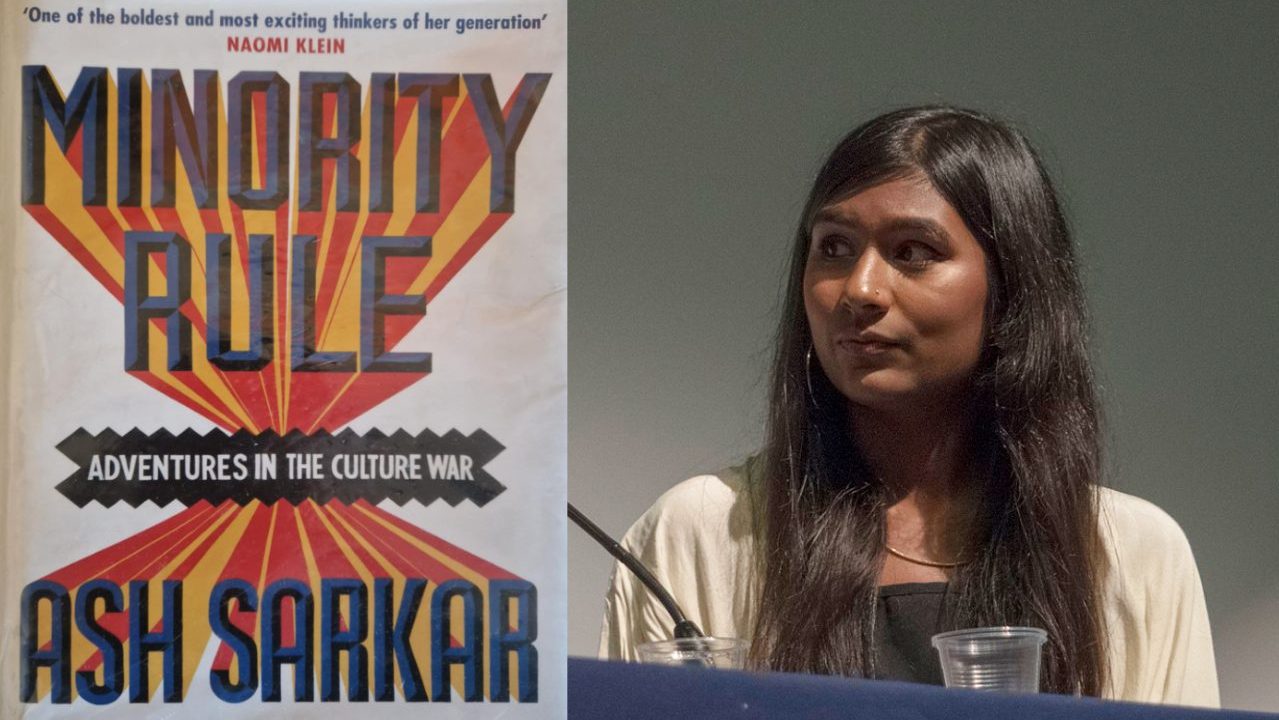
What has happened to the left and the politics of community, equality, and dignity it is meant to support? This year, a brilliant book by journalist Ash Sarkar, Minority Rule, argues that a combination of right-wing inflammation and left-wing self-harm has shifted the political battlegrounds from economic and material factors to an obsession with what Sarkar calls ‘minority rule’ – the “paranoid fear that identity minorities and progressives are conniving to oppress majority populations”. Rather than focusing on financial issues such as energy, food, and housing prices, political discourse is saturated with hyper-toxic debates on immigration, transgender identity, and ‘cancel culture’. Sarkar’s diagnosis of the hysterical ‘culture wars’ points the issue to two places: a right-wing media that amplifies the voices of a few extremist politicians and uses statistical rarities to construct fantastical narratives, and an identity-obsessed left which has become more concerned with trivial semantic debates and the appearance of moral purity than substantive political and economic issues. Left-wingers at Oxford and other ivory towers would do well to take note.
Sarkar, an editor at the left-wing Novara Media, has attracted some prominence in recent years for clashes with prominent figures, including a debate with Piers Morgan where she declared she was “literally a communist”. Minority Rule is written in a breezy, accessible, and amusing style, which romps between using expletives and quoting Stuart Hall at length. The most engaging, provocative, and original part of the book is the opening chapter, which directs her ire towards those on the left she sees as stymieing the cause. Later chapters, which put great emphasis on the role of the media in creating political dividing lines, are also insightful and trenchant, but occasionally digress too far into personal disagreements with particular journalistic interlocutors. With the subtitle ‘Adventures in the Culture War’, it’s not surprising that the book is filled with outrageous, frustrating, and unbelievable stories and incidents, but sometimes the enumeration of particular events within the culture war (which it’s better to try to forget about) comes at the expense of greater elaboration and reflection.
As the emphasis on ‘minority’ suggests, Sarkar’s key concern in the work is to draw out a process of division and polarisation within the working class, a group whose interests should, from her Marxist perspective, be aligned. Sarkar is keenly aware of the difficulties in conceptualising the group of people she wishes to talk about. Indeed, the very difficulty in doing so gestures towards one of her central theses – how cultural issues have distorted the traditional ‘class consciousness’ and sense of shared interests. She writes: “Rather than shaping a sense of class identity around shared material and economic conditions … it’s instead defined by political and cultural outlooks.”
The right-wing media and politicians have not only created a dangerous frenzy on issues such as immigration, they’ve managed to turn the debate into one that ostensibly divides by class: affluent middle-class liberals in metropolitan cities are set against authentic working-class communities in neglected areas of the country. There is an increasing sense that ‘working-class’ refers to an identity and way of life rather than a material status. Sarkar incisively demonstrates how the same politicians and commentators who, ten years ago, publicly demonised the working-class as “chavs”, now lament the fate of the ‘white working class’, introducing a racial focus that inflames cultural division rather than ‘levelling up’ communities. Such right-wing rhetoric falsely creates the impression of a zero-sum game in which progress towards racial equality necessarily comes at the expense of improving the living standards of others.
The most interesting part of Sarkar’s work is the challenge she raises to the contemporary left. In the first chapter ‘How the “I” Took Over Identity Politics’, Sarkar explains how the once-radical idea of ‘identity politics’ – originated by black feminists to draw attention to how race intersected with class and gender – has become, in Sarkar’s words, “confused, atomised and oddly unambitious”. Rather than focusing on combating inequalities and entrenched institutional problems, the raison d’être of much momentum on the left has become dealing with problems such as ‘microaggressions’ and linguistic correctness. Sarkar highlights three particular problems: the notions of irreducible difference, competing interests, and unassailability of lived experience. These have led to a focus on performativity rather than genuine progress, and a culture of intolerance. The left has, in Sarkar’s brilliant phrase, “absorbed the idea that the personal is political, at the expense of remembering that the political is still political”.
Sarkar argues that there has been a great overcorrection. Until recently, the white man with a BBC accent was the ultimate authority – and in many, many places, he still is. But amongst progressives the admirable impulse to listen to others – to understand others – has been so greatly elevated that, in some spaces, the appeal to lived experience has become a rhetorical move that carries an automatic veto of any opposition. Irreducible difference supports this: if one’s experience as, say, a gay man or trans-woman is radically incommensurable with that of a cis-gendered straight man – as Thomas Nagel thinks a bat’s is with a human’s – then naturally you won’t wish to question a claim they make which is grounded in it. Sarkar argues that these barriers of lived experience are not unimpeachable and that such divisions lead to the deeply problematic idea of competing interests – the belief that even though someone agrees with you on a hundred different issues and shares the same socio-economic position as you, that, if they disagree on a single issue, they are no longer a viable political ally. This logic, which creates an inability to work together for the greater good, also opens the door to right-wing exploitation – it allows people to pit the projected interests of the white working class against minorities living in deprivation in London.
This obsession with an all-or-nothing view of politics unfolds constantly in universities. I recall a feverish argument over a JCR motion supporting Palestine because there was disagreement whether it should also show support for Jewish students facing antisemitism. The idea that there is a single dimension to progress, that solidarity requires complete and utter agreement, and that minor issues can be allowed to get in the way of real problems is an affliction that the left must purge if it is to get anywhere. Even Sarkar’s own last chapter, which ends with an impassioned call for unity against rentier capitalism, fails to live up to her otherwise rigorous defence of toleration. Her attacks on landlords and property owners feel overly crude and ad hominem, fostering an antagonistic mindset which eschews the possibility of democratic solutions. However, Sarkar, as “literally a communist”, probably wouldn’t care too much for my Rawlsian view of reasonable agreement. Are we radically opposed, incommensurably different, utterly at-ends, in the fight for progress, then? Of course not!
Minority Rule was published by Bloomsbury.