

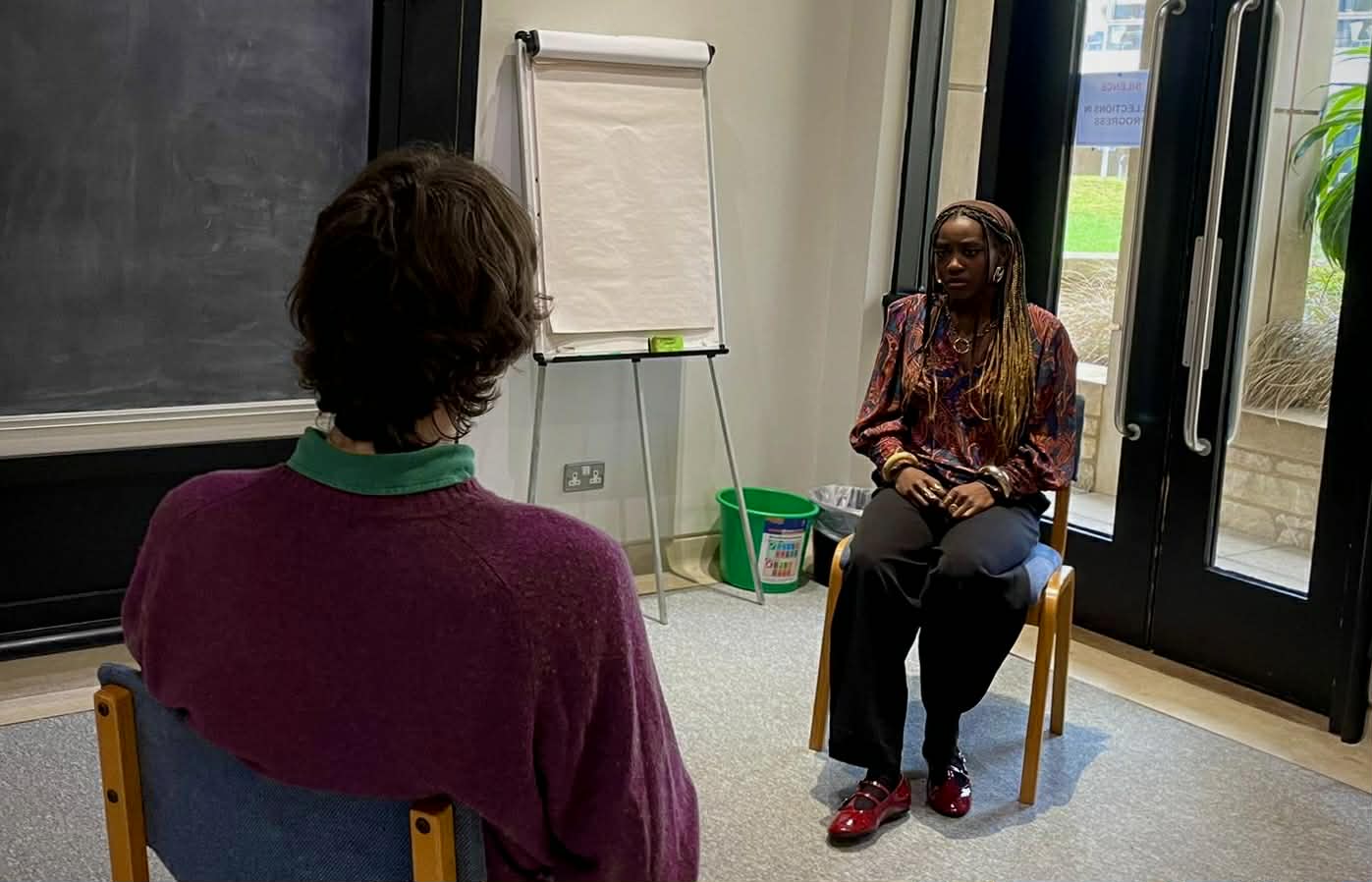
GREYJOY is Blackstar Production’s second show, written by Rebecca Harper. Taking a light, sharply comic tone, it grapples with the weighty themes of end-of-life care, sibling relationships, and anticipatory grief with assurance and deftness. Each night features a number of “placed” audience members, cold-reading as one of the play’s doctors – a formal risk which is both playful and fresh. I sat down with Rebecca, Blackstar’s co-founder Tom Onslow, and crew and cast members Zee Obeng, Libby Alldread, and Avani Rao to talk about the show.
Our conversation meanders through the topics of Horrible Histories, American roads, and whether the sea or snow is scarier, before I start the questions proper, beginning with Rebecca’s inspirations for the project. She explains that the cold reading element emerged about halfway through the writing process, “very inspired by a lot of plays with audience interaction. My favourite play is An Oak Tree by Tim Crouch”, which shares GREYJOY’s interest in metatheatre, and “devolves into this thing about grief and performance. I was separately writing about my experience as a medical mock patient, and at some point, the two came together”. As for inspiration for the title, Rebecca teases that “it references the surname of some Game of Thrones characters, you’ll have to watch the show to find out why that’s important!”. Initially called Moonbear, GREYJOY, with its heavy yet hopeful connotations, “picked up a better thread,” being suggestive, slightly ominous, and oddly tender.
When I ask what drew the rest of the team to the project, Zee, one of the play’s co-stars, responds effusively: “GREYJOY’s script was beautiful. I think that I look for things that are written in a way that I feel moved by, it’s not just the themes but the very way that it’s written. I had to be in it. I couldn’t talk about anything else in the week I auditioned.”
GREYJOY’s emphasis on rhythm and lightness is palpable even in our brief conversation, not least because of the genuine warmth and affection between the cast and crew. This tonal balance, effortlessly juggling humour and weight, is one of the play’s greatest strengths. Tom explains that the show relies on the cast’s ability to “land a laugh and then go into something really tough. People have to really trust that they can do that, that they’re not going to step on one [by] doing the other. That they work together, a laugh doesn’t discredit a sad moment!”
Zee has a slightly different take: “It’s like when you’re talking to someone about something [serious], the easiest way is to make it funny. Is that a British thing? I think it’s very human, something we all do, everyday.” Avani, the assistant director, is quick to add that the humour “makes it real, like the characters are actually going through these events – they wouldn’t joke about it if they weren’t”. Rebecca agrees: “Grief brings out some really odd things. I’ve been at some really funny funerals. The things you remember about someone are often funny stories. That’s a nice part of grief to focus on.”
GREYJOY, at least in part, draws on Rebecca’s own life experiences: “I have three characters who go through different things. Cait’s relationship with her sibling is the most similar to my own – growing up with someone, and being at different stages in life, and having different concerns over time is something that speaks to me in particular.” In terms of the play’s exploration of anticipatory grief, Zee tells me that “as an actor, it’s oddly therapeutic. Working through Cait, her experiences aren’t unique experiences. Being able to put words to it feels very poignant, and I think it could be for the audience too. It’s a play that sparks conversation”.
With its cold reading element, GREYJOY definitely blurs the lines between actor and audience more than most. Libby, one of the cold readers, explains that “there’ll be less pressure because I’m not going out as an actor, there’s more freedom than in playing a character”. Zee, meanwhile, says that because “the way I play it depends on the person who’s opposite me, I’m thinking a step ahead – it allows me to act like never before. It’s terrifying and exciting. If someone doesn’t read a line in the way that I expect it to, I have to keep going, but I think that adds to it”. Rebecca points out that “ I’m excited to see the moments which make our cold readers uncomfortable, or laugh. That’s part of the fun of it, representative of how people go into these medical exams in real life. There’s a sort of pre-established social script to follow, you interact with it as it comes.” The cold readers, then, function as a hyper-surrogate for the audience. Tom says that they hope the cold readers “play a game with it. When you’ve learned lines, you need to find pockets where you keep the performance fresh – hopefully the cold readers do that automatically”.
I’ve been greatly enjoying the GREYJOY marketing, which has encapsulated the dry, witty humour that the play promises, and teased various references within the script. Tom assures me that this is something the play comes by naturally, offering up an anecdote wherein Rebecca hung up a call quoting Shakira’s “whenever, wherever”. Zee tells me that her favourite reference from the script is to Lemony Snicket’s A Series of Unfortunate Events, where “one of the characters says something like ‘I used to think I was Violet Baudelaire, but I’m probably Count Olaf’”. Tom and Rebecca both pick a reference to Tim Curry, which also draws on Blackstar’s previous show, Teen Spirit. When asking what they think connects Blackstar’s shows, I’m told that the “Blackstar constitution [is]: gay, siblings, grief. We call it the GSG model! What else – bad accents, quite dry, people apologise too much. You explain it to people, say it’s funny, and they ask ‘is it really, though?’”. Libby informs me that Rebecca’s modus operandi is “funny, sad things”, which GREYJOY certainly seems to fit with confidence and charm.
My final question is medical, to match the show. If GREYJOY had a warning label, or list of side effects, what would it say? “Uncontrollable laughter”, “might cause tummy pain”, “heartstring palpitation”, “thoughts of your sister”, “white room syndrome”. To those of you coming to see GREYJOY, be prepared!
GREYJOY will run at the Michael Pilch Studio in Week Two, 28th – 31st January.