

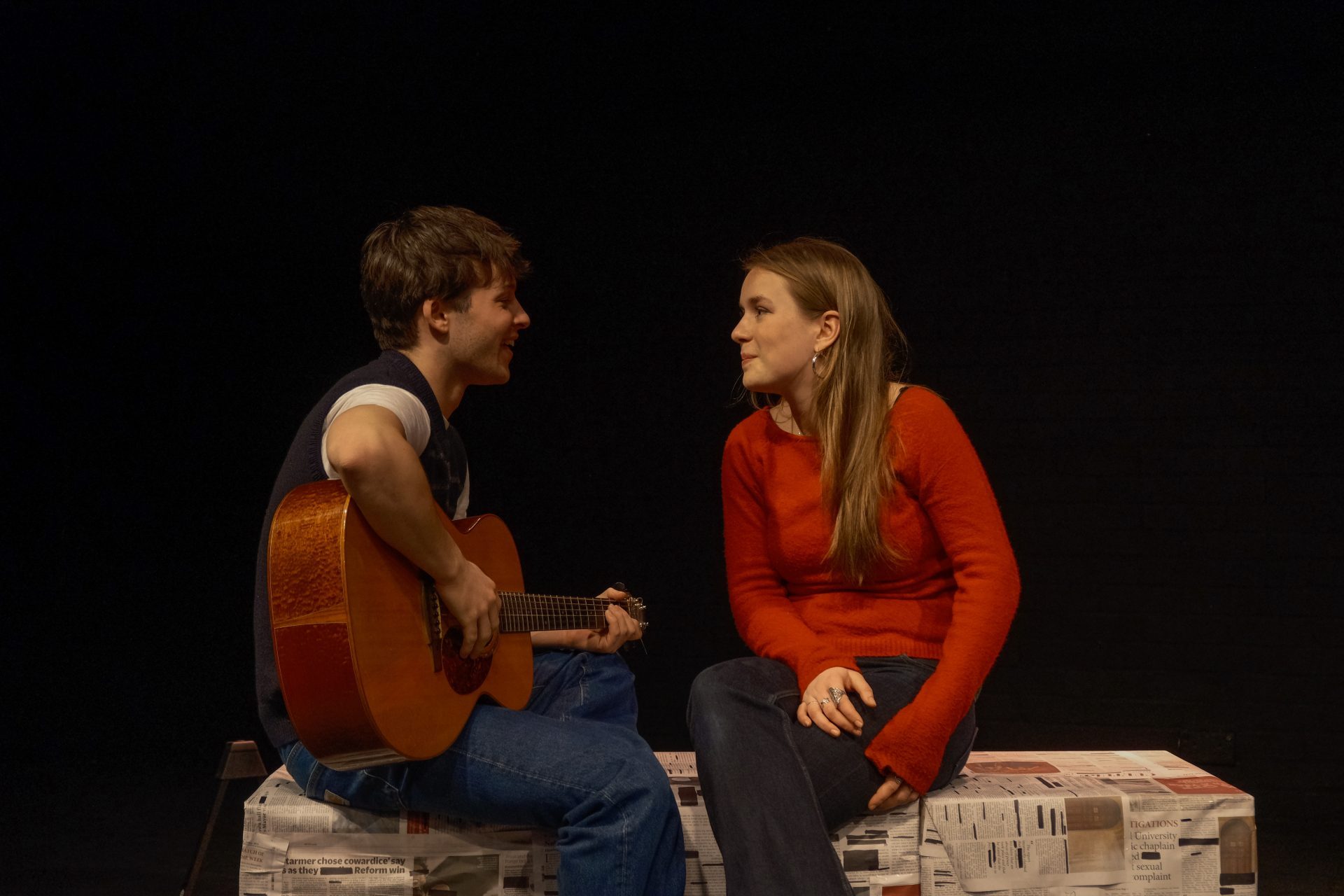
Lighthouse Productions’ debut project delivered a fast paced, hilarious version of Sam Steiner’s script. Co-director Alys Young told Cherwell that she wanted her and Ivana Clapperton’s interpretation to reflect “the intimate space of a new relationship”, a “messy mix of humour, sadness, and hope” – and the play definitely did not fail to deliver. Bernadette (Caeli Colgan) and Oliver (Kit Rush) were a fantastic onstage pair, handling the many-layered script with relentless energy.
The play is based in a dystopian world where a ‘Hush Law’ is introduced, restricting everyone to only 140 words a day. The action flits between the time before and after the imposition of the Hush Law, contrasting the chaotic joy of a relationship’s early stages with a painful new reality where the two are unable to have the conversations necessary to prevent their relationship from spiralling downwards. The play addresses imbalances in relationships. The number of words each character saves is used as a metaphor for the amount of love they provide to each other.
The play deliberately disorientates the audience for the first few minutes, who only understand via the lighting choices that something went very wrong. Moments of youth and happiness – Oliver spinning Bernadette around, the two joking as they meet up in a pet graveyard, a lighthearted game of charades – are bathed in a warm golden light. This is contrasted to the restricted present of the ‘Hush Law’, which is cast in an icy blue light. Here, every interaction starts by saying a number – later revealed to be how many words they have left each day. The magic of Steiner’s script is that the audience only understands it as the play unfurls.
Having not been familiar with Steiner’s work before watching Lemons, I read the premise of the script and assumed that it would be a demoralising watch, commenting on the rise of censorship. In actuality, the production was able to make clear allusions to today’s political context while retaining an enormous amount of humour. The actors made the most of the script’s comedic lines. Their well-timed delivery created laughs in unexpected moments: in a quiet, intimate conversation Corgan calls Oliver’s ex “fat”, and Rush created many laugh-out-loud moments by maintaining Oliver’s energy throughout ridiculously long lines.
As the play jumped back and forth from past to present, they managed to come across both as naïve adolescents in the ‘honeymoon phase’ and as jaded adults whose petty jibes at each other’s flaws reflected typical relationship arguments.
Rush was particularly hilarious, playing Oliver as an overexcited, slightly childish young man who speaks far too much when nervous. Colgan’s contrasting ability to deliver scathing put-downs of his over-excitement complemented this nicely. The actors’ chemistry was some of the best I’ve seen. Humour could also be found in their argumentative scenes, and this allowed the production not to be dragged down by its dark premise.
The moments before the introduction of the Hush Law formed the dramatic climax of this interpretation: the two decide to say everything they’ve never said to each other, all at once. The decision to frame this with a projected scoreboard behind them, making them face each other as if in a boxing match, made what could have been a devastating scene one of the production’s funniest; with a breathless sense of triumph, Rush announces to Colgan “I don’t like your brother”.
A frustrating aspect of the play were the moments focused on Oliver’s ex, Julie. Initial allusions to her were delivered comedically, but she quickly becomes a clear sore spot between the pair. It was only by checking the production’s promo material that I realised that the dancing girl (Elektra Voulgari Cleare) projected onto the background screen was supposed to be Julie. It seemed that there was no way of understanding this reference, since Julie is never a presence onstage. Given the political commentary present in the play, the screen could have been used more to draw attention to the dystopian themes, such as with the Gatsby-esque blinking eye, rather than introducing confusing extra elements.
All in all, the boundless energy of the actors combined with clever production choices made this production exciting and thought-provoking. From the moment of horror as the Hush Law is passed to Oliver’s fear that it will only benefit the rich, the play’s central metaphor hits home with an audience living through the age of Trump and rising inequality. As repression of freedom of speech increases globally, the directors certainly picked this production at a crucial time.
Lemons Lemons Lemons Lemons Lemons runs at the Burton Taylor Studio, 27th-31st January.