

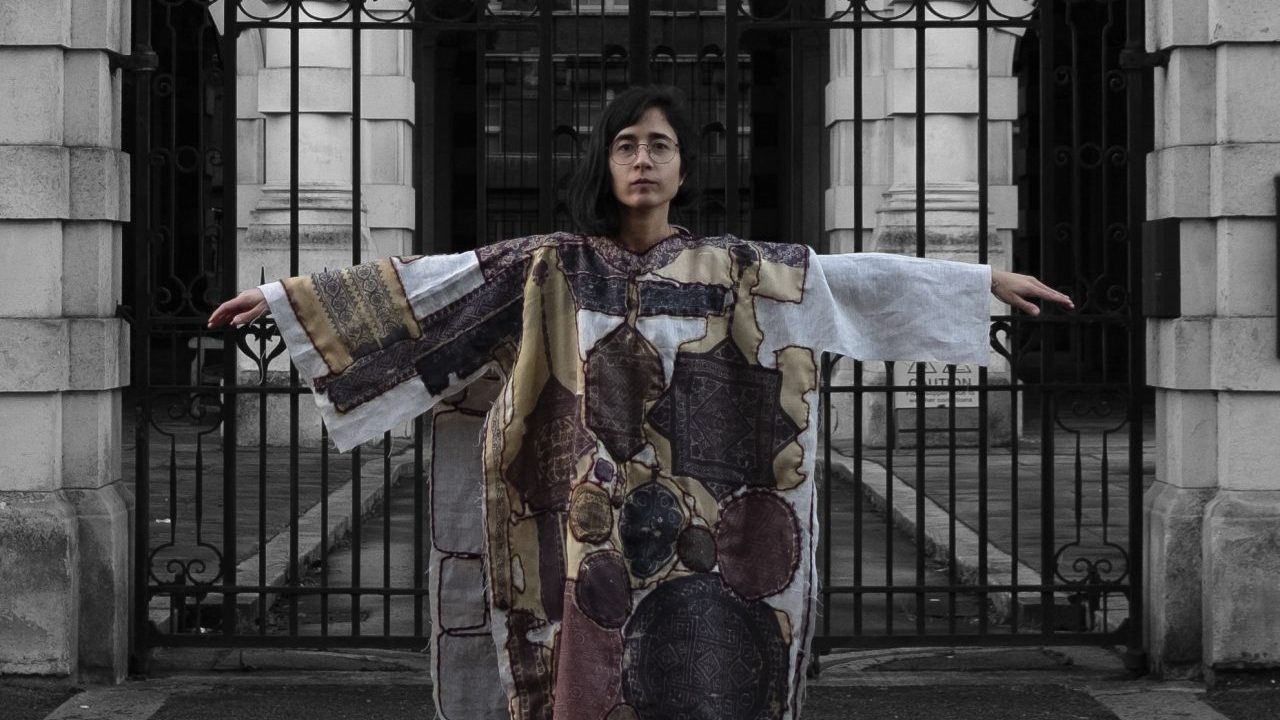
Today, the colonial history of the Pitt Rivers Museum is common knowledge. Whether you know of the details or just the dodgy vibes, the Pitt Rivers once represented an era of brutal European colonisation, with valuable objects stolen from communities and held in Oxford for their ‘exotic’ and ‘curious’ qualities. Despite efforts to supposedly decolonise the museum and honour the descendants of those exploited by colonialism, the museum has a long way to go. The lingering colonial rhetoric and problematic methods of display are no more evident than in the museum’s latest photographic exhibition, Suturing Wounds.
In the photos, Egyptian artist Sara Sallam sheds light on the exploitative and colonial 19th-century practice of violently excavating Byzantine-era Egyptian cemeteries to steal textiles from the deceased. She poses in front of Blythe House in London, a huge storage facility containing millions of artefacts from British museums, and wears a tunic made of facsimiles of late antique Egyptian textiles, sewn together by the artist herself. Once worn to express social status and Christian devotion, western colonists admired them for their aesthetic value alone. They ignored the dignity of the dead and instead proceeded to inflict more violence against Christians in the Middle East, which continues today in the persecution of Palestinian Christians, the direct descendants of such rich but exploited traditions. As a Byzantinist myself, I was extremely pleased to see this under-researched aspect of history explored in a tender, personal way. Sallam stitched together reproductions of textiles from the Akhmim cemetery to represent the literal suturing of the wounds created by colonisation. The additional medium of photography situates the tunic in a colonial setting and thereby renders its use an act of protest, a confrontation of colonised and coloniser through material objects.
When I visited the exhibition, I initially could not find it. Tucked behind tall cases on the very top gallery, the view from the ground floor consisted simply of bright pink words describing the photos. Eventually, when I found it, I had one thought only: was this it? The photos were used as a sort of wallpaper to be placed on some doors, probably storing more stolen artefacts. An effect of this was that I could not actually see much of the subject of the photos. This was exacerbated by the fact that the wood beams of the doors cut through much of the image of the tunic itself. Likewise, with the image taking up an entire wall, Sallam only reached my height, a mere five feet and two inches – anyone taller than me would probably struggle to see for this reason, and there was hardly enough space between the doors and the cases opposite to stand back and take in a larger view. I found that I actually had a better time viewing these photos online rather than in person.
Perhaps the most egregious issues, however, were that the images were of low quality (I could see the pixels) and that one of the wood beams cut through the sign which showed the background to be Blythe House. The entire point of the photographic medium was rendered null and void, as the viewer was given virtually no information. Would the average viewer have known the context? No. In fact, the two friends I attended the exhibition with were clueless, understanding the vaguely anti-colonial messaging but unaware of the specific culture represented and why. There were no captions to explain the significance of the textiles, leaving the viewer in the dark. In fact, I worry that this results in the content of the artwork being misunderstood by most, reduced instead to an aesthetic object once again. It is such a shame that Sallam’s work, fascinating in itself, was displayed so carelessly, despite the artist herself being a co-curator. Unfortunately, these practices seem to align with the enduring colonial spirit that permeates the museum as a whole.
My own family was torn apart by British colonisation in Ireland, inheriting the generational problems of addiction, poverty, and identity loss. To this day, I have never met any of my estranged Irish family, and I feel a sense of emptiness knowing that I will never have a connection to an entire half of myself. This context shaped my experience at the Pitt Rivers. I can only imagine how it must feel to have been affected by the horrors of slavery and genocide, and seeing sacred objects from my culture displayed so recklessly in the museum. The museum’s approach to decolonisation can be characterised with one word: passive. Performative activism checked off the list, the museum simply places a plaster over the wounds caused by colonisation. Signs designed to separate the museum from problematic practices are completely separate from their cabinets – the viewer is not challenged at all.
Sallam’s project is a bold look into the effects of colonisation on Egyptian communities today, but ultimately falters in its display in the Pitt Rivers Museum, which cannot separate itself from its colonial history. Until its orientalist and careless presentation of artefacts is changed, I do not believe that it can meaningfully champion decolonial art. Take the relatively small display of the Evil Eye, the caption of which begins by describing the practice in the past tense, before adding an appendage which briefly mentions its continuance. Archaising language like this, treating colonised cultures as though they are remnants of the past in need of archaeological ‘discovery’, is to reduce these traditions to primitivity and erase the living communities who continue to practice them today. Entrapment of Sallam’s photos to the very architecture of the Pitt Rivers itself represents the endurance of colonial curation which characterises the museum.
This article refers to a temporary display hosted by the PRM on behalf of Photo Oxford Festival. The artist and Photo Oxford oversaw the design, production, and installation of the display which ended on 25 January 2026.