

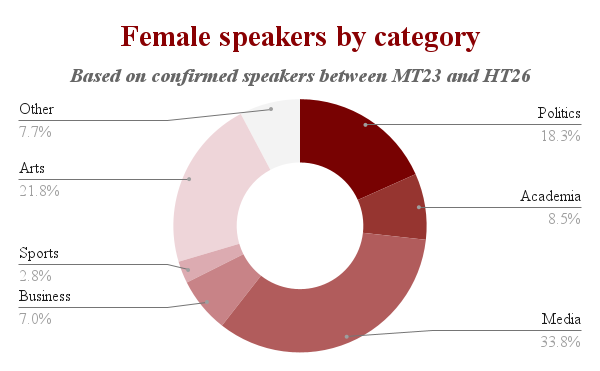
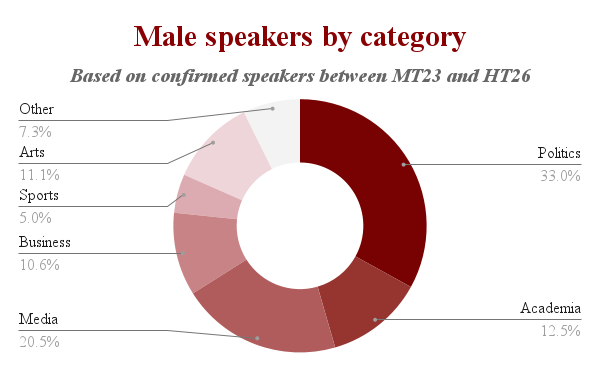
A Cherwell analysis of over 560 Oxford Union speakers can reveal that 25.1% of confirmed speakers since Michaelmas term 2023 are women. In total, the Union confirmed 424 men, versus only 142 women. Cherwell based its figures on the speakers announced in the last eight term cards.
The divide is particularly stark between politics and arts. For speakers from a political background, including British MPs or foreign heads of states, only 15.7% were women.
According to a UN Women study, 27.2% of politicians around the world in national parliaments are female, almost double the rate of confirmed Union speakers. In the UK, 40% of elected MPs in the 2024 general election were female.
Most of the confirmed women were from an arts or literary background, as the Union disproportionately confirmed female speakers from the creative industry or authors. 39.7% of confirmed arts speakers were women, including actresses, singers, or novelists, while 35.6% of confirmed media speakers were female. This includes journalists, non-fiction authors, political commentators, or subject experts.
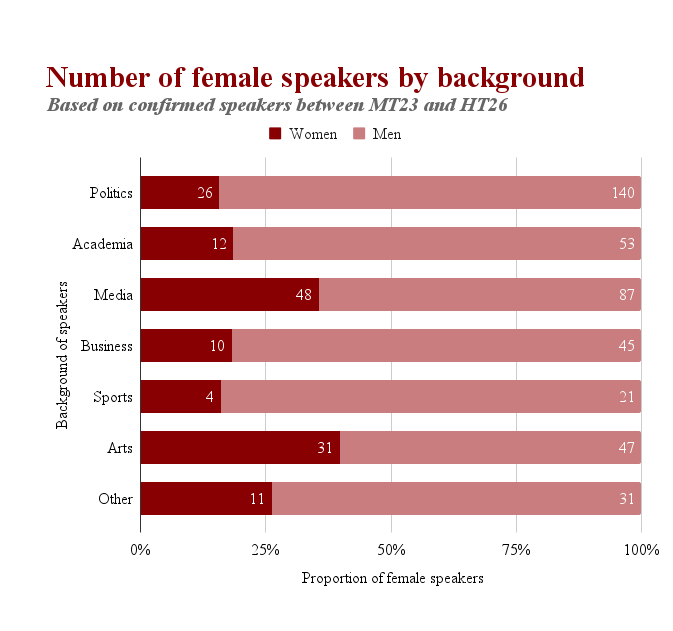
The gender disparity is also apparent for speakers from other backgrounds, such as business or sports, where respectively 18.1% and 16.0% of confirmed speakers at the Union were women. Over the past eight academic terms, the Union confirmed only 4 female sporting personalities, 10 business leaders , and 12 academics – compared to 21, 45, and 53 for men from each respective category.
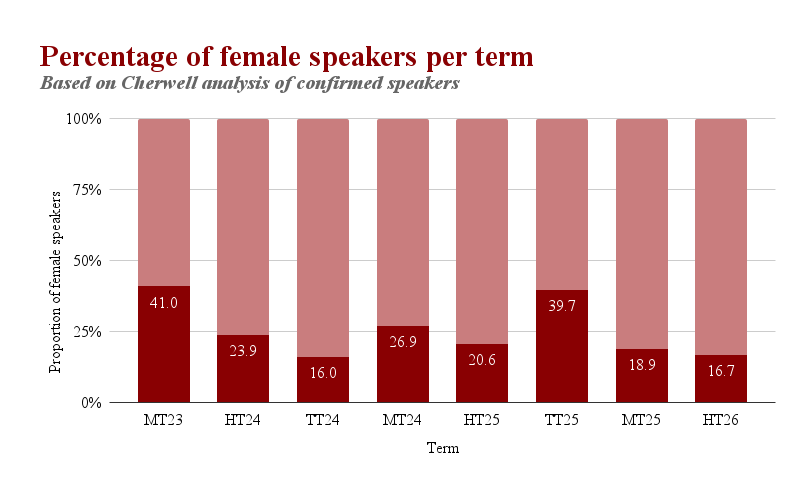
There is a notable difference between terms with male versus female presidents. On average, there were 20.1% of female confirmed speakers when the president was a man, and 31.2% of female speakers when the president was a woman. Over the past eight terms, there have been an equal number of female and male presidents.
Two terms particularly stand out for gender parity of confirmed speakers, Trinity 2025 under Anita Okunde and Michaelmas 2023 under Disha Hegde, which both had around 40% of confirmed female speakers.
Speaking with Cherwell, several former Oxford Union presidents described that even when aiming to maintain gender parity in the invites sent, committees often faced difficulties in materialising these aims. They attributed this partly to the low response rate of invited speakers and the difficulty to predict which personalities will be willing to speak at the Union. They commented that the lack of gender parity in confirmed Union speakers reflected more general gender inequality in the world.
One former female senior official also described internal biases within the Union, with male-dominated invitation committees sometimes deeming female speakers “less popular”. The former presidents that Cherwell spoke to emphasised the need for more diverse committees to ensure better gender parity in confirmed speakers in the future.
Cherwell’s analysis does not reflect speakers who cancelled or rescheduled their events, so final proportions of speakers at the Union may vary.
Cherwell found no non-binary speakers over the past seven academic terms. A 2021 national census found that 0.1% of the general population is non-binary or gender non-conformning. The Oxford Feminist Society and the Oxford University LGBT Society were approached by Cherwell for comment.
Last year, the Oxford Union has invited several figures criticised by feminist organisations for sexual violence. The Oxford Feminist society previously condemned the Oxford Union for their invitation of convicted domestic abuser Dizzee Rascal, calling it an “insult to the victims of domestic violence and to women in general”. The Oxford Union also invited American actor Kevin Spacey who faced several allegations of sexual misconduct, as well as Don McLean who was issued a restraining order after a domestic violence incident.
Anita Okunde, Oxford Union President last Trinity, told Cherwell: “Championing higher quantities of quality women speakers has been a priority throughout my two years in the Union. While I am incredibly proud of the inspiring women we represented during my term, I am resolved that, like for the women leaders before me, it had to be the result of deliberate strategy and effort.”
According to Okunde, her administration deliberately focused on making sure that if “ratios were skewed” in speakers invited, the committee would focus on “inviting either women or people of perspectives at risk of being unrepresented”. Reflecting on her term, Okunde told Cherwell: “It helped that many of my ‘dream speakers’ happened to also be women. When you set the bar with female world leaders, it sets a standard for the rest of the committee to follow.”
Discussing representation on the committee, she told Cherwell: “My committee featured a near 50/50 gender split. We had the privilege of the most competent women serving at every level. This directly influenced the voices in the room and the guests we invited. When women lead behind the scenes, we see better representation on the stage.”
Other student societies also disproportionately confirmed men to their speaker events. Oxford Speaks’ term card for instance only includes one woman and seven men, for the Politics Society it is one woman and four men. The Oxford Labour Club’s term card features two women and two men, while the Oxford University Conservative Association has confirmed three women and five men.
The Oxford Union and current President Katherine Yang declined to comment.