

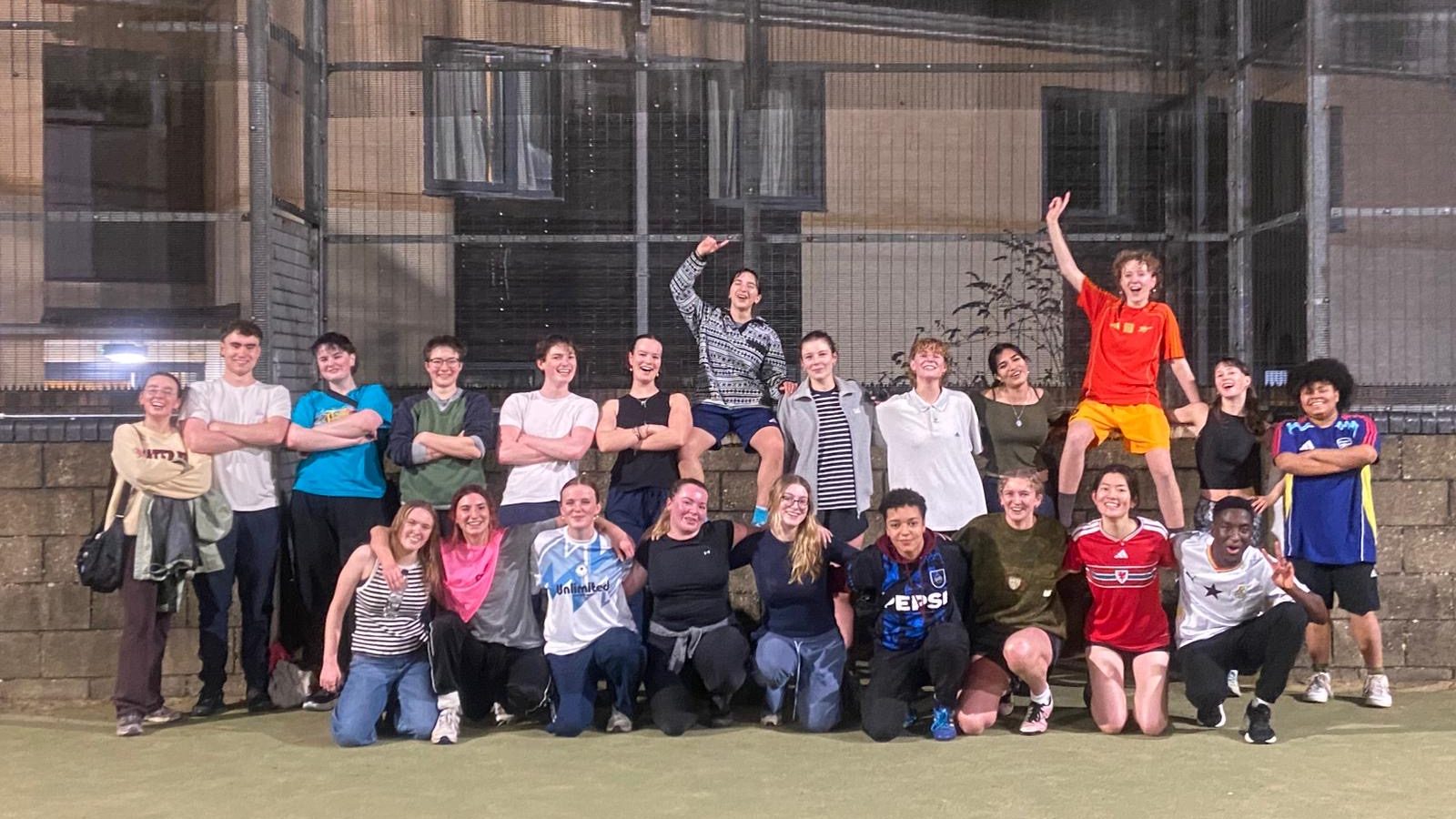
Pitch Futchball to me in three words. “Silly, friendly, and proud,” Sadie Russell, a second-year English student at St Catz, says, after some thought.
“Family, welcoming, and relaxed,” Jesse Katz Roberts, a second-year History student at LMH, offers.
Russell and Katz Roberts are two of the minds behind Futchball FC, Oxford’s queer football club founded in Trinity 2025. “We were just literally in the pub,” Russell tells me. “We wanted to have a way of hanging out with a group of our queer friends regularly, and I had a friend at another university in Glasgow who was part of a very queer football team. So we made the [Futchball] account and put a post out and asked our friends we knew to come, and then just hoped it would get bigger.”
And it has – though it began as just that, a small group of friends, Futchball now has more than 80 members on its group chat, and a core group of about 15 to 30 who show up to the Union Street Astroturf every week. (“Thank God for Sadie’s entrepreneurial spirit”, Katz Roberts interjects.) In fact, most of the attendees are absolute beginners. “There’s no pressure or stress”, Russell says. “We’re just there to have a good time and to be silly.”
Despite the complete lack of seriousness on the pitch – or perhaps precisely because of it – both Russell and Katz Roberts are aware of how important the grassroots community they’ve created is. At Oxford, sporting societies can fall victim to a hypercompetitive culture and be alienating to newcomers: “I wanted to make a space that wasn’t one where ‘you have to be good or you shouldn’t be on the team’.”
“It all just felt quite serious,” Katz Roberts adds. “I remember playing football in school or with my family, and it was very, very competitive.”
For queer people in particular, the homophobia entrenched in sports at almost all levels often colours their experiences with sports for the worse; in 2024, Stonewall UK found that 1 in 5 LGBTQ+ people experienced discrimination in a sports setting. Football especially is home to damning levels of LGBTQ+ discrimination. Kick It Out, a UK charity which aims to tackle all forms of discrimination across all levels of football, recorded double the reports of transphobic abuse in the 2024/25 season compared to the season before.
Most queer societies in Oxford lean more artistic – think Kolour Theory or The Green Carnations – but a queer sports club provides a different kind of environment, one that challenges and reclaims a traditionally hostile and hypermasculine space. “First off, everyone’s not afraid to look stupid, and that’s the energy which makes it different from a magazine or a club night. But more importantly, I wanted to be able to say to people: if you’ve hated football before, [Futchball] would be different. Some people, especially gay men who have had really bad experiences with the aggressively male culture in sports, have been like ‘Yeah, Futchball’s really nice, because I’ve gotten to play a game that I really enjoy, but it’s not got the baggage it usually does’,” Russell explains.
What began as – and still is – a chill kickabout between friends has been embraced by the local community. Last term, Oxford’s very own LGBT+ nightclub, Plush, chose Futchball as its local cause to sponsor, ultimately raising a total of £921, which Russell and Katz Roberts have been using to pay for weekly pitch rentals, kits, and trips abroad for friendly matches with other queer football teams. “They’ve been really amazing to work with, and they’re so supportive of us,” Russell says.
Fundraising efforts like those are becoming more valuable as Futchball expands: it’s completely free to attend every week, and will remain so if Russell and Katz Roberts have anything to say about it. I float the prospect of one day registering Futchball as a university society to secure funding, and am thoroughly unsurprised when they both make sounds of disagreement. “I’m quite anti-becoming an official uni society, partly because of all the bureaucracy involved, but mostly because I want anyone from Oxford to feel like they can come, even if they’re not from the uni”, Russell explains. According to the university’s Sports Federation Hub, sports clubs registered with the university are only allowed to have 20% of their total membership be Oxford Brookes students, and another 20% be non-University members. “We’re only able to be like this because it’s a very grassroots bunch.”
“[Futchball] is literally the thing I’m proudest of in my time at Oxford,” Russell says, laughing. Both second-years, Futchball’s leaders worry who they’ll pass this community down to: as much as Futchball is a collective effort, it also needs a few dedicated people to manage the administrative and logistical duties of ensuring it stays afloat. “Hopefully Futchball and its community will be our legacy,” Katz Roberts says.
The surprising ease with which Futchball has taken off has shown both Russell and Katz Roberts that the appetite for alternative spaces like these is stronger than expected. “More people should start queer sports clubs,” Russell suggests. “I’ve heard talk of a rugby version; there is a demand for rugby that’s less straight and male. And people are more up for stuff than you realise.”
Katz Roberts gives me a perfect one-liner to end our chat: “If you love football, but you hate the environment, come to Futchball.”


