

Oliver Martin (co-founder of Silent Tape Productions)’s new play You Got Me takes cues from Waiting for Godot’s nonsense dialogue and Woolf’s nonlinear narratives. The result is a hard-hitting story about memory, powerlessness, and the cyclical passing of time.
Alex (Cohen Rowland) and River (Charlie Heath) are stuck in a room, slowly losing their memories. Alex thinks they’re in hell. River believes the pair are being watched for entertainment. In River’s words (mocking the unseen audience for their depraved tastes) “put two idiots in an unmarked room”, and watch them go mad. Martin’s standout style is constant linguistic slippage. Alex and River, slowly losing their cognitive function, invert syntax accidentally, resulting in spoonerisms and malapropisms aplenty.
The pair put forward theories. Is this purgatory? Do they have “sementia,” despite their youth? To quote Martin, while the play “explores some of the comedic potential of memory loss”, it also acknowledges “the cruelty and horror of real diseases like dementia.” The show is dedicated to the memory of Kathleen Harrison. Martin describes her as “ a loving mother, grandmother, and spouse, and one of the best people that I have ever known. She was taken from the world in 2025, but dementia stole her life from her much earlier than that.”
As the play goes on, Alex and River grow more accustomed to one another, yet this progress is undone when, at the end of the play, their initial meeting is repeated word for word. The cyclical structure indicates Alex’s and River’s chronic amnesia, but it also alludes to the repetition of theatre as a medium, where actors repeat the same things to fresh minds each night.
Ambiguity, therefore, abounds in two senses. There’s the basic facts of the story, which remain unclear. Alex and River are in the same boat as the audience; they don’t understand how or why they ended up in the room, and have limited access to their memories before entering the room. Then, there’s linguistic ambiguity, since Alex and River are constantly “flucking” up their lines (“if you can’t handle the Keats, get out the kitchen”). It was fascinating that these grammatical, syntactical, or semantic errors usually amounted to nothing more than a dialogic quirk: the audience laughed, but were always able to identify what was meant.
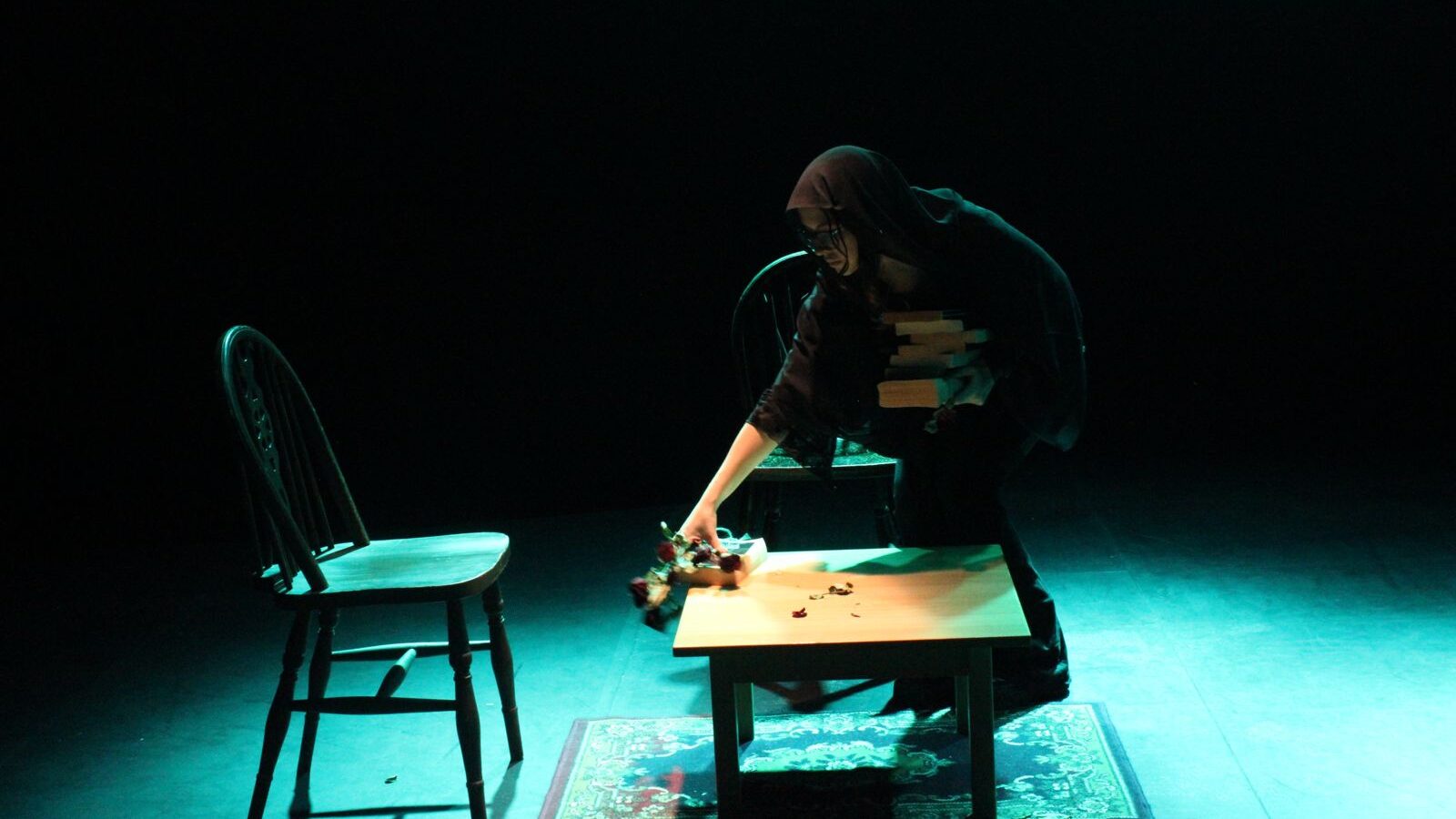
At first, Anna Ewer’s set leans into the domestic: two wooden chairs, a Persian rug, a coffee table. A large pile of vintage Penguin Modern Classics are strewn haphazardly across the table and floor, while a half-dead bouquet of roses lies on the table, dead petals littering the floor. Throughout the play, the Figure (portrayed by Maddy Howarth on opening night and then after by Saffy Hills), removes props. The stage becomes bleak, the eerie emptiness of the black box encroaching on the actors. The Figure, a Grim Reaper type clad in a wispy black gown and veil, seemed to be made of the same stuff as empty space.
The play was filled with allegorical yet farcical moments, modernist in its broken logic and evident disinterest in the suspension of disbelief. Alex and River repeatedly try to leave the room, but always end up walking straight back in. Sometimes, when they re-enter, their state of mind has been altered. At various points, Alex and River slip into Woolf-esque characters. They assume the role of husband and wife arguing about their daughter Clarissa in an allusion to Mrs Dalloway. Alex (disgruntled mother) calls River a “deadbeat dad”, which River defends in a bread-winner diatribe.
Almost as soon as the episode starts, it’s over: neither Alex nor River can recall having slipped into their Woolfesque personae. I can understand audience members leaving this play feeling disoriented, even alienated by the slippage. Personally, I found the ambiguity incredibly alluring, a puzzle that demands scrutiny.
Cohen Rowland and Charlie Heath gave fantastic performances. Rowland’s character, Alex, is sensitive. He speaks French intermittently, sentimentalising the few memories he can remember. Heath’s character, River, is acerbic and discerning, scribbling in a red leather-bound notebook that his past self has filled with literary quotes. The pair had a captivating chemistry onstage. A testament to Martin’s expert direction, the actors kept the audience on their feet, creating variety in tone, body language, and volume. Together, they sold Martin’s premise successfully, absorbing the audience entirely with their distress.
Alex and River’s memory loss seemed to be imposed by some kind of distant dystopian authority, rather than be the result of a genuine physiological symptom. Whenever their memory hits a block, Méryl Vourch’s lighting design flickers in distress. The play is linguistically allegorical and resolutely playful. In one scene, Alex and River compete with each other for best proverb, mangling words along the way.
A linguistically playful production on a stripped-back stage, You Got Me was a top-notch mind game which I’ll be pondering for some time.

