

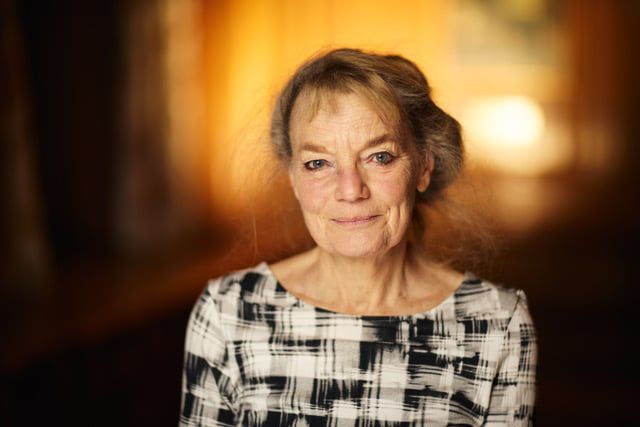
When Anna Olliff-Cooper applied to Oxford, she had just been diagnosed with a rare form of blood cancer. Doctors said she had three months to live, but she hadn’t quite processed that. “If somebody says to you that you are dying within a few months, it takes an awful lot of time to sink in”, Anna said. “You think, well, they’ve made a mistake. It’s quite bewildering.”
When we spoke, she was studying art history in the Next Horizons programme, taught by Harris Manchester College and Rhodes Trust. At 76 years old, Anna was one of the oldest students at Oxford University.
Growing up near London, she got a scholarship to her local grammar school and always thought she would love to go to Oxford. But she got an offer from medical school at a time when university education was uncommon for medical students, even less so for women. “I didn’t really feel I was worthy to come to Oxford because that’s where all the very bright people go”, Anna said. Overcoming self-doubt remained a work-in-progress for her.
As a young medic, Anna took care of people with leukemia, lymphoma, and related blood cancers at a time when patients had about six weeks to live. The newly established unit in Southampton only had a portable cabin with a professor and Anna on staff. “We didn’t have computers, but we had huge sheets of graph paper, and we had to plot how people’s blood levels were going up and going down”, Anna explained.
The frontier of medicine was tough. Once, a young boy had died in the middle of the night after receiving some drugs. So the next time Anna administered the drugs, she sat up with the patient and checked blood potassium levels throughout the night. “I saw it going up and up and up, so I gave him anti-potassium treatment, and he survived”, Anna said.
The portable cabin has grown into a major oncology centre today, but Anna, with her characteristic modesty, insisted that she wasn’t a ‘pioneering leukemia researcher’ as her son described her.
Her eldest son, Jonty, who had reached out to Cherwell about this interview, wrote that his mother is “shy as a mouse” and “crippled by self-doubt”. That was despite Anna’s adventures across geographies – and times.
She had some “hairy moments” when travelling the Sahara for six months with a boyfriend. When a spring on their Land Rover broke, someone had offered to swap the part for Anna. “Fortunately, my boyfriend said no, which was quite a relief”, she chuckled.
Then she caught dysentery. “We slept on a mattress on top of the Land Rover, and I remember waking up one morning to see this vulture sitting there. I might have been hallucinating, but I certainly remember seeing this bird and thinking, ‘God, I’m much sicker than I think I am, I need a doctor.’” The borders were closed, however, and the pair had to wait a month. Anna got better – a miracle she would repeat decades later.
“I’ve done time travelling, too”, she joked as she reminisced on her part as Lady Olliff-Cooper in The Edwardian Country House, a Channel 4 reality TV programme that sent her back a century to experience an authentic Edwardian lifestyle. When her family was chosen, the producers sent them train tickets but would not tell them the destination. “We just had to get on the train,” she said, and so she did.
For all her uncertainties, Anna was remarkably candid in our conversation. “I did have an affair with a married man”, she said. “It was a dreadful ménage à trois – so embarrassing in retrospect.”
Anna worked as a GP until her retirement at age 62. She discovered a talent for portraiture, but suddenly lost some vision in the centre of her eyes. With art off-limits, Anna started training to be a therapist, and soon she was working pro bono at a centre for rape and domestic violence survivors.
Then Jonty broke his collarbone while doing a master’s at Stanford University. Anna went over to help, and while there she heard about the Stanford Distinguished Carers Institute. She became a fellow and took courses on everything from blockchains to AI.
Back home, Anna found herself “getting very tired, then extremely tired, and then ridiculously tired”, she said. “Things started to break: I took something out of the washing machine and broke one rib, twisted suddenly and broke another rib. When I finally got to the hospital, the nurse pulled me up, and another rib gave way.” She was eventually diagnosed with amyloidosis – a disease not unlike what she spent her early years treating. Doctors gave her three months.
Anna didn’t speak in detail about her chemotherapy, but Jonty wrote of the devastating process: “The treatment was gruelling, but it worked, and she bought herself a little more life. How long, we do not know.” She attended her son’s wedding in a wheelchair and applied to Oxford at the encouragement of a friend from Stanford, not knowing if she’d live to attend.
Just before her course was due to start, she made a recovery. “Oxford is my bucket list thing”, she said. “Other people might want to go on a cruise around the world, but I wanted to come here.”
I told Anna that many students of my age think of Oxford as a stepping stone, a place to build experience for the CV while leaving ourselves little time to learn what we enjoy. Anna instead sees her studies on women’s self portraiture in art history as “of no practical use at all”, but something she’s doing simply because she likes it.
“But I may not have much time”, she said. “The outlook of my condition is not good. If they say it’s coming back, I can probably get re-treated, but you’ve got to go all the way through [chemotherapy] only to get maybe three months with good health again.”
That hasn’t stopped her from thinking about moving to Sweden, where her son is now living with his wife. “It would be another little adventure”, Anna smiled.

