

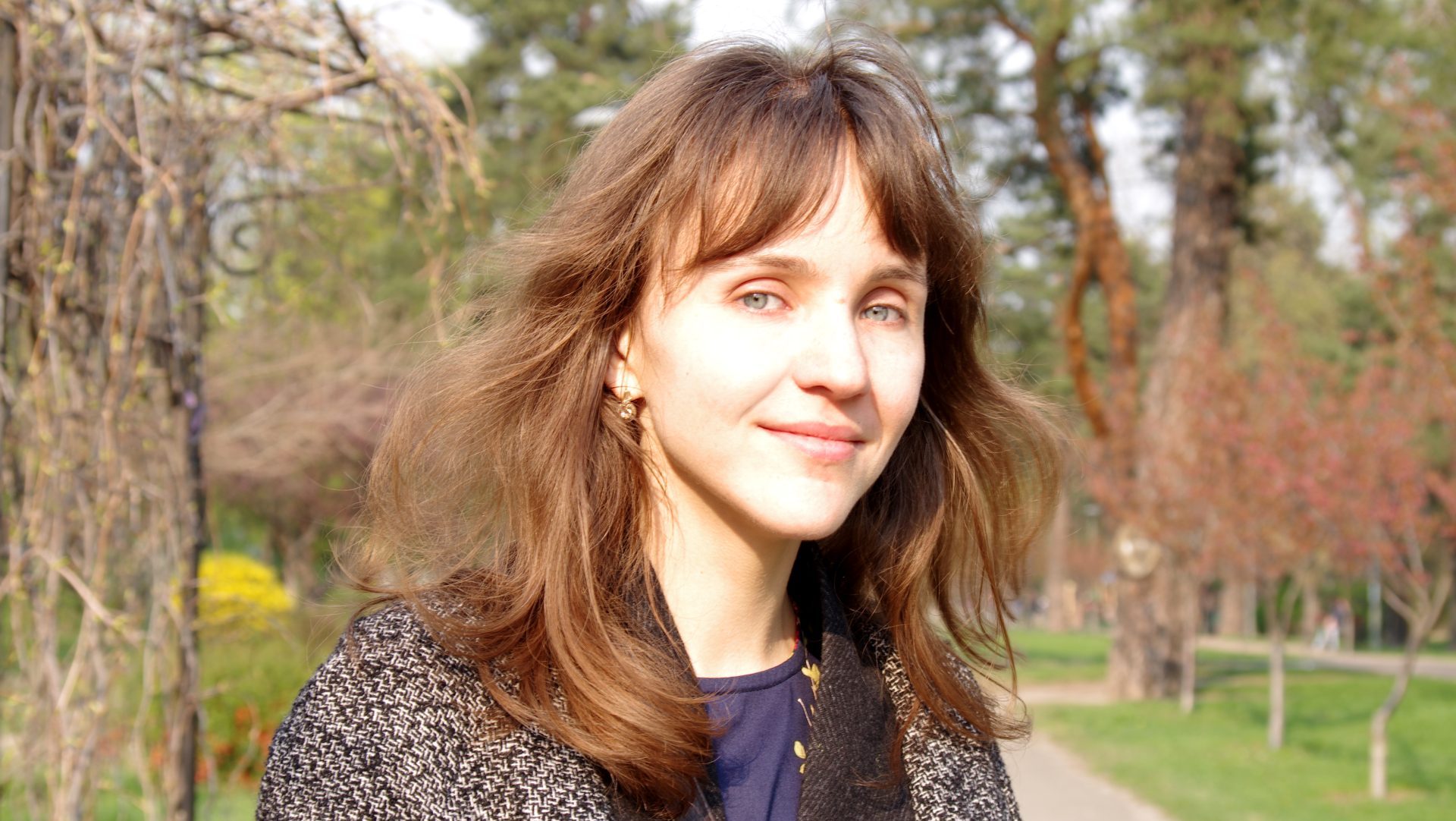
Iya Kiva is an award-winning Ukrainian poet, originally from Donetsk. Since 2014, when war first came to her region, she has lived in displacement. When I speak to Iya, she is in Lviv, where funeral processions for soldiers pass daily and the wounded walk the streets. Iya’s poetry explores her reality: her home, the texture of life under siege, the work of language in wartime.
Cherwell: Please give us a picture of your daily life.
Kiva: I live in Lviv, an old and beautiful city. By Ukrainian standards I am relatively safe, although from time to time there are attacks and civilians are killed and injured here. I live near a military hospital, so every day I see soldiers being treated there. War is not something far away, you see it every day, just by going out into the street.
I live near Lychakivska Street, where funeral motorcades for soldiers pass. They are accompanied by a mournful folk song that became popular after the Maidan in 2014. I can look out the window and see public transport stopping out of respect for the dead, people kneeling. When I go to Kyiv, the situation is different. I hear explosions, listen to the shaheds circling the house where I stay, see rockets or drones shot down. Sometimes the whole night passes like this.
This is my reality, in which I write, translate, edit, read, and think. But this is only from the outside. My internal state is unstable. Since February 2022, I have not had enough intellectual energy for daily tasks, because the events in Ukraine mentally exhaust even those who live in the rear. Cities you love are under attack. People you know are killed or injured. Even when it happens to people I do not know, or cities where I have never been, I feel the tragedy has happened to me. The Ukrainian community is now a big threatened body, of which I am part, and the pain in any part of this body is my pain too.
Cherwell: Your connection to Donetsk is evident in your work. For readers who only know the name of the city through the war, what was its character before?
Kiva: Donetsk appeared on the wave of 19th century industrialisation. My region is a region of resources: coal, salt, limestone, ore for metallurgy. The city arose around a metallurgical plant and mines, with capital from Wales, Belgium, Italy, France. Donetsk is a steppe, a place of heavy human interference in nature. The factories and mines are in the city itself, not outside it. My childhood impressions are of difficult ecology. Waste heaps, artificial mountains, are scattered throughout the city. They can be pink, ashen, black.
Roses are one of its symbols, like coal. There is an interesting dichotomy: hard work underground, which resembles hell, and beautiful roses on earth. Donetsk is also associated with Vasyl Stus, one of the most significant poets and dissidents in 20th century Ukrainian literature. His uncompromising, stubborn nature seems to me part of the Donetsk mentality. Inside me, Donetsk is an internal map: where I was born, studied, worked, and lived longest. A place that shaped me and was shaped by me.
Cherwell: In your writing, personal experience and war seem to merge. Do you construct that deliberately, or does it arise on its own?
Kiva: Poetry for me is a form of thinking, of exploring myself and the world. The war has been going on for almost eleven years now, and through poetry I explore the reality in which I live with, and in, war. With each year, it becomes harder to remember what life in Ukraine was like before, what I was like before, 2014.
I need to enter into resonance with some experience, thought, or reality for a text to emerge. It’s like caring for an orchid for a long time and one day seeing a flower on its stem.
I intuitively explore sound and meaning in language rather than rationally constructing them. I find it more interesting not to know where a thought, metaphor, or line will take me. I would call it the logic of water in a river, which makes its way by mastering the landscape and moving according to its features. This seems close to the pulsation of language itself. Language that unfolds through metaphors cannot know in advance what its new metaphor will be.
Poems are a tension between me and reality. I stretch like a string to extract sound from reality, to find out how it sounds.
Cherwell: My own writing sometimes reveals me to myself. Do you experience something similar?
Kiva: Yes, poetry is a place, almost a physical space, where I am most myself, where I am absolutely naked, defenceless, vulnerable. This vulnerability is also strength, because to expose myself through words requires courage. In poetry I am naked, but also as free as possible. Writing comes naturally to me, but reading poetry in public is still uncomfortable. I feel naked in the presence of other people.
The main principle does not change: write in your own language, rely on personal experience, honestly listen to your time, and recreate its music in poetry. After 2022, a sense of responsibility was added. To the living and dead Ukrainians of many generations. Culture is a kind of flash drive for recovering identity, especially through language. I’ve become more attentive to what I can capture in poetry, not out of compulsion, but by re-adjusting the optics to see more value in the everyday. Like changing the lens on a camera, even though you’re still the same photographer.
Cherwell: Is your poetry an act of resistance? Is language a battle, and are you fighting?
Kiva: I’m a little tired of these formulations. An act of resistance is to be a soldier, a paramedic, a volunteer, to make a donation. Poetry is an art that makes the resistance of Ukrainians visible. It allows me to feel my own experience and the experience of others at the level of specific stories and emotions, to touch this experience with my hands, roll it on my tongue, hold it in my ears, twirl it in my thoughts like music that resonates in the heart.
The war destroys not only people, cities, animals and nature, but also the intellectual potential of Ukrainians as a community. Writing during war is difficult, emotionally, psychologically, practically. In this sense, Ukrainian poetry is an act of resistance to the destruction of intellectual resources and culture.
Cherwell: What is challenging you recently?
Kiva: Since the full-scale invasion, the hardest thing has been trying to control my emotions. Living in a war means living where one grief is replaced by another, one news of death by another. Ukrainian pain today is like sailing endlessly in a stormy sea, not knowing whether you will reach the shore, without seeing the shore. There is much more experience now than emotional, physical, and psychological resources to live it and reflect on it. Taking responsibility for my emotions in such circumstances is not easy, but necessary, in order to be an effective adult on whom other people can count.
Cherwell: What are you hopeful for?
Kiva: I don’t really like the idea of hope. For me, hope is associated with powerlessness, a passive role, shifting responsibility to some imaginary figure; God, another adult, snow, rain, so I don’t like it. To have hope is a great luxury. And in the world of recent changes, our already unfair world has begun to look even less hopeful. I prefer to ask myself: what can I do? You can always find some specific answer to this question if you are honest with yourself.