

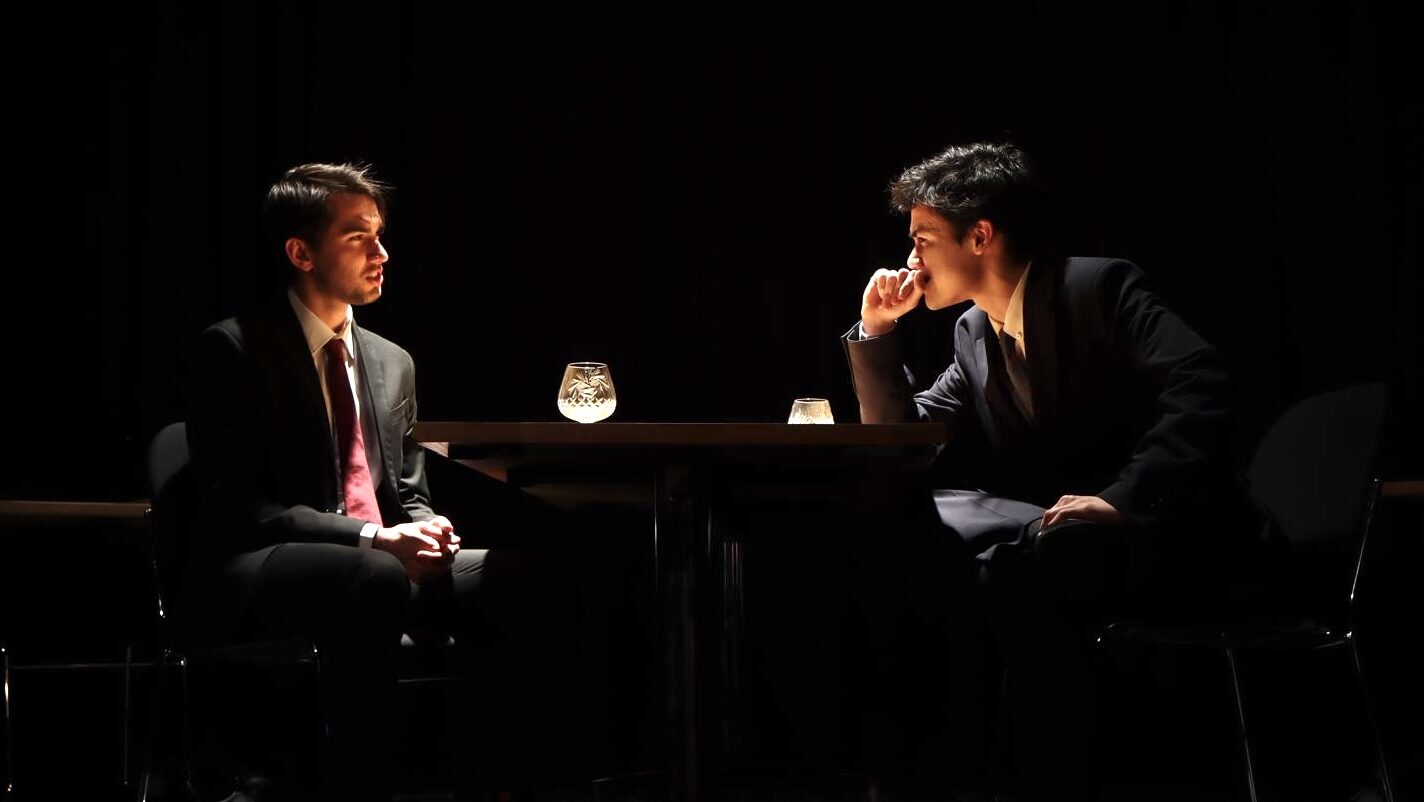
James Graham’s Ink, directed by Georgina Cooper with the St John’s Drama Society, dramatises Rupert Murdoch’s acquisition of The Sun in the 1960s, tracing its astonishing surge to unprecedented popularity. Perhaps it was an awareness of the slightly meta aspect of reviewing a play about journalism for a student publication that drew me to the auditorium in St John’s – in any case, by the end of the evening, I was not exactly reassured in my choice of vocation.
The plot follows Larry Lamb, an editor filched from The Mirror by Rupert Murdoch in his self-aggrandising effort to reboot the failing tabloid, The Sun. Overcoming an overwhelming lack of funding, resources, and staff, the limited editorial team see The Sun’s steady rise to success, and are in turn faced with the complications that form the inevitable corollary to this.
Rohan Joshi carried much of the show’s vivacity in his role as Larry Lamb, careening over the stage with an infectious nervous energy as he recruits and then manages his hastily-assembled team. The ‘boardroom’ scenes were a particular highlight, with the editor waxing increasingly passionate about the minutiae of newspaper formatting (an episode which, I’m sure, would have felt familiar to all Cherwell staff). Other standout performances included Inaya Chaudhry as an increasingly disenchanted Stephanie Rahn, portraying the model with just the right balance of elegant naivety. Zach Kapterian gave an endearingly awkward performance as Beverly, with effective comedic timing that consistently raised laughs.
Laurence Skinner portrayed an erratic Murdoch (for better or worse, there was no attempt at an Australian accent). The businessman was intimidating and unpredictable, sporadically erupting into outbursts of hysterical passion, or profane vituperations. He delivered his lines in an abrupt, barking manner, which conveyed the requisite impression of volatile intensity, but made it somewhat difficult to understand his enunciation.
The play’s idiolect was characterised by a brand of dry and sarcastic Britishness, replete with lewd innuendos, passive aggressiveness, and awkward pauses. It was gratifying to see copies of Cherwell being used liberally as props – although the criticism of its front page in lieu of The Mirror was less than flattering. The two levels of the auditorium’s stage were put to inventive use: in a particularly memorable scene, the reactions of the rival papers to the news of The Sun’s unexpected success were staged simultaneously on the separate layers. The sound design, although a little farcical at times, was impressively extensive, particularly the echoing effect in the church scene, transforming the otherwise simplistic mise-en-scène to reproduce the reverential sombreness of the projected location.
However, the play, divided in two by an interval, as a whole felt unbalanced. The first half breezily follows the early stages of publication, leaning heavily into the comedic aspects, and drawing out each distinct character with energy and wit. In the second half, however, the scrappy underdog narrative was displaced by an abruptly grim kidnapping story: rapid banter gave way to hushed anxiety, the pacing slowed down palpably, and the lighting became ominously tenebrous. Yet the established emotional valence of the preceding action meant that the tonal shift was less than cohesive; the discrepancy was, overall, too drastic and too sudden for it to feel natural. Lamb morphs startlingly from enthusiastic and likeable, to sinister and brooding, playing up the contrast to such an extent that the two halves felt like entirely different plays. As a result, it seemed to form a slightly facile ‘debate’ structure, examining the tabloid first in a positive and then a negative light. Graham’s scrupulous avoidance of sermonising on press ethics came across here as rather convoluted – it would have been more effective were he to have come down on one side or the other.
The darker scenes veered on the side of the melodramatic: red paint is splattered across a white canvas, leaving the stain lingering for the rest of the play in a less than subtle visual metaphor. A soundscape of ominous thunder formed the sonic counterpart to this, investing the drama with a Gothic exaggeration that sat in problematic juxtaposition with the naturalism of the first half. Graham’s script presupposes an interest in Murdoch’s career; if the world of journalism doesn’t appeal to you, the play would come across as somewhat monotonous. This emerges particularly during the protracted one-on-one meetings between Murdoch and Lamb, wherein the former descants endlessly on abstract ideals and cliched rhetoric in a manner that, by the end of the two and half hours, makes you inclined to think the entire industry should be discontinued.
Perhaps because of the strictures of the script, which refuses to come to any kind of conclusion, an opportunity for political engagement was missed. The show was staged more as a period drama; its application to modern life was, unfortunately, overlooked. In spite of the failings of the script, the play was, on the whole, well executed, if a little too overblown and heavy-handed in places. Several strong individual performances ensured the production’s appeal, and attest to the burgeoning potential of these actors. Ultimately, the play left me with a newfound appreciation for the working environment at Cherwell – it could be far worse.


