Haleh Blake was always told she was worth half a man. “As you grow up as a girl, from very early on, you realise that you’re treated as a second-class citizen”, she tells me.
Blake is a British-Iranian human rights activist who lived in Iran until she was 14. She is co-founder of United4Mahsa, a non-partisan social activist group which works to bring attention to human rights issues in Iran.
Blake’s passion and determination is immediately evident. Her activism is rooted in memory and lived experience rather than ideology and worldview. There is a steeliness, an iron-willed determination about her. She has no time for demoralisation – only action.
We begin our conversation by discussing her childhood in Iran. “In the morning at schools [sic], they make you chant, death to America, death to Israel, death to England”, Blake recalls. “Everything was controlled.” Musical instruments, TV shows, Disney movies – all were banned. Morality police patrolled busy areas, arresting women who did not comply with modesty rules. Blake’s first memory of the morality police was when her brother and aunt were arrested while walking together in the street and were questioned about their relationship.
Growing up in the 1980s without the internet, there was little exposure to the world outside Iran. Yet Blake came across photos of her parents from before the 1979 revolution, in which women wore miniskirts rather than hijabs. She questioned how Iran had transformed from a Westernised society into a “military state” in which basic freedoms were denied.
Iran was once on a path towards progressive expansion of women’s rights. From the 1930s to the 1970s, under the Pahlavi dynasty, Iranian society underwent a profound modernisation and secularisation even as the Pahlavis maintained a monopoly on political power. In 1963, women earned the right to vote. By the late 1970s, Iran had female politicians, judges and diplomats. Family Protection Laws in 1967 and 1975 increased the minimum age of marriage for women from 9 to 18 years old. But in 1979 these advances were sharply reversed. The Islamic Republic, headed by Ayatollah Khomeini, overthrew the Pahlavi dynasty in the 1979 Revolution and introduced Sharia Law, rewriting the role of women in Iranian society. Mandatory hijab laws were introduced and gender segregation returned in a new era of state-imposed ‘modesty’.
I ask Blake how Iran has changed since her childhood in the 1980s. “Nothing has really changed”, she replies regretfully. “What has changed is that people are more educated. There’s been a shift where Iranian youth have become so integrated mentally with the rest of the world through social media.” As Blake speaks, I’m struck by the cruel reality of young, aspirational teenagers being exposed to a world of freedoms and opportunities which are denied to them.
“This is so personal to me”, Blake says. “I’m a feminist, first and foremost, and the reason for that is because of what happened to me.” It is evident in her words that she carries with her the experiences of her past – the memories of being worth less as a woman, of being controlled in every aspect of life. It will never leave her. Now, it is these memories that propel her forward, urging her to speak out for those who have no voice.
Blake was 14 when she moved to the UK with her family. “Coming to the UK, I was striving to be equal”, she says. Blake gained opportunities she would never have had in Iran. Having grown up under authoritarianism, Blake does not take for granted the life she leads. “All I want is for Iranians inside, Iranian girls, to have the same opportunities, because I’m essentially the same as them”, she says. “I was born there, and I just had an escape route. My parents didn’t want their daughter to grow up in Iran.”
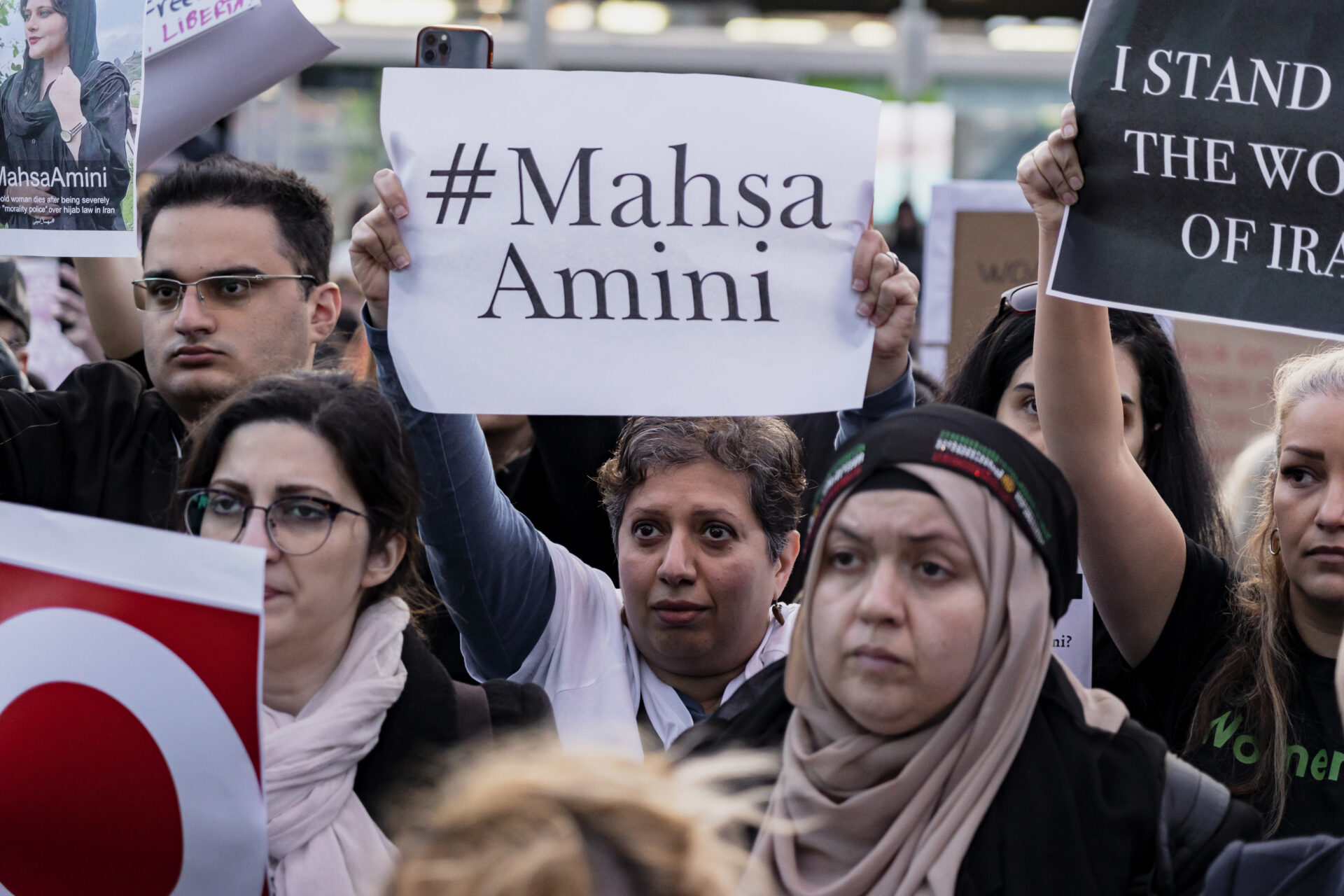
It was in 2022 that Blake became a leading advocate for human rights in Iran. On 13 September of that year, Jina Mahsa Amini, a young Kurdish woman, was detained by the morality police for failing to wear the hijab properly. Eyewitnesses say that police pushed her into a van and beat her severely. She died three days later in hospital. A UN fact-finding mission later found the Iranian state responsible for the “physical violence” that led to Amini’s death, which sparked a nationwide protest movement united under the slogan ‘Woman, Life, Freedom’. Iranian authorities responded with force, firing live ammunition and tear gas into crowds of largely peaceful protesters, leading to an estimated 550 deaths.
Blake was compelled to act. “What I realized is there’s a whole network of lobbyists for the regime that are paid from inside Iran, who are running the regime’s narrative globally”, she says. Indeed, the National Iranian American Council (NIAC) is widely viewed as a de facto ‘Iran lobby’, due to its endorsement of positions which align with the interests of the Islamic regime, including opposition to sanctions on Iran and objection to the designation of the Islamic Revolutionary Guard Corps (IRGC) as a terrorist organisation. To combat this misinformation and propaganda, Blake posted daily updates on the situation in Iran on social media.
She also started going to protests in support of the ‘Women, Life, Freedom’ movement. At the start, there were only a few people holding placards in Trafalgar Square. Nobody knew each other. “We were all very scared. We used to go to protests in the UK with our face masks and sunglasses”, Blake notes. “That’s no longer the case. We’re still afraid, but at least we trust each other.” Blake’s caution is understandable: the Islamic regime has long targeted activists abroad, through both online harassment and physical threats. A 2021 report by Freedom House, an advocacy group in Washington DC, found that Iran engages in transnational repression in at least nine different countries, using tactics like assassinations, constant surveillance and threats to family members still in Iran.
Blake was among a group of protesters who decided to collaborate on social media to raise awareness collectively rather than individually. They founded the advocacy group United4Mahsa. It aims to provide information on the Islamic Regime’s repression of its people by providing English updates, translating reports that British-Iranians like Blake were receiving in Farsi from inside Iran. United4Mahsa quickly created its own press release to direct journalists to this information, sharing and verifying information for The Guardian, The Times and other news outlets.
Speaking to people inside Iran is a crucial aspect of Blake’s activism. “I don’t come from a monarchy-loving family. My family revolted against that”, she says. Yet it quickly became evident to her that many Iranians were supportive of Crown Prince Reza Pahlavi, son of the deposed Shah. “If those inside Iran are telling me that they support him and they don’t trust anyone else, then who am I to say anything else?” Indeed, the anti-regime protests which gained momentum last month saw widespread support for Pahlavi. Videos showed masses chanting “Javid Shah”, meaning “long live the king”.
Many Iranians see Pahlavi as a transitional figure best placed to oversee the country’s transition to democracy. Pahlavi himself has said he does not wish to stand for political office. But in April 2025, Pahlavi’s office unveiled the Iran Prosperity Project, a group of papers which set out a roadmap for a post-regime Iran. Clause 12.6 outlines the need to hold a referendum for the nation to choose a system of government: a democratic monarchy or a democratic republic. A transition to democracy enjoys broad support among Iranians. A June 2024 survey found that just 20% wanted the Islamic Republic to remain in power, and 89% supported democracy.
Blake emphasises that her role as an activist is not confined to promoting her own specific viewpoint. “I see myself now as a vessel”, she emphasises. “All my personal views are on hold until Iran is free.” This duty to faithfully represent the views of Iranians stems from Blake’s conviction that she must use her platform to speak for the tens of millions who have no voice. She views herself as connecting Iranians to the rest of the world; personal preference is a privilege to be gained upon democracy’s ascent.
Blake and I turn to the most recent anti-regime protests in Iran, which started on 28 December 2025. The protests originated in the bazaars – the commercial heart of Iran’s economy – as the Iranian rial plunged to a new low against the US Dollar. Demonstrations proliferated in Tehran and other cities across the country in ensuing days. The focus of the protests quickly became political, as demonstrators began chanting anti-government statements such as “Death to the Dictator”. By 4th January, videos emerged showing security forces shooting indiscriminately at protesters. Four days later, the government imposed an extensive internet blackout which aimed to prevent details of the regime’s crackdown being beamed to the world.
The 8th and 9th January were two of the bloodiest days of the protests. The Crown Prince called for protests on both days and “millions came out”. Intelligence suggests that at least 1.5 million people took to the streets in Tehran alone on the 8th January. “The accounts I’m getting from people is that it was a sea of people”, Blake tells me. “The first thing that everyone said is that everyone’s out, we won.” Yet any illusion of victory was shattered once the regime started shooting.
The protesters came from all aspects of society. “I’ve seen videos of 11-year-olds asking people to come out, and I’ve seen a 70-year-old woman in crutches on the corner, in her hijab, chanting death to the dictator”, Blake explains. “These images really show the diversity of those who are unhappy.”
“Some of these stories I have been translating, honestly, I don’t wish anyone to hear them”, Blake says quietly. I sense that she shares with Iranians across the globe a feeling of helplessness, watching on from afar as the regime’s oppression continues unabated. What remains in her power is remembrance: ensuring the stories of those killed are never forgotten.
Blake is keen to emphasise that the protests were not motivated solely by a concern for women’s rights. It was not simply a feminist movement. “Men are very much also a victim of this regime”, Blake observes. Ultimately, people were protesting for so much more than human rights within a theological framework: they were calling for an end to the Islamic regime entirely. It is a regime viewed by many Iranians as an occupying ideological force which cannot be modified and requires dismantlement.
Amidst the ‘Women, Life, Freedom’ protests of 2022, Blake says she was “bombarded with requests” from western media for information. Many interviews were particularly interested in the feminist angle. Earlier this year, she received media requests during the height of the protests, but with their brutal suppression the media coverage quickly died down. Undeniably, the Western media has been restrained in its coverage of the government crackdown in Iran. Blake tells me she reached out to hundreds of journalistic contacts to implore them to cover the protests, only to be rejected. An expression of despair crosses her face as it’s clear that she feels many have not truly recognised or supported the bravery and sacrifice of the Iranian protesters.
The regime’s crackdown killed over 36,500 people in just a few days. Why, then, has the political left been so conspicuously silent about these human rights abuses? Blake points out that many of those who were so outspoken about the humanitarian situation in Gaza were markedly muted about the Iranian regime’s crackdown. Tom Fletcher, the UN Humanitarian Chief, for instance, has been silent on the killing of protesters in Iran. This, she says, is the latest iteration of a years-long trend of progressive figures turning a blind-eye to the regime’s crimes. She recalls in 2016, when Jeremy Corbyn accepted £20,000 to appear on Press TV, the Iranian state broadcast network, a channel banned in the UK for its part in filming the detention and torture of an Iranian journalist.
“In the last few weeks, I have been trying to engage with left-wing political parties, and they’re not engaging”, Blake says, her head lowering in disappointment. She observes that the left sees the Islamic Republic as a victim of imperialism, oppressed by America and Israel. This worldview means that many “can no longer deem them as oppressors of their own people”, she notes. “It comes from a place of privilege for some of these people, where they sit in a higher moral ground of ideologies, but actually don’t understand what it’s like to live under some of these dictatorships. They are so removed from the realities of the Middle East.”
What can the British government do to aid the Iranians who want an end to the regime? Blake’s eyes light up as I ask this. Her answer is clear and determined – it’s a question she’s evidently been waiting to answer. “Stop negotiating with our killers. Prescribe the IRGC. Close down the centres of the Islamic Republic on British soil.” She wants to see the expulsion of Iranian ambassadors, because “you can’t negotiate with a terrorist organisation”. Finally, she implores political leaders to “engage with Reza Pahlavi” as a legitimate leader of the pro-democracy Iranian opposition.
When I ask what will need to change for the protests to succeed, Blake’s response is immediate. “Every single Iranian I’ve spoken to is asking for intervention”, she asserts. “How do we avoid more violence? How do we protect more lives? Surgical intervention is actually the most logical way.”
I end my conversation with Blake on an optimistic note: her vision of a post-regime Iran. Imagining what Iran could become brings a small source of comfort amidst the grief and trauma which lingers a month on from the government crackdown.
“My dream is to be able to work with Iran, work for Iran”, Blake says. She envisions an Iran which is “prosperous and friendly to the world”, with a thriving economy, burgeoning trade, and good relations with other countries. “I want to get to the ballot boxes. I want to see that people have the choice to decide their own fate”, Blake emphasises. She does not care whether the outcome is constitutional monarchy or republicanism, only that a true democracy with genuine checks and balances emerges.
For 47 years, Iran has not been able to contribute its culture and heritage to the world. “Imagine what’s going to come out when it’s all free”, Blake points out. “We are a 7,000-year-old nation with a deep-rooted interest in literature, in history, in architecture, in music, and in art.”
“Tourism will be incredible. We’re so excited to share Iran with everyone!”, Blake exclaims, a smile spreading across her face. “I can’t wait to take my husband and my friends, just to share a piece of everything I’ve described to them.”
As my conversation with Blake draws to a close, I’m reminded of the principle guiding her activism: true solidarity is not about speaking for others, but rather ensuring they are heard. Her message is clear: listen to Iranians and stand with them in their fight for freedom. It is a promise she upholds in every social media post, every television appearance, and every protest. She will never give up.