

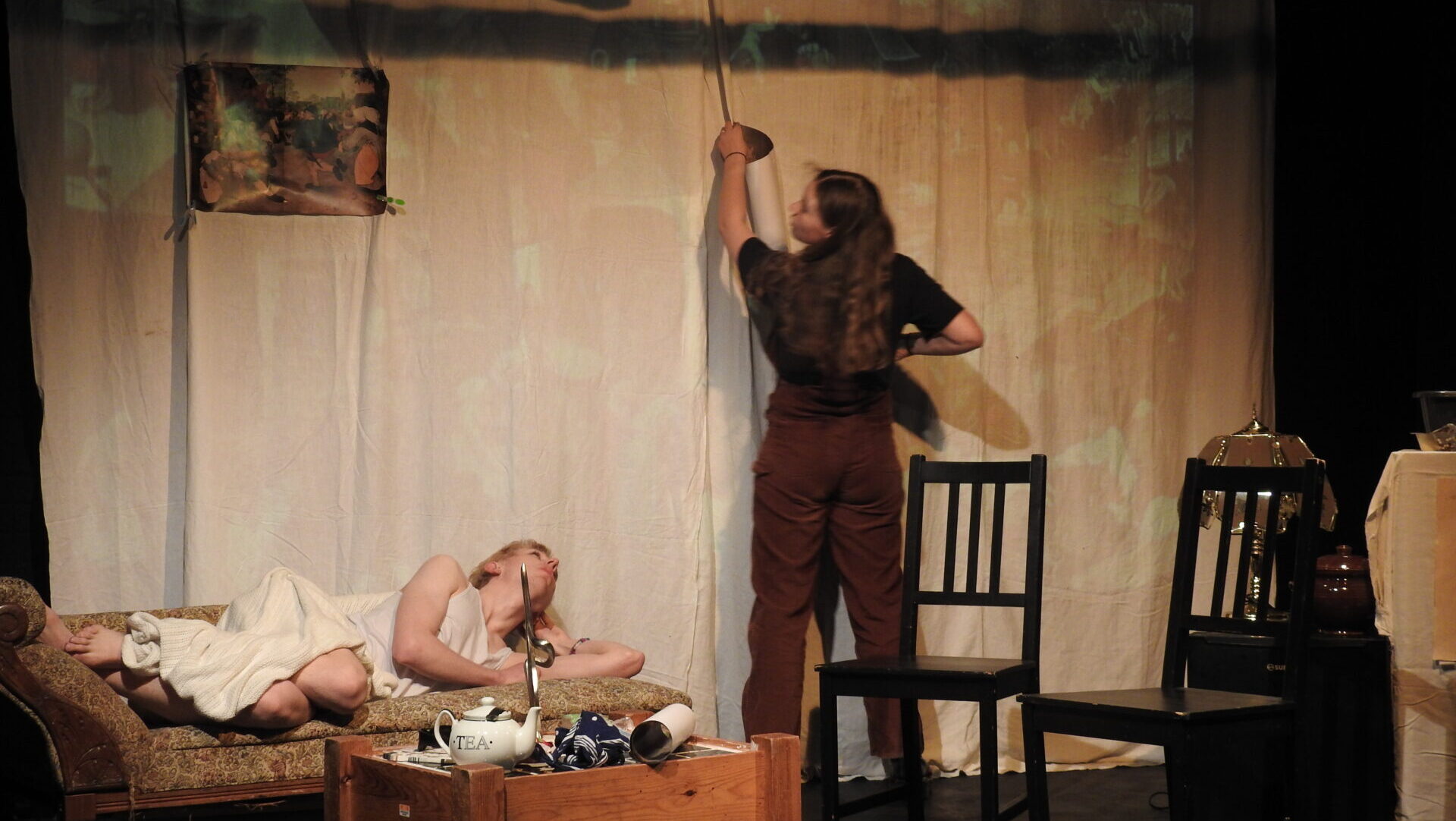
“Have you ever watched two ships crash into each other in Antwerp harbour?” asks Pieter, in the opening lines of Kilian King’s new play Brew Hill. Pecadillo Productions’ latest show is (quite rightly) aiming for the Edinburgh Fringe, but I imagine that’s only the start of where this story could go; the kooky, self-assured tragicomedy has immediate cult classic potential.
Brew Hill tells two stories. Pieter (Hugh Linklater) is modelled on Pieter Bruegel the Elder (1525-1569), an influential Dutch painter during the Renaissance. His monologues – which narrate the story of his son and protege Yoris – punctuate the present-day story of two recent-ish art graduates, Gordon (Jem Hunter) and Nat (Trixie Smith). Nat reports a strange dream about a Pieter Bruegel painting, despite having never encountered the artist’s work. Once she’s researched Bruegel, Nat decides she wants to start a brewery (‘Brew Hill’, as in ‘Brue-gel’), a place she feels will reflect the community she sees in Bruegel’s paintings. Meanwhile, Gordon compulsively checks Skyscanner for flights to Berlin.
Gordon and Nat’s friend from university, Kirsty (Hannah Wiseman), prompted the biggest laughs in the show. An upright, wool-coat wearing professional, Kirsty was a perfect foil for Gordon and Nat. Her polite reactions to their daily routines, their home, and their dreams were genuinely hilarious. Kirsty provides access to the outside world, bringing her “cool” new friend Peter (Hugh Linklater, in his second role) over. Peter’s reappearance tears at the fabric of the play’s reality when he begins to monologue about balloons in the exact same way as Nat in the previous scene.
Brew Hill has an all star cast. Linklater is unflinching as Pieter, monologuing seamlessly through anger, pain, and tenderness. Wiseman is incredibly endearing as Nat, depicting her dependence on Gordon beautifully. Hunter as Gordon is inspired. Adorned in a white vest and living off the chocolate balls found in the corner of a Müller yoghurt, Hunter’s sun-glassed, deadpan vocal fry delivered some fantastic lines. Wiseman, who played Kirsty, is a delight to watch. Hunter and Smith together form the powerful comedic core of the play.
Gordon and Nat’s relationship is one of evident love and mutual support, but it is also fractured. Gordon can be cruel and dismissive. His poor mental health puts pressure on Nat to complete daily tasks; she’s perpetually washing up. Meanwhile, Nat is a recovering alcoholic (but it’s okay, she can start a brewery, since she doesn’t like beer?). It’s implied that she’s forced Gordon into the role of physical and emotional caretaker many times.
At first, the two timelines – Pieter versus Gordon and Nat – appeared inchoate. Who made the wacky decision to embroil a late medieval painter? Pieter felt like an anachronism, fighting for relevance even in the dialogue itself: “Of all the people to have a parasocial relationship with, you chose Pieter Bruegel? I mean, what’s wrong with Justin Bieber?” But the audience’s patience is rewarded when, as the story unfolds, the two narratives reveal satisfying resonances. King tells a watertight dual story with a clearly defined set of thematic parallels: (not) following dreams and how “the final act of love is letting go.” Or, in Peter’s words: “The balloon is you and the sky is Berlin.”
Beyond the well-executed dual plot, potent motifs formed another network of ideas. References to balloons abound, particularly the helium-filled kind that children treasure, then immediately release. Clark signals scene changes with bassy rave music, which has the amusing effect of making Pieter look as though he’s catwalking on and off stage.
Méryl Vourch’s set is naturalistic, providing two zones. A small stool is reserved for Pieter towards the front of the crowd. The majority of the stage is used to create Gordon and Nat’s home, which most of the time reflects what can only be described as a depression hovel (in Kirsty’s words, “I love it in here. Isn’t it so shabby chic?”).
Bruegel’s paintings, which often depict scenes of labour, are described as “poverty porn” by Gordon, and provide the play the opportunity to muse on capitalism and community. Amongst the seemingly never-ending online discourse about third spaces and ‘being a good villager’, it was immensely refreshing to see the utopian, romanticised ideal of community, especially as it would have existed under feudalism, critiqued.
Behind this, images of Bruegel’s paintings are projected onto a sheet. At one point, Nat pegs printed pictures of Bruegel’s paintings – ‘The Gloomy Day’ and ‘Landscape with the Fall of Icarus’ – to the sheet, in a supernatural, metatheatrical move. When Kirsty visits her, Nat explains how brilliant she finds Bruegel’s work, growing increasingly impassioned. Kirsty responds with a polite but vacuous “mmmm”, sending the audience into hysterics.
Brew Hill is a triumph. King has assembled a talented cast and crew to deliver a punchy depiction of the enabling and suffocating effect of love. Eccentric, well-made, and packed with EDM, the show leaves you planning to book that flight you’ve always dreamed about.


 aiming for Fringe, but this kooky, self-assured tragicomedy has immediate cult classic potential.)