

Many of us have already heard the voice of Hind Rajab. On 26th January 2024, the Palestine Red Crescent Society received a call about a six-year-old girl in need of aid. Hind Rajab was trapped in a car with her family whilst under fire.
Audio recordings of the call were published by Red Crescent on 3rd February 2024 and quickly went viral. In a statement responding to the film’s Venice Film Festival nomination, director Kaouther Ben Hania said that after listening to the full recordings, she abandoned work on a different project to make The Voice of Hind Rajab. “After listening to it, I knew, without a doubt, that I had to drop everything else. I had to make this film.”
The film is built around the original audio of Hind’s call. The dramatized portrayal of the aid workers as they respond to the situation is delicately handled, emphasising the bravery of the workers but also the way their desperate heroism is stunted by administrative obstacles.
The film forces the viewer not just to watch but to listen. Rather than showing graphic visuals, a move appropriately dubbed “eerily kind” by M. Gessen in The New Yorker, the film instead has the viewer bear witness to the emotional turbulence experienced by the aid workers and victims of the war.
Ben Hania has noted the “forgetfulness of scrolling” and the proliferation of violent images that characterise the modern media landscape. She makes a clear and effective choice to steer away from both, using long shots which focus on the faces of the actors. There is an interest in the daily (but not mundane) details of the lives of the aid workers: at one point, we see an aid worker lock themselves in the bathroom to play a game on his smartphone whilst tears of helplessness stream down his face.
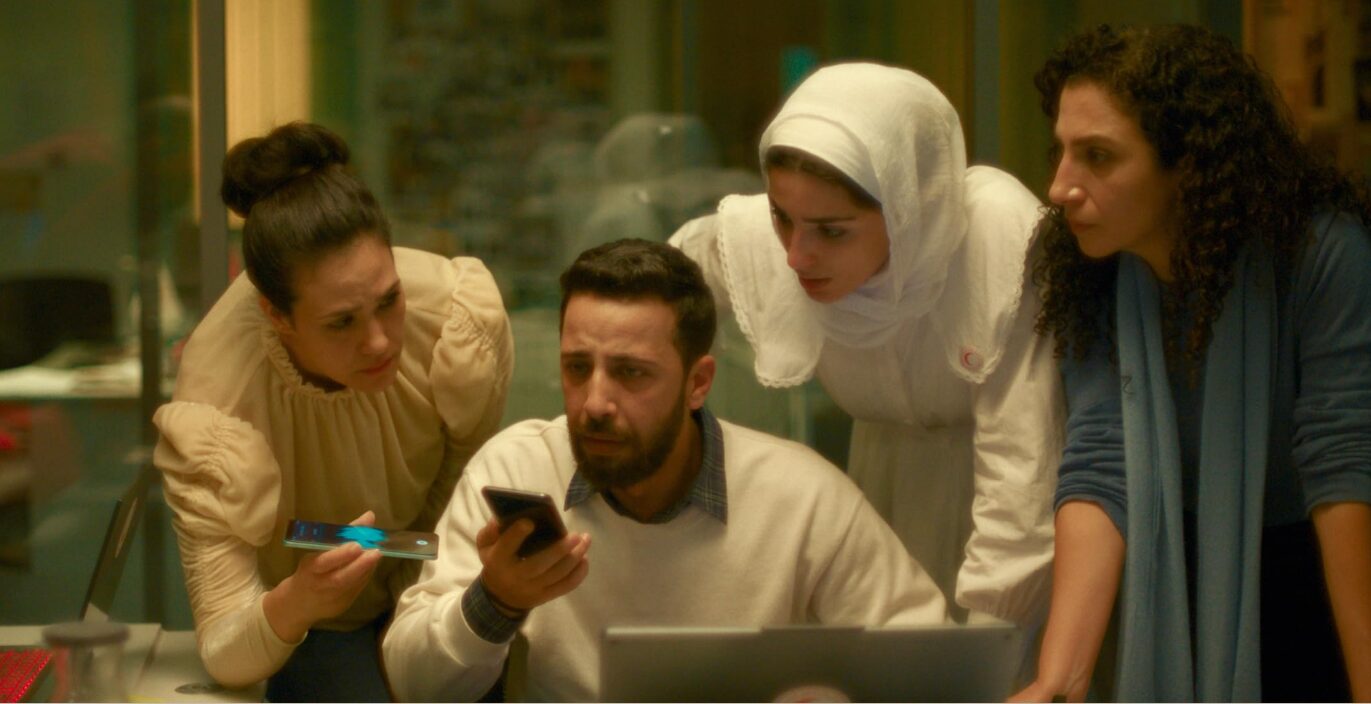
Memorable performances were given by all four actors as they depicted the oscillations between hope and devastation that aid workers regularly navigate. Omar (Motaz Malhees) is the first person to speak to Hind. In order to dispatch an ambulance, Omar needs Mahdi (Amer Hlehel), the coordinating officer, to confirm an approved route through the warzone via intermediaries who consult with the Israeli military. At each administrative level, there is tension and powerlessness. Omar argues with Mahdi; Mahdi in turn argues with his superiors, who, for the most part, are a silence hidden behind a telephone.
Rana (Saja Kilani) first appears onscreen as a sleek, professional force, ethereal and upright in her white hijab, checking on others, about to head home. Rana ends up on the phone to Hind supporting Omar, hunched over the phone, quivering, just about holding together a semblance of reassurance as Nisreen (Clara Khoury) supports her from the background. Memorable performances were given by all four as they depicted the oscillations between hope and devastation that aid workers are regularly forced to navigate.
The Voice of Hind Rajab premiered at the 82nd Venice Film Festival in August 2025, where it received a twenty three minute standing ovation. Since then, debate has been sparked regarding the ethics surrounding Ben Hania’s depiction. Peter Bradshaw, in The Guardian, explains the dilemma inherent in presenting an “authentic shattering recording in a Hollywoodised suspense drama, getting actors to cry and rage alongside a kind of docufictional hologram.” Bradshaw appears to admire Ben Hania nonetheless, saying she has a “reckless, ruthless kind of provocative brilliance”. Others are conflicted. Joseph Faihm for the BFI says that “the aestheticisation” of the film “ultimately denies Hind individuality” and that “she is reduced much of the time to a mere voice – an echo of suffering.”
There is an undeniable ethical dilemma in using Hind’s real voice. One wonders, for instance, whether the premise would have been considered permissible had we not been regularly exposed to graphic war footage via short-form videos. Yet, using Hind’s voice enables an immortality she might not otherwise have been granted. Was Hind made a martyr before Ben Hania got involved, or after? Is distressing spectacle an appropriate mode of resistance? The film’s content even explores the ethical complexity of representation. At one point, we watch the actor playing Nisreen being recorded for Red Crescent’s social media: the hand holding the phone to actor Nisreen’s face is playing a video of real Nisreen. These are all important concerns. I can only speak for myself when I say that when I left the cinema, it felt important that I had heard Hind’s real voice, not an actor recreating it (which itself would have created a different set of ethical problems).
On 18th January, two days after the UK release, I sat weeping amongst a small tearful audience in the Phoenix Picturehouse. As the credits rolled, no one made a move to leave, not until the final credit rolled and the lights came on. Our tacit silence, punctuated only by quiet sobs, felt devastating but sacred. A witnessing. To quote Ben Hania: “Cinema can preserve memory. Cinema can resist amnesia. May Hind Rajab’s voice be heard.”


