

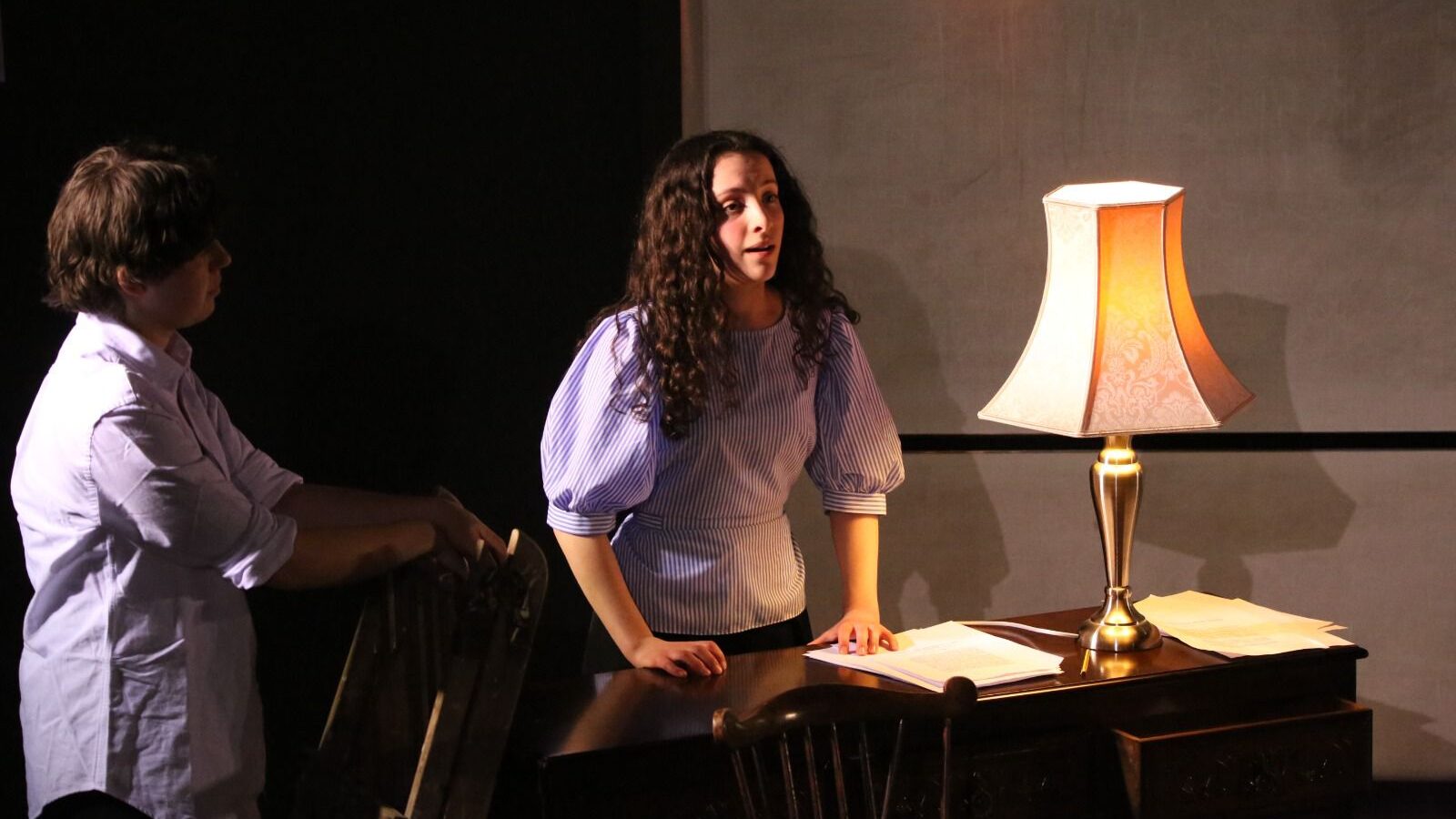
Cartesian Production’s Noether is a production driven by passion. This original play, written by Esme Somerside Gregory, tells the story of the German mathematician Emmy Noether (Yael Erez) and her struggles with the misogyny of her male peers against the backdrop of the rising Nazi state.
This show is unique in that it was devised entirely by the company. It touches on the major academic pursuits of Noether’s life; from her struggle for habilitation at the University of Gottingen in 1915, to proving ‘Noether’s Theorem’, and finally facing expulsion from Gottingen University under the Nazi administration in 1933 and finding refuge at Bryn Mawr College in America. My degree means that I rarely interact with mathematics, yet the skill of this production demonstrated to me the value of Noether’s contribution to the field. Although maths might well be a foreign language to me, the feeling of academic curiosity and fervour that the show conveyed is impressive to students of all disciplines.
The show deviated from the usual OUDS venues, held in a lecture theatre in the Mathematical Institute. And that’s all it was, complete with a podium and a whiteboard and jazzed up with a wooden cabinet, ladder, and chair. The audience were seated behind desks, which was particularly convenient for this reviewer scribbling away in my notebook (I like to think the scratching of my pencil was more immersive than distracting). I was initially skeptical about this somewhat sparse set design but it proved to be suitable for a play so entrenched in academia. The production didn’t need a complex set to transport us to Noether’s lectures; they were played out immediately before us by Erez, and watched by the rest of the cast seated in the front row.
Physical theatre was a recurring motif in Noether, with some moments triumphing more than others. The first use of this technique, where the cast arranged chairs which Noether stepped across and then leapt off was executed deftly but didn’t seem to contribute much meaning or visual interest to the moment for me. However, the company later staged an argument between Maggie Kerson and Esme Dannatt, in which Kerson, embodying the misogynistic resistance to Noether’s habilitation at the university, climbed a step ladder, with each step punctuating the words “every step of the way”. She was met at this level by Dannatt, raised up by the other cast members arguing in defence of Noether’s exceptional intelligence. The movements, paired with excellent performances from both Kerson and Dannatt, imbued this moment with an emotional intensity, and produced a captivating scene.
During one of Noether’s lectures, Erez explained the maths while the rest of the cast began to move their arms rhythmically, creating shapes with the air; they pulled, tilted, raised, and lowered. The cast then joined Erez onstage, still reaching and compressing in these dancelike motions, first discordantly, until gradually the group began to cohere, and they were stretching, raising, inhaling in perfect sync. This dexterous expression of the learning process was undoubtedly one of the best moments of physical theatre in the show.
Somerside Gregory’s script was well written, tight, and rich. She has clearly engaged in a ruthless editing process to capture a lifetime of devotion to mathematics within an hour. The script felt well paced, if a little dense with information that I was underqualified to process, but nonetheless, the narrative overall kept me engaged. The script balanced between focusing on Noether’s struggles in the university, and moving out to the wider tumultuous social climate. This provided a level of depth to the play, simultaneously the story of an extraordinary individual, and yet familiar to anyone who knows their European history. This script resonates ever more jarringly with today’s political climate – a line about America as the “hospitable” antithesis to Nazi Germany came across as sadly ironic, and highlighted the script’s relevance and sensitivity to its context.
There were some issues with projection, with some lines getting lost, or trailing off towards the end. The cast were not fitted with microphones, and they had a big space to fill, so this is an understandable technical challenge. It caused particular difficulties when the audience were faced with a script that was already at times difficult to follow because of the richness of information. The show also featured an interesting composition by Nicole Palka, the initial few bars of which felt a little anachronistic, evoking something of an 80s sci-fi rather than 20th-century Germany. However, it soon came into its own, and underscored the cast’s movements with an almost cinematic quality.
With its 1930s setting, the play inevitably interacts with the rise of fascism, and what this means for the Jewish Emmy Noether. The production doesn’t tiptoe around its difficult topics; it tackles them boldly, most notably in a scene where Noether’s teaching is interrupted by a bang at her door. The lights turn red and reveal a brown-shirted officer descending the stairs through the audience towards Noether, wearing a red armband. The officer’s silent presence instills a ripple of discomfort among the students, which bleeds into the audience thanks to a combination of the fidgeting and murmuring of the cast underlaid with the gradual intensifying of the sound. This moment was captivating; so simple, and yet so well executed.
Noether was a masterclass in devising. The passion conveyed in Somerside Gregory’s script combined with the enthusiasm and precision of the cast produced a show that illuminates Emmy Noether through the skilful intersection of history, abstract algebra, and stagecraft.


