

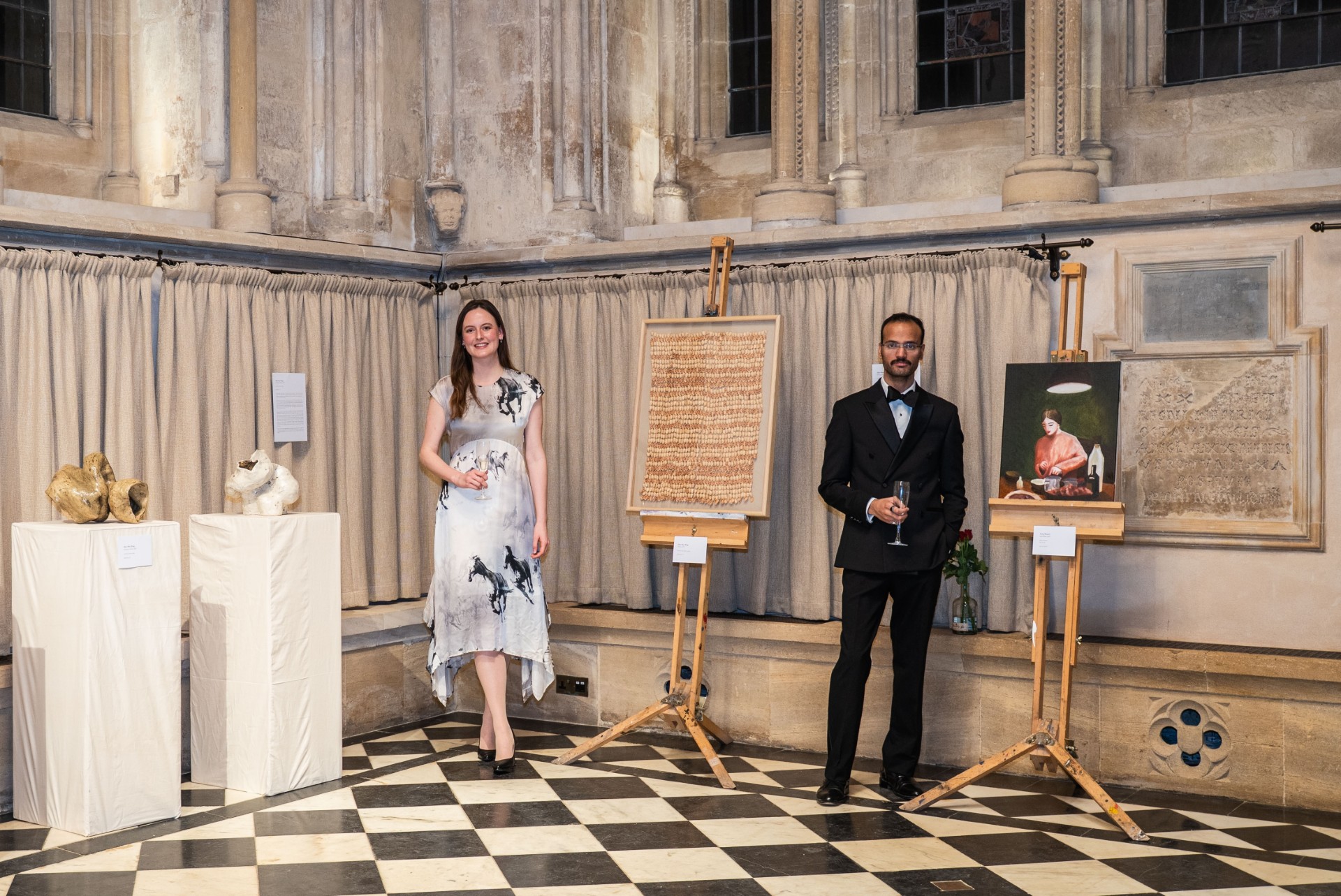
In the face of changing technology, how do artists perceive artificial intelligence, and what role does it play in their work? Responding to AI, an exhibition curated by Aniq Shamsi and Alice King, confronted this question directly. I had the great pleasure of attending a private viewing of the exhibition in the Christ Church Chapter House, and of meeting the artists at the forefront of the discussion.
Whether AI-generated images can be considered ‘art’ is highly contentious, even among non-artists. Arguments against ‘AI art’ include the lack of originality and the negation of effort. But others see these tools as a platform for innovation, stimulating ideas and testing different options. The entanglement of art and AI is only increasing, with models like ArtEmis even claiming to be able to predict a viewer’s emotional response to art, using large datasets of visual inputs and textual descriptions. Entering the centuries-old Chapter House, I was gripped by the contrast between such modern subject matter and the truly historic setting.
I was initially surprised by how many of the artists I spoke to were in favour of artificial intelligence, or used it in their creative process. One such artist, Alan Kestner, used AI to layer the vignettes in his piece, which would have been extremely time consuming to do in the traditional way. The description of his work, Dark Eyed Sailor (2024), includes a positive reaction to AI: “It opens up new possibilities to extend an artist’s repertoire.”
However, not everyone agrees. Sonja Francisco, a DPhil Chemistry student at Wolfson College and one of the exhibition’s featured artists,expressed concern about the effects AI may have on the environment. This was reflected in her artwork, Remember to Water the Pink Tulips in My Bedroom (2026). It consists of one mixed media piece and two separate tulip vases, one of which wilts with the label ‘generate image: pink tulips’, while the other blossoms. She poignantly focuses on the huge amounts of water used by data centres, creating tap droughts in local communities and affecting their everyday lives, down to the flowers in their homes.
A prominent theme of the exhibition was that of the artist’s creative process, and its inability to be recreated by AI. Munise Akhtar’s foray into Persian miniature painting focused on the physical effort artists pour into their work, tied to the emotions which motivate them to do so. After the death of her father, the symbolism of angels resonated with her, and she describes the creation of her piece as “allowing grief and focus to coexist within the same space”. She hand-burnished paper with stone, prepared pigments herself, and transformed raw gold leaf into paint. For her, AI cannot replace these traditional methods, nor can it remove the grief characterising her work.
Ruth Swain takes an alternative approach, with a series of oil paintings blurring the line between reality and image. Her Tom and Jerry (2025) piece captures the current state of AI-generated art, often producing images which are ever so slightly off or misproportioned. The viewer is presented with an unnatural, almost birdseye angle of a cat reacting to a photocopy of a mouse emerging from a machine. The painting intentionally mimics the appearance of AI and challenges the viewer to question the extent to which AI-generated images are reflective of reality. Swain confronts the theme of the exhibition directly, focusing on the viewer’s perspective rather than the meditative processes behind the art.
While the exhibition was student-run and featured the art of several postgraduates, it was nonetheless star-studded. M. Freddy, a Parsons School of Design graduate and featured speaker at MIT and the United Nations, explored the idea of art as a relationship through the concept of an envelope. Viewers were encouraged to open the letter, read its contents slowly, and reflect on how the fingerprints and subtle creases on the paper could not be recreated by AI. Likewise, Farrah Azam, an award-winning painter who has been commissioned by King Charles and Camilla, presented a beautiful work of gold leaf on a navy blue background depicting the London skyline, influenced by her Kashmiri background. Like others in the exhibition, Azam drew upon her upbringing and culture to ground her art distinctly in humanity. Aniq Shamsi, one of the curators of the exhibition and the Christ Church GCR Arts Officer, traced his family tree through the ancient cuneiform script (Inheritance, 2025), drawing upon such traditions to remind us that art and its power have endured several millennia before AI, and will continue to do so alongside it.
Shamsi and King’s Responding to AI exhibition was vibrant, heartfelt, and raw, stripping art back to its foundations and reconsidering what it means in a world of changing technology. The high quality of the exhibition and its organisation were impressive and spoke to the curatorial vision of Shamsi and King. Whether AI comes to have a true place in art is yet to be seen, but showcases like these forecast the controversy it creates, and remind us of the traditions that brought us to this point.


