

“I think there’ll be a war. Perhaps we’re all going to die”, my Arabic teacher announces as the engine-roar of an American fighter jet causes the walls to shudder.The class erupts with a loud, anxious laughter.
“It’s okay, we can all die together!” she says with a grin, giggling at our shock. Normally, she teases us for our absences or tardiness. She is kind and maternal, sometimes bringing us biscuits or dates. Today, her tone surprises me.
Coming to Amman for my year abroad brought the usual culture shock: new weather, new rhythms, new social codes. What I hadn’t expected, however, and what even frightened me at times, is the ambient inevitability of conflict that permeates daily life.
We are nothing if not in a bubble at Oxford. We use the word “crisis” to refer to writing our essays last-minute. Last year, during term time, my life revolved around my work. The gravest things that could possibly happen to me was that I could sleep through a morning rowing outing, perhaps I’d turn in an essay late, or forget to return a library book. I stopped checking the news, simply because I had the privilege of being too busy for the outside world. Here, I hold my breath as I read the headlines each morning.
At the time of writing, Trump had been threatening American military intervention in Iran for several weeks. Due to its precarious location between the two conflicting nations, the result is an invasion of Jordanian airspace – the country being dragged, against its will, into a proxy war for the second time in under a year. The last time this happened, I was preparing for my Prelims when my year abroad plans had been thrown into the air without warning.
Last June, Iran and Israel engaged in a brief and intense exchange of direct and proxy strikes during the Twelve Day War. Shrapnel fell in Jordan and air raid sirens blared, while the glow of American, Israeli, and Iranian missiles could be seen from rooftops across the Jordanian capital all the way to Beirut. I felt certain that I wouldn’t be coming to Amman as I had originally planned – but when the war ended on only its twelfth day, I was reassured by both classmates and tutors that everything would be fine. Fast forward to the present, and my entire cohort is currently studying in Jordan.
The first time I heard an F-15 jet was last October. Some classmates and I were sitting on a street-side balcony in Downtown Amman, tasting Knafeh – a sweet, syrupy, Palestinian dessert – as the warm autumn sun shone down on us. Then it came. Though I had never seen a plane fly so low, low enough to darken the entire street with its shadow, the sight of it was nothing compared to the horror of the sound.
The sound of an F-15 is unmistakeable. In fact, I have been counting them. I used to hear them once a week at the very most. Now, I hear them at least three times a day. Even now, as I write, I hear one flying overhead. As they rip through the air, I think: “Keep going. Pass us by.”
Until a few days ago, I did not know the sound that would come next. I only hoped for the engine’s roars to fade away. On the 28th February, the US and Israel launched missile strikes on Tehran. In retaliation, Iran struck American military bases across the Middle East, including Jordan. Sitting on my bathroom floor, air sirens blaring, feeling the ground lurch with the crashes of intercepted planes, I was not certain they would ever stop.
On the 2nd March, Jordan announced partial airspace closures. I read this news in my break before class. Around half an hour afterwards, the air raid sirens started again and I had to take shelter in the library. Sat on an office chair between the bookshelves, away from the windows, I felt some of the biggest crashes yet. They were close enough for me to hear the ambulances racing to the scene.
I decided to go for a swim after the ‘all clear’ alert. Even though the women’s pool is underground, around my sixth lap, I began to hear the unrelenting crashes of intercepted missiles once more. I dove beneath the water and sat at the bottom of the empty pool. Silence. Between the unwavering air raid sirens, the continuous crashes of missiles hitting the ground, the low thunder of American jets racing to Iran, and the near-constant patrol of the Jordanian Air Force; with my breath held and my eyes closed, I realised just how long it had been since I had the pleasure of hearing nothing at all.
A few hours later, I booked a flight home for 4th March. Almost all flights out of Jordan have been cancelled. My flight cost me over five times more than I would usually pay. I have spent every penny I have saved, but I need to get home. At the time of writing, I have no idea if this flight will be cancelled too.
In Oxford, war is only ever theoretical. It is something discussed in tutorials, analysed in essays, and debated in the Union chambers. Here, it is infrastructural. When my teacher jokes that we might all die together, we laugh. Beneath the laughter, there lies recognition. She has lived her entire life within earshot of other people’s wars. I have not.
I think of my other teachers here in Jordan: one of whom is a Syrian, who spent three years in prison, where he was beaten for opposing his government. He and his wife – also a teacher of mine – are here because Jordan is the safer alternative. Like millions of others, they did not come by choice. I think of my grammar teacher, an elderly Jordanian woman, who called her sister fearfully when two jets interrupted class within minutes of each other. I think of my late father, an Iraqi who assumed an Irish name when he came to the UK to better integrate – and, I suppose, to forget. In our house, the news would play on a continuous loop. Now, I understand why.
A large part of my decision to study Arabic is owed to my father’s passing. Having now experienced life in the Middle East, including its wars, I now understand him far more than I ever could have anticipated.
When I arrived in Oxford, we began learning Arabic from Al-Kitaab – the standard textbook used in universities. One of the first words we were taught was “United Nations”. We could barely introduce ourselves, yet we were already pronouncing the language of international diplomacy. As the chapters progressed, the vocabulary darkened: “to decapitate”, “bullets”, “martyr”. I remember finding it faintly comic, as though the syllabus had skipped the banalities of daily life and leapt straight into the Security Council. We laughed about it then, a group of slightly overwhelmed first-years conjugating verbs relating to political violence. Only later did I learn that Al-Kitaab was originally designed for American diplomats. Its vocabulary no longer feels random. Just two days before the first US and Israeli strikes on Iran, American officials were describing recent negotiations as constructive and promising. As jets pass overhead and air raid sirens interrupt class, I am struck by how quickly the language of diplomacy collapses into the language of violence. The same textbook that teaches us to say “peace negotiations” also teaches us the verb “to be killed”.
I used to think of safety as an invisible constant, something so guaranteed it did not require acknowledgement. Now, I know it is a privilege – and a fragile one at that. I no longer scroll past headlines. The past few weeks, I have read them with the uneasy knowledge that they may determine whether I would remain here, or whether my year abroad would once again be suspended mid-air. I do not feel safe in Jordan anymore. The FCDO now advises against all but essential travel to Jordan and all Oxford students are now required to evacuate the country. In the worst case scenario, we are simply returning home to the UK. My teachers are not afforded this same privilege.
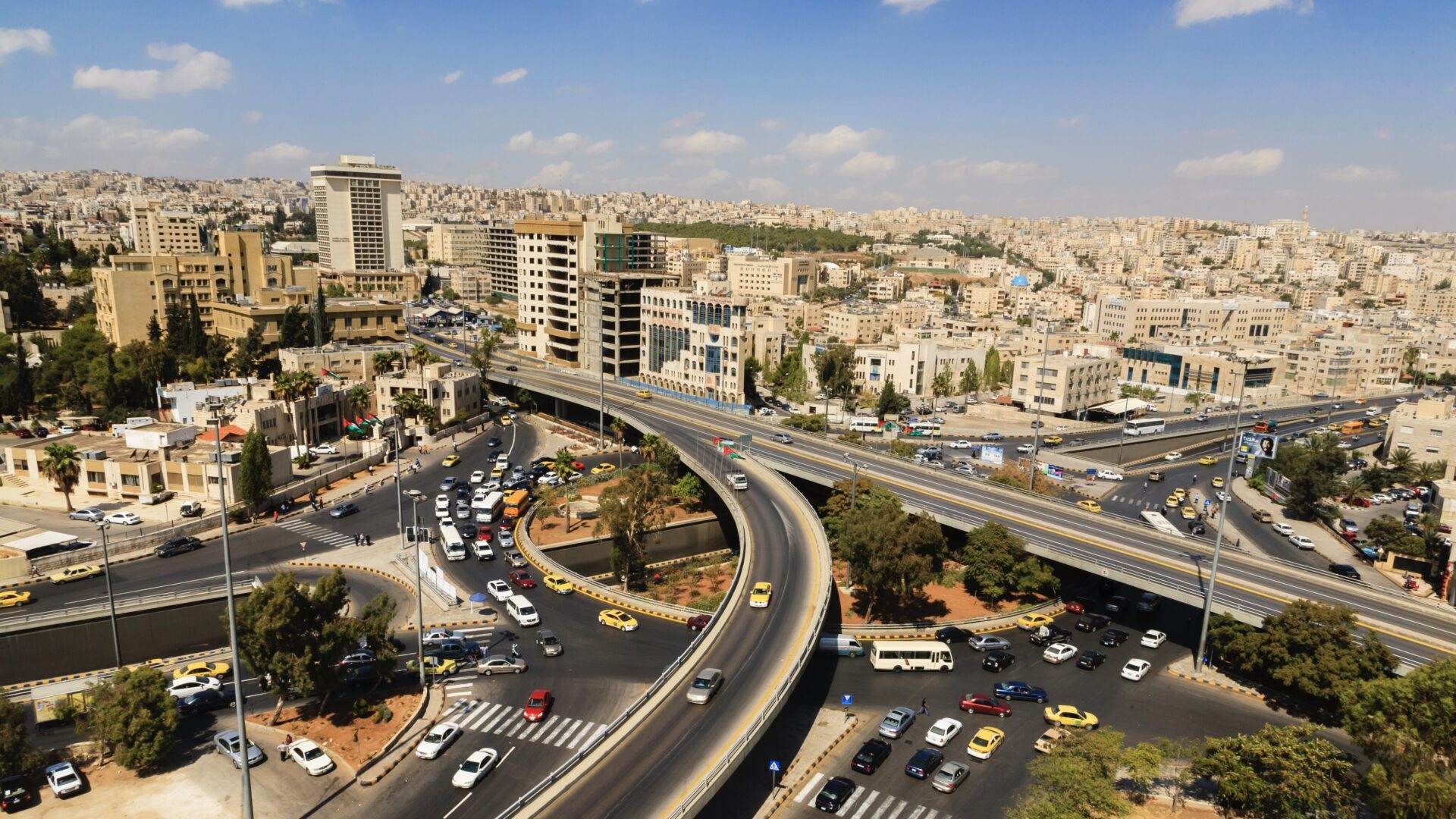
That said, Jordan is so much more than its geopolitics. Despite being so far away from Oxford, I really was beginning to feel at home here. In the early evening, the city softens; the swallows arc between the concrete rooftops, the call to prayer folds into the hum of traffic, and the hills glow pink under the sunset. Amman is erratic and sprawling, but it is alive. Shopkeepers press extra sweets into your hand. Taxi drivers insist on conversation. Strangers offer directions before you have even asked. The people possess a kindness that persists through the worst, regardless of what passes overhead.
Life continues with a startling normality. My teacher still brings biscuits. My classmates still complain about homework. Downtown Amman still smells of cardamom and diesel and sugar syrup. There is Knafeh to be eaten, exams to revise for, birthdays to celebrate. The jets pass overhead, and someone inevitably rolls their eyes and says, “again?”.
We continue conjugating verbs.

