

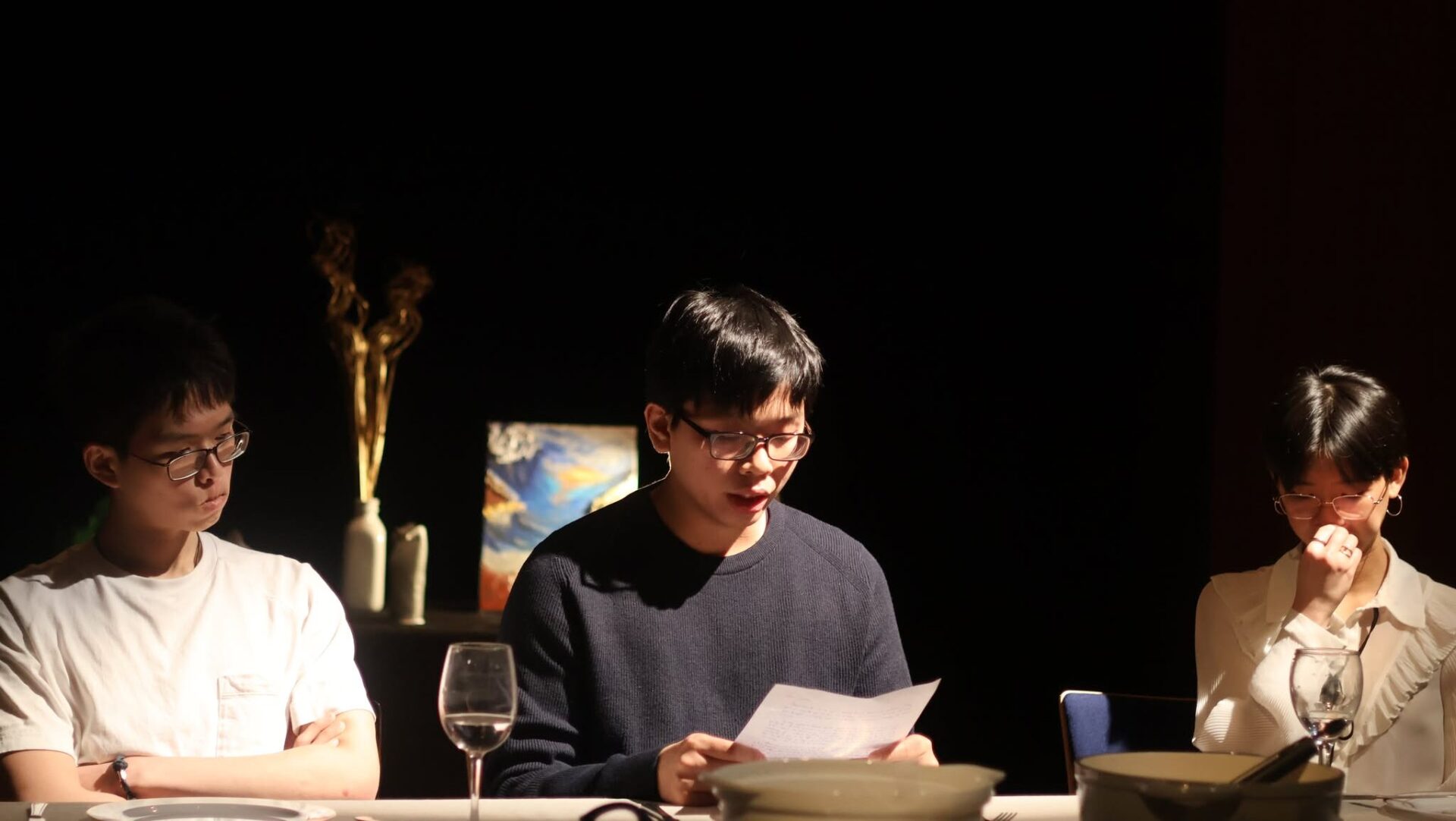
OUMSSA Theatre makes their debut with Jordan Tannahill’s Late Company. While the text originated in Canada, OUMSSA Theatre’s take on it is nonetheless entrenched in Singaporean culture. This one-act play takes place in a couple’s house, at a dinner with another family which the couple arranged in order to clear the air between themselves and this family. However, the families never truly reach a resolution, and the play descends into a confusion of homophobia, politics, social image, responsibility, and blame.
Director Garion Sim watched the play when it came to Singapore in 2019, and it was this production by Pangdemonium that inspired its choice for OUMSSA Theatre’s inaugural show. He explains how this production has been “an inspiration for how to interpret the script with a Singaporean lens and has been very helpful in shaping how we personally think of the play.” And it is this Singaporean lens which is at the crux of this particular show. Director Natalie Tan explained how the script encourages the production companies to adapt the script and make it more local. She uses the reference to a “pride parade” as an example; in Singapore, there aren’t Pride Parades as we know them in the UK. Instead, there is “Pink Dot”, an event which celebrates the “freedom to love”, and originated in support of the LGBTQ+ community. However, this particular term raised the issue of balancing the non-Singaporeans in the audience with the company’s Singaporean roots, since Tan was unsure if those outside of OUMSSA would grasp this reference. However, the Singaporean resonances remain evident in all parts of OUMSSA Theatre’s interpretation of this script. Sim believes they even transcend the content to enter into the style of the text, citing “the fast pace, family politics underneath a veil of niceness […] is a style present at every tense Chinese New Year dinner that is immensely relatable that we hope to capture in the play.”
Social dynamics are a crucial aspect of this play. The cast were tasked with the difficult challenge of both performing their characters, and then also performing the social performances and masks that these characters wear. They successfully conveyed the stilted awkwardness of unspoken social tension in the opening scenes. Nicole Tan as Tamara gave a particularly witty performance, with her ill-placed comment about “breast-milk” heightening this awkwardly tense atmosphere. Tan explains how she “can definitely empathize with the side of [Tamara] that says things which break typical social norms, sometimes out of nervousness.” While this trait is something which “took a long time for [her] to learn to love”, it is nonetheless part of what makes playing Tamara so enjoyable for Tan.
Additionally, the presence of the audience adds another layer to the sense of social performance. Yet Sim doesn’t believe this audience are just passive observers to the action. He sees the audience as “an unwilling judge for both families” yet in other ways, it is also “voyeuristic in nature, staring through the window into the house […] as they struggle to defend and rationalize their actions.” The domestic setting of this play does feel natural and yet somewhat violated by the presence of the audience, since this presence necessitates that everything must face outwards, in the end-on formation of the Corpus Christi Auditorium. I was able to view the set up close in all its minute detail, which contributed to the “lived in” feel of the space. The set is laden with art, both canvases and sculptures which, assistant director Grace Yu explained, were made during an art session with OUMSSA. This gives the show a bespoke feeling and acts as a reminder of the wider community behind the production, interpolating the Malaysian and Singaporean students into this production in a variety of ways.
Sim also explains how “in current rehearsals we are very focused on movement […] trying to get the actors to interact with the set more as well, and truly act like this is a home.” This was conveyed during the rehearsal, when Nicole Tan and Meira Lee slipped out of their characters to discuss the specificities of their movements around the dining table. In a way, this also felt like an education in such social cues and showed how deeply ingrained into the play itself social performances and perceptions are.
The OUMSSA community have thrown themselves behind this play, yet it hasn’t been an easy ride for this first time production company. Nonetheless, Late Company is shaping up to be a deeply layered show. Natalie Tan described it as “a play of discovery”, with a slow release of information that gradually alters our perspective as we learn more about the play and its characters. OUMSSA Theatre’s adaptation provides a cross section into a Singaporean household, and it is this quintessential Singaporean nature that makes Late Company feel refreshing – a taste of home for OUMSSA, and a glance across to another culture for the rest of the student population.
Late Company runs at the Corpus Christi MBI Auditorium from 6th March – 8th March.