

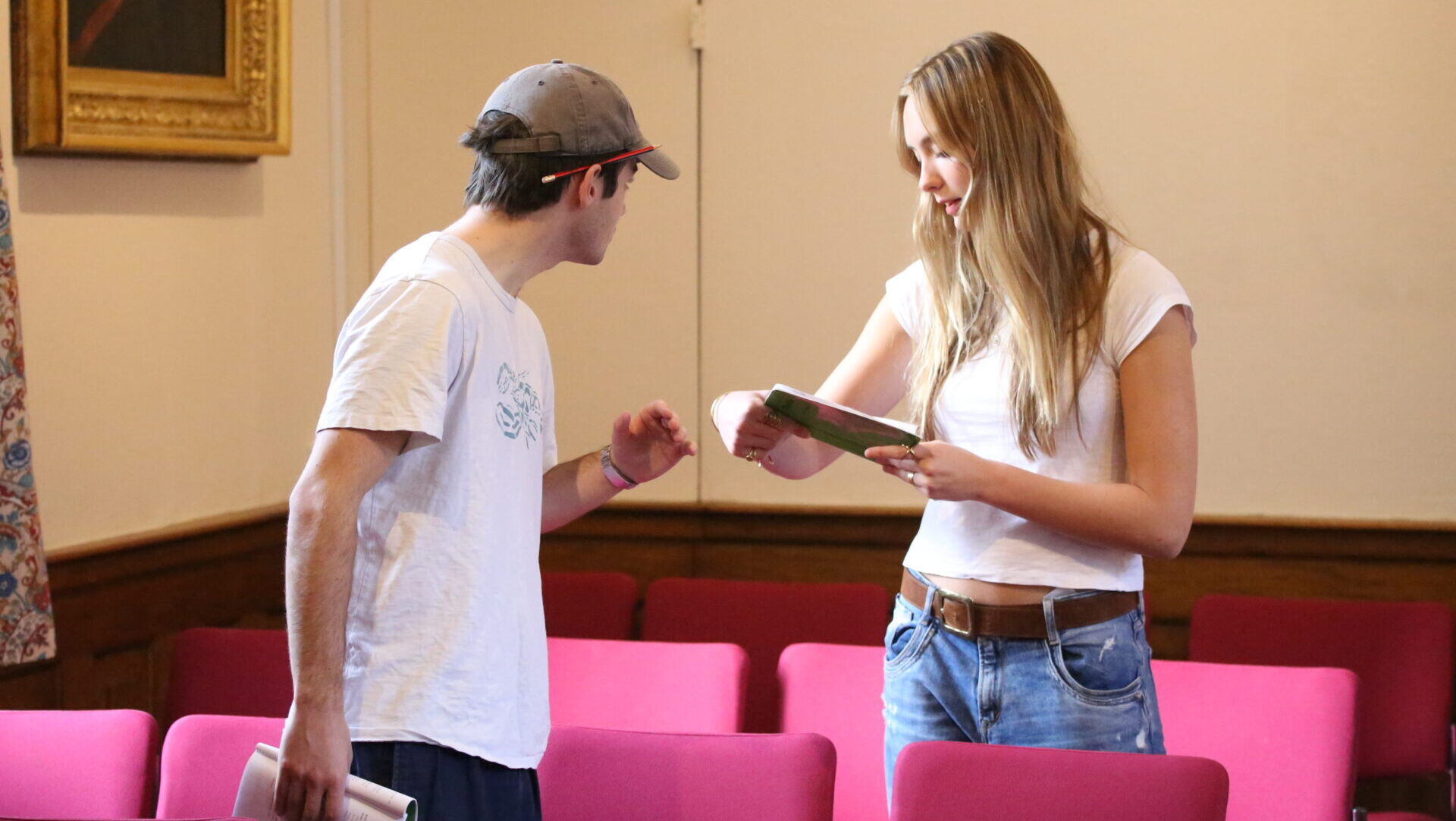
After their vibrant staging of Company at the Oxford Playhouse earlier this term, Fennec Fox Productions are set to return next week with a run of The Flick (2013) at the Burton Taylor Studio. Annie Baker’s Pulitzer Prize-winning drama follows three underpaid cinema attendants negotiating quotidian trials and tribulations as they rehearse the tedium of their service jobs. I sat down with Joshua Robey, the director, to discuss what it was about the play that appealed to him so much.
Robey tells me that The Flick is a play he’s been considering for a long time; he’d previously encountered it in an academic context, but was drawn to it as “the most naturalistic thing I’ve ever done”. For Robey, the play’s affective power lies in its subtlety, featuring compellingly understated dialogue, and focusing in on the minutiae of character interactions. Within the play’s idiolect, there is “so much unspoken subtext”, such that “every moment is rich with what’s not being said.”
After the expansive and well-equipped stage at the Oxford Playhouse, this production’s venue, the small-scale Burton Taylor Studio, might threaten to raise more than a few logistical restrictions. Yet the production promises to mine the venue for all its potential by means of somewhat unconventional staging. In order to reproduce the cinema setting, the action of the play will take place on the seating racks, with the audience positioned centrally on the stage. This arrangement is just one of the ways in which the production seems to thrive on fostering a close, yet subversive, connection between the audience and the onstage characters.
The thematic concerns of the play are ultimately well reflected by the venue, harnessing what might have been a disadvantage to enrich the play’s emotional matrix. The intimate space, in combination with the limited cast, facilitates concentrated access to the characters as they lay bare their psyche, generating an atmosphere that Robey calls “claustrophobic in a good way”. Bound as it is by dramatic unity, the play is fundamentally absorbed in characterisation, paying close attention to the nuance of human dynamics.
The Flick demands a different kind of attention from its audience, asking us to detune from the overstimulation of life to zero in on the compelling moments of quietude. The play’s action is slowed down by the mechanics of reality – silences are deliberately drawn out as the cinema is swept, and trivial conversation immerses you in the stasis of the characters’ everyday, producing what Robey describes as “a heightened form of realism”.
The play’s script, first performed in 2013, bears the inevitable contours of a society still weighed down by the effects of the 2008 financial crisis. The focus on the petty betrayals among the cinema employees is set against a background of widespread disempowerment, a failure of trust in the mechanisms that structure working life. Nor are these concerns frozen within their original context. The continual resonance of such themes is illustrated by their application to, say, the fraught state of graduate employment and the enforced monotony of service jobs in an environment where capitalism systematically de-skills all of its labour. The narrative may, then, resonate with a potent reflection of the artistic cost of this.
For Robey, the play explores “how difficult it is to care about others when self-preservation is so necessary”. Yet in spite of these tensions, testing the limits of human empathy, he maintains that the narrative is ultimately about “solidarity”.
Robey seems to approach the play as an exercise, comparing the process to restoring a painting: for him, the emphasis is on lifting out what’s already there, uncovering the play’s essence rather than smothering it with additional brushstrokes. While directing is usually an additive practice, he explains, with The Flick, it became “a process of winnowing”. Robey describes the play as one that sits and rests in the imagination. It resists playing up the emotion, and won’t necessarily devastate its audience in the moment, but lingers and accrues impact through retrospect.
Towards the end of our conversation, I decide to torture Robey with the question most excruciatingly reductive for a thespian: how would you describe the play in three words? After offering a literal answer – “cleaning up mess” – he settled on “popcorn, betrayal, connection”, the core components of every great narrative. Expect innovation, unorthodoxy, and “a rewarding challenge for both cast and audience”. This is a play that will slowly creep up on you, grip you, and excite you. See you at the movies.
‘The Flick’ runs at the Burton Taylor Studio from 10th-14th March.

 at the Burton Taylor Studio.)