

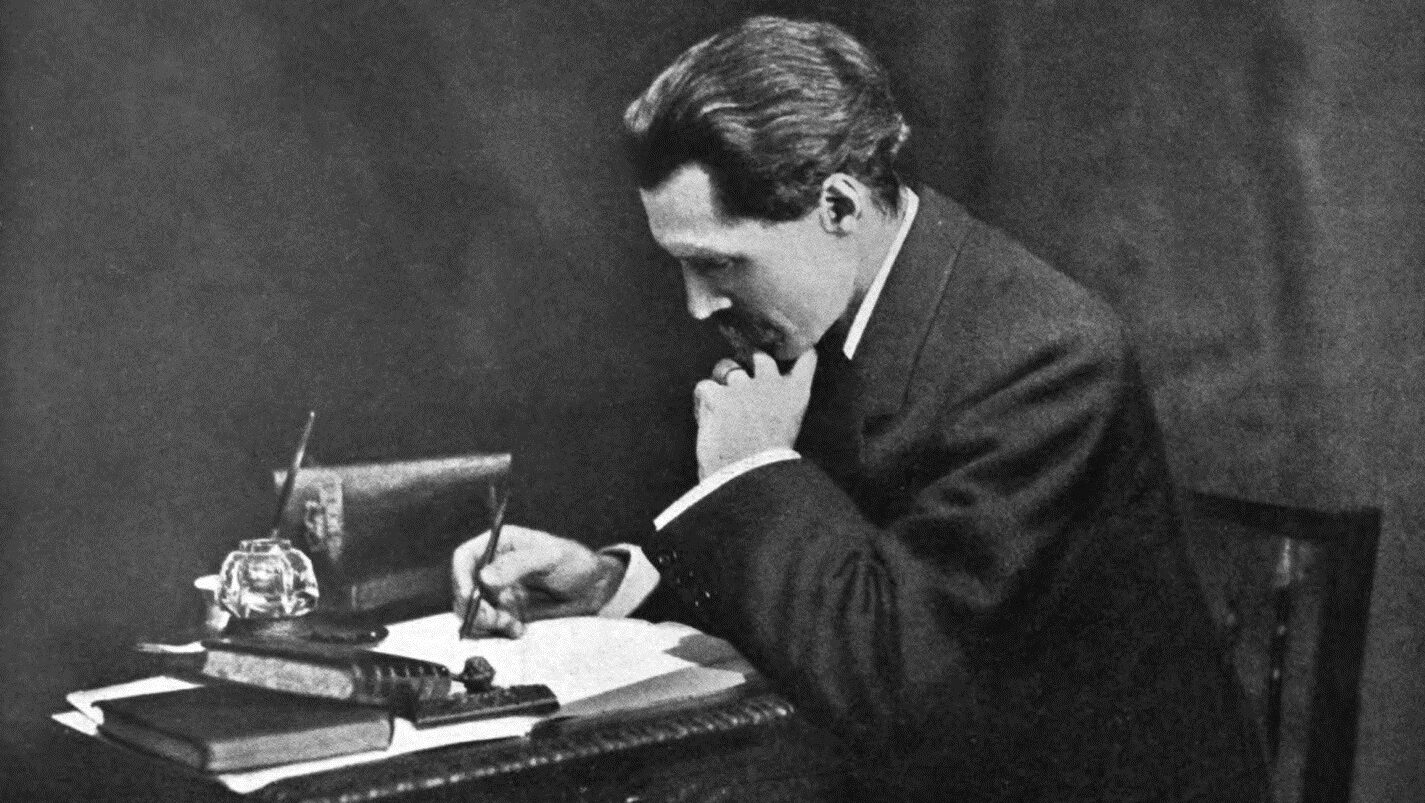
George Gissing won a scholarship to Oxford in the 1870s, but was unable to take up his place, having landed in jail for stealing money to help a prostitute whom he later married. He was released after a month and exiled for several years to the United States. The rest of his life, and his entire career, grew out of the crater of that first disaster.
The 23 novels which Gissing published between 1880 and 1904 provide a rich panorama of the slum-dwellers, labourers, prostitutes, shopkeepers, businessmen, clergymen, housewives, scholars, journalists, suffragettes, Grand Tourists, politicians, and aristocrats of 19th-century England. His short stories have largely been neglected, but this three-volume edition from Grayswood Press – the first exhaustive collection of the stories – is intended to correct that. It succeeds brilliantly. These three handsomely bound, luxuriantly printed volumes contain a total of 103 stories – over 1,000 pages of George Gissing content – and show him to have been a master of the short story. Volume One contains stories which Gissing wrote for newspapers while in exile in the United States after his time in jail. Volume Two mostly contains stories and sketches which were commissioned to give a picture of London and English social life. Volume Three, which finds him at the peak of his powers, contains the very best short stories and the ones which have previously gained much wider recognition.
Both Gissing’s finances and his love life were extraordinarily messy. His first marriage to an abusive prostitute ended with her early death; his second wife, with whom he had two sons, went mad and they separated; and as soon as he met the love of his life – Gabrielle Fleury, who had translated his novels into French – he died of tuberculosis aged forty-six. When, in a letter to a friend, he described the focus of his work as being “with a class of young men distinctive of our time – well‐educated, fairly bred but without money”, he was clearly describing himself. The sense of dislocation, of belonging neither to one class nor the other, and its impact on his personal life, is strongest in his novel Born in Exile – a study of ambition, hypocrisy, and class hatred – in which an arrogant, upwardly mobile atheist intellectual, ashamed of his humble origins, masquerades as a clergyman in order to marry the daughter of a wealthy religious scholar; eventually he is exposed and dies alone in exile in Europe. Tellingly, Gissing was also obsessed with the ancient world, and his lifelong ambition was to become a classical scholar.
If this all sounds like it would have made him slightly insufferable, it also charges his fiction with a rich psychological complexity. The isolated, ill-fated young man of his novels appears repeatedly in the short stories. ‘Christopherson’ is about a bibliomaniac who once owned 24,718 books, lost everything in business, and continues to squander his tiny remaining income on obsessively hoarding books. ‘The House of Cobwebs’ concerns a young novelist and the friendship he strikes up with his eccentric new landlord. ‘Topham’s Chance’ is about the crafty escape of a disgraced university graduate from his employer, a semi-fraudulent correspondence tutor.
In The Odd Women Gissing had written harrowingly about the plight of women in Victorian Britain, and his female characters, more than those of most male writers of his generation, possess real agency, as can be seen in stories such as ‘Fleet-Footed Hester’, about a teenage girl in Hackney who wants to be a runner, and ‘Miss Rodney’s Leisure’, about a young university graduate who emblematises the intelligent, determined New Woman of the 1890s.
Also in evidence is his rare sense of humour, as in ‘A Freak of Nature’, about a bored middle-aged man who goes to the country and plays several practical jokes by impersonating his employer. More in character is his bleak masterpiece, ‘The Day of Silence’, the story of a wharf worker and his wife and their seven-year-old son who try to enjoy a summer weekend; the father and the son go boating and drown in an accident; the mother collapses and dies due to heat-induced illness. Gissing was not a cheerful writer.
As well as characters and incidents, he was extremely adept at descriptive writing, especially at evoking the squalid, decaying atmosphere of the London slums in which most of his early novels are set, and which gives his books such value as social documents.
Many of these stories are just sketches of a character or a group or a single incident and, rather than building momentum towards something, they trail off quite inconclusively. Largely absent are the laidback style, colourful observations, and deft construction of his more famous contemporary Kipling. (As it happens, Gissing loathed everything Kipling represented, and his late novel The Crown of Life is notable not only for its scalding attack on imperialism but for its uncharacteristically happy ending). Gissing’s occasionally bland prose, too, becomes more of an obstacle in stories of three or four pages than in novels of three or four hundred pages, where the structural mastery of the whole and the sustained delineation of character amply compensate for the dry surface.
Gissing as a writer is more than the sum of his parts, and his short stories, with exceptions such as ‘The Day of Silence’ and ‘Christopherson’, are more rewarding as a whole than they are individually. Together they provide a bustling mosaic of Victorian England which is as valuable as any one of his best novels. This three-volume set is indispensable for the library of anyone who cares for 19th-century fiction or for harrowingly realistic accounts of poverty, loneliness, and failure.
George Gissing’s Collected Short Stories, Vols. 1-3, edited and introduced by Pierre Coustillas, are available now from Grayswood Press.


