

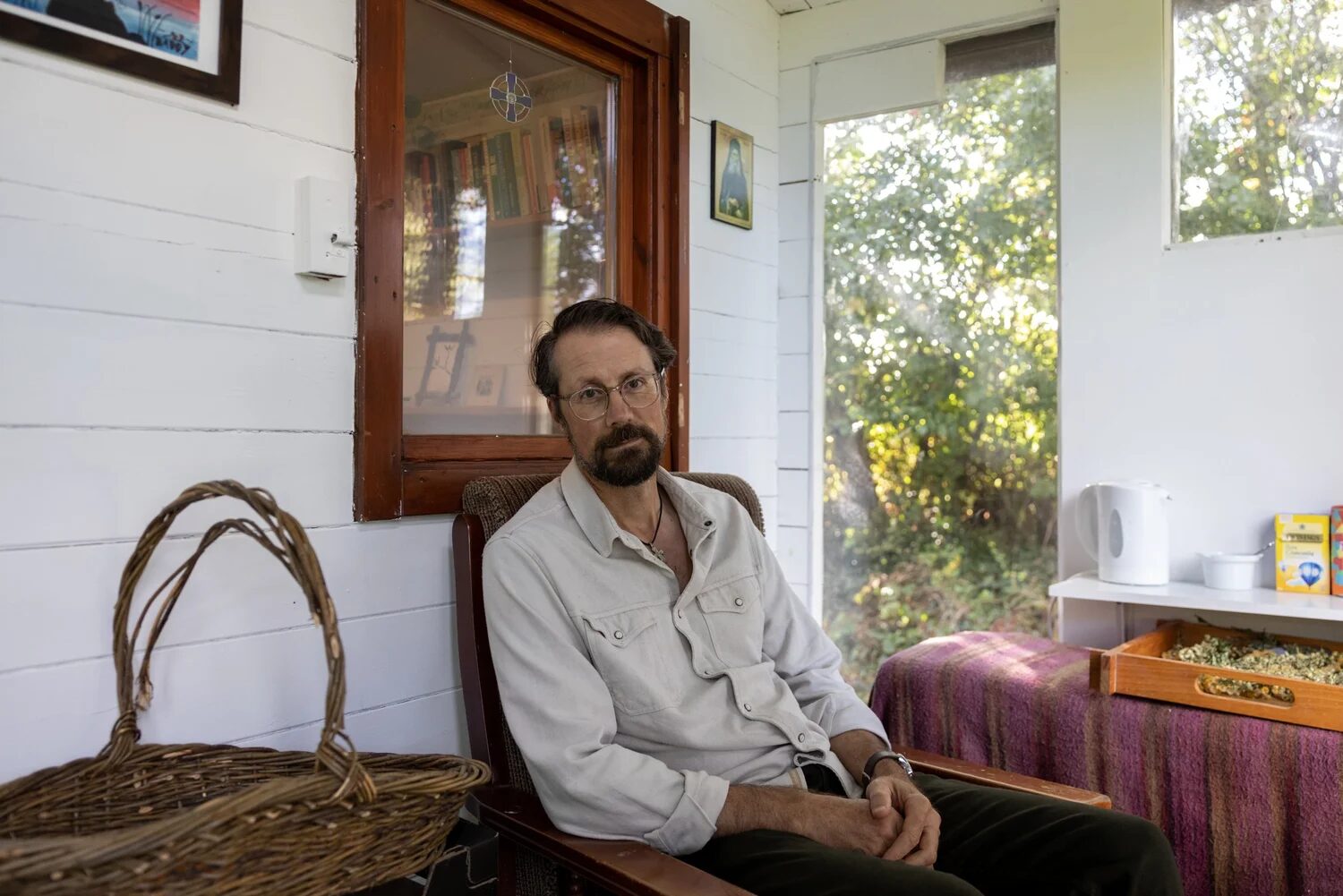
Paul Kingsnorth is an English writer and perhaps the most astute critic of technology’s impact on society writing today. I met him over Zoom, calling from his smallholding in the west of Ireland to discuss his latest book, Against The Machine: On the Unmaking of Humanity. He edited Cherwell himself back in the early ’90s while studying History at St Anne’s College – “back in the Ice Age,” he jokes – and remembers late nights “desperately trying to lay out pages” on a desktop computer. “I would’ve been very excited if you told me when I was the editor that I’d be being interviewed by the paper one day”, he says with a smile.
In a former life – which included an arrest for chaining himself to bridges at Twyford Down – he was an environmental activist, deputy editor of The Ecologist, and even named one of Britain’s “top ten troublemakers” by the New Statesman. In January 2021, after a lifelong spiritual journey involving both Buddhism and an “ill-fated foray into Wicca”, he was baptised into the Romanian Orthodox Church at a monastery in Shannonbridge. Now farming in rural Galway using traditional methods, Kingsnorth writes about Christianity, technology, and how what he calls “the Machine” is busy unmaking humanity while we’re too distracted by our screens to notice.
His latest book, which he has described elsewhere as his magnum opus, lays out his main thesis on the impact of technology in greater detail than ever before. It is an attempt to pin down something he believes has been growing for centuries – what he calls “the Machine”. Even now, he admits, something he finds difficult to define in a sentence, “which is why I ended up writing a 300-page book about it”. Having said this, he does an admirable job for my sake:
“What we’re looking at, I think, is a kind of technological, cultural, political matrix, which has been building up for at least 300 years, at least since the Industrial Revolution, which is encroaching on us now and enclosing us, and we are increasingly enslaved to it.”
This system, he suggests, is warping both the planet and the people living on it: “We have a technological, digital superstructure, which we can’t live without, which everything is dependent upon, which is eating away at the natural world, destroying the oceans and the climate and the metals under the ground in order to feed itself. And it is creating a particular way of seeing, a very rationalist, very left-brained way of seeing.”
The implied endpoint of this, Kingsnorth suggests, is that “we all get to live forever, we have conscious machines to serve us, we have robot servants, we can replace our bodies. It’s technological utopianism, and it is infecting everything now to such a degree that we almost can’t see it. We’re like a fish in water”.
Central to his analysis is what he calls the “progress trap”, a concept he borrows from historian Ronald Wright. “You create something that makes things more convenient and simple, but then that creates a load of other problems, which you then have to solve using more progress, usually more technology. And the further you go into that system, the more trapped you are within the technological matrix.”
He gives the example of post-war industrial farming: nitrogen fertilisers and pesticides produced abundant food and population growth, but then came soil depletion, insect collapse, and ecological crisis. The population boom meant there was no turning back: “You’ve got millions more mouths to feed… so you can’t go back to farming as you were before at a lower intensity.” As a result, “most of those problems can only then be addressed by new forms of intensive technology, because you can’t go back to living simply… You go further and further and further into the trap”.
AI, he argues, exemplifies the “progress trap” perfectly. “What’s AI an answer to? What’s the problem it’s trying to solve? Nobody seems to know. It’s gonna create mass unemployment. It’s gonna cause a reality collapse where we don’t know what’s real.”
In an age where political discussion can increasingly feel like a kind of team sport, Kingsnorth’s work is striking for evading easy political categorisation. He’s written for The Guardian, The Spectator, and The New Statesman. His influences range from Marx to Roger Scruton, from anarchist revolutionaries to conservative traditionalists. “I genuinely don’t fit into any obvious political category that is around. I can look at the conservative right, and I can agree with them on a lot of stuff, and I can look at elements of the left and agree with them on a lot of stuff… I don’t think that that’s contradictory, because the politics I’m talking about is the politics of scale and place and roots, and that crosses the boundaries.”
Accordingly, the book draws from a wide array of thinkers from disparate movements, weaving a variegated yet surprisingly coherent tapestry of thought. “It is eclectic”, Paul agrees, but “it does all fit together. If you’re a tribal thinker, you look at a book like this, and you think, ‘this guy’s all over the place. It doesn’t make sense. Is he left-wing or right-wing? I can’t work it out.’ But if you’re thinking in terms of the politics of the Machine, or the politics of refusal of the Machine, then it all fits together perfectly”.
The problem, he argues, is that “particularly in the age of social media, everybody is extremely tribal about their politics. So we have to be progressive, or we have to be conservative, or we have to be reactionary. We have to love Trump or hate Trump. There’s no room for nuance”.
His response is to try to “keep above it” and look at the bigger picture: “The Machine rolls on, and it absorbs the left, and it absorbs the right… You can all continue to have your tribal fights, but in the end, we’re still all rolling towards technocracy. We’re still all rolling towards the AI god. The world is still being run by Peter Thiel and Elon Musk, and I don’t really care whether they’re conservative or liberal. It doesn’t matter.”
This leads him to one of the book’s most memorable formulations: “We have a culture war because we don’t have a culture.” Without genuine local culture or shared spiritual foundations, he argues, “we’re just slaughtering each other over transgenderism or immigration or whatever, in a way that doesn’t even solve those problems, but just allows us to have these huge identity battles so we can feel like we’re in the right tribe and we’re fighting off the wrong tribe”.
Social media, he insists, is the accelerant. “We wouldn’t have a culture war if we didn’t have social media. It’s not to say that the issues wouldn’t be there… But you wouldn’t get this relentless tribal hatred of everybody else without social media.” The algorithm feeds you increasingly extreme content, be it from the right or the left, “and you end up coming out of that very angry, and hating whoever you’ve just been told to hate on the other side. And meanwhile, all the money’s going to Elon Musk and Peter Thiel… and you’re not closer to solving any of society’s problems”.
There’s an obvious irony to Kingsnorth’s position: he writes about the dangers of the Machine while using Substack, featuring on podcasts and maintaining a website. It’s a contradiction he’s fully aware of.
“There’s no escape from the Machine because we’re all entwined in it now”, he says. “I think it would be almost virtually impossible to live without an internet connection now… In quite a short time, in 20 or 30 years, we’ve seen the construction of this society where we’re all supposed to do everything online. Everything’s online, from your banking to your pension, to getting on a flight, getting on a bus, buying a ticket, going to a concert.”
His own response has been to draw clear boundaries. He doesn’t have a smartphone. He doesn’t use social media. “I have to write online because otherwise I wouldn’t have a career… So you just have to do your best to draw up a set of principles that you’re gonna stick by.”
Thirteen years ago, he and his wife moved to Ireland with their young children, settling on two and a half acres in the rural west of the country. They home-schooled, grew their own food, cut grass with scythes. “We wanted to be as self-sufficient as we could. So we’ve done that. We have some polytunnels and veg gardens and chickens and ducks, and have a little orchard, and grow as much firewood as we can. It’s a good place to hide. I can kind of make forays out into the world and then come back home to my little retreat.”
For students, his advice is blunt: “If there’s one thing people can do to resist the Machine, it’s to get rid of their social media accounts, and that is easy, and it’s possible, and you don’t actually need them. Especially when you’re a student.” After taking the leap, he says, “you’re gonna feel much better, and you’re gonna suddenly realise that you’ve been heavily manipulated into these tribal groupings”.
Despite the increased presence of technology and social media since his own student days, he’s encouraged by what he sees in the younger generation. “I meet a lot of young people doing my book tours…loads of whom have just refused to have smartphones, because they’ve grown up in this whole technological matrix – can see it quite clearly in a way that sometimes older generations can’t.”
His advice extends to practical career choices too. “If you’re gonna get jobs in the future, if you’re gonna work, you want to do something that can’t be replaced by an AI. Do something actually practical.” His daughter who, he says proudly, “is more of a Luddite than I am”, is about to study bookbinding. It’s a fitting profession: conserving physical objects that will last, a tangible craft that – at least for now – big tech cannot replace.
For some, Kingsnorth’s conversion to Orthodox Christianity might seem like a radical departure from his environmental activism. He sees it differently. “Everything I’ve ever done really has been, I suppose… a spiritual search, if you want to use that word, and I wouldn’t have used that word when I was younger… I wasn’t an activist because I wanted to reduce carbon emissions… That’s a good idea, but for me it was always something unnameable that was being destroyed. You know, if you are destroying the natural world, you are destroying a place that you shouldn’t be destroying because it’s full of biodiversity and the rest of it, but you shouldn’t be destroying it because of how good it is for your soul.”
He had “profoundly spiritual” experiences in nature as a young person and came to see “something inherently sacrilegious about destroying a rainforest or ripping up an old hillside or destroying an ancient monument, quite apart from all the utilitarian arguments”. “You come back to that question that we came to earlier, which is: what does it mean to be human? And how should you be living on the Earth? And is there a God?”
His move to Ireland created the space for this spiritual journey. “I don’t think I’d have become an Orthodox Christian if I hadn’t moved to Ireland… even though these days Ireland is very modern and progressive and all that, it’s still, under the surface, very Christian in its landscape. It’s covered in holy wells and ancient monastery ruins.”
Kingsnorth’s next project is The Book of Wild Saints, a collection of stories about Christian saints who lived as wilderness ascetics, illustrated with woodcuts by Ewan Craig. “I’m trying to write about the wilderness tradition in Christian spirituality… trying to lay out the stories that so few people know about, about these kind of wild ascetics of Christianity.”
After that, possibly a return to fiction. “After doing something like Against the Machine, which is this great big intellectual exercise, I need to go and do something more creative again.”
Recipient of the Gordon Burn Prize in 2014 for his novel The Wake, Kingsnorth came to Oxford as the first in his family to attend university. “I assumed everyone was gonna be much cleverer than me, and I’d immediately get found out”, he recalls. “And there definitely were a lot of people much cleverer than me, but actually, not as many as I thought, so it was fine.” He met his wife on his first night at St Anne’s, in the college bar, though he adds with a laugh that “there was a lot of on and off over the years”.
It was at Oxford that he first realised he wanted to be a writer. “Coming from the kind of background I came from, I didn’t know any writers. Writers were this kind of glamorous species of people that I’d never met.” Working on Cherwell gave him confidence. “I just realised I liked it. I was able to do it, and I did it a lot, so I got fairly good at it.” Oxford was also where he discovered activism. “I wanted to combine my writing with my politics and kind of write to save the planet. That’s what I wanted to do when I was sort of 19, 20.”
But writing, he says, “is just the way that I understand the world. I can’t really imagine not doing it”.
For a writer who tackles such an all-encompassing topic with great eloquence and erudition, Kingsnorth is refreshingly humble regarding his work. The aim of Against the Machine, he says, is not to provide a manifesto or a global plan. “It’s an attempt to analyse what’s going on around us… I want people to read the book, come away from that understanding my analysis, and then they don’t have to agree with it”, he says cheerfully, “you can argue with all of it if you want to”.
“It’s profoundly anti-human, the direction of things. And so I’m just trying to kind of raise a flag for humanity again, I suppose.”