

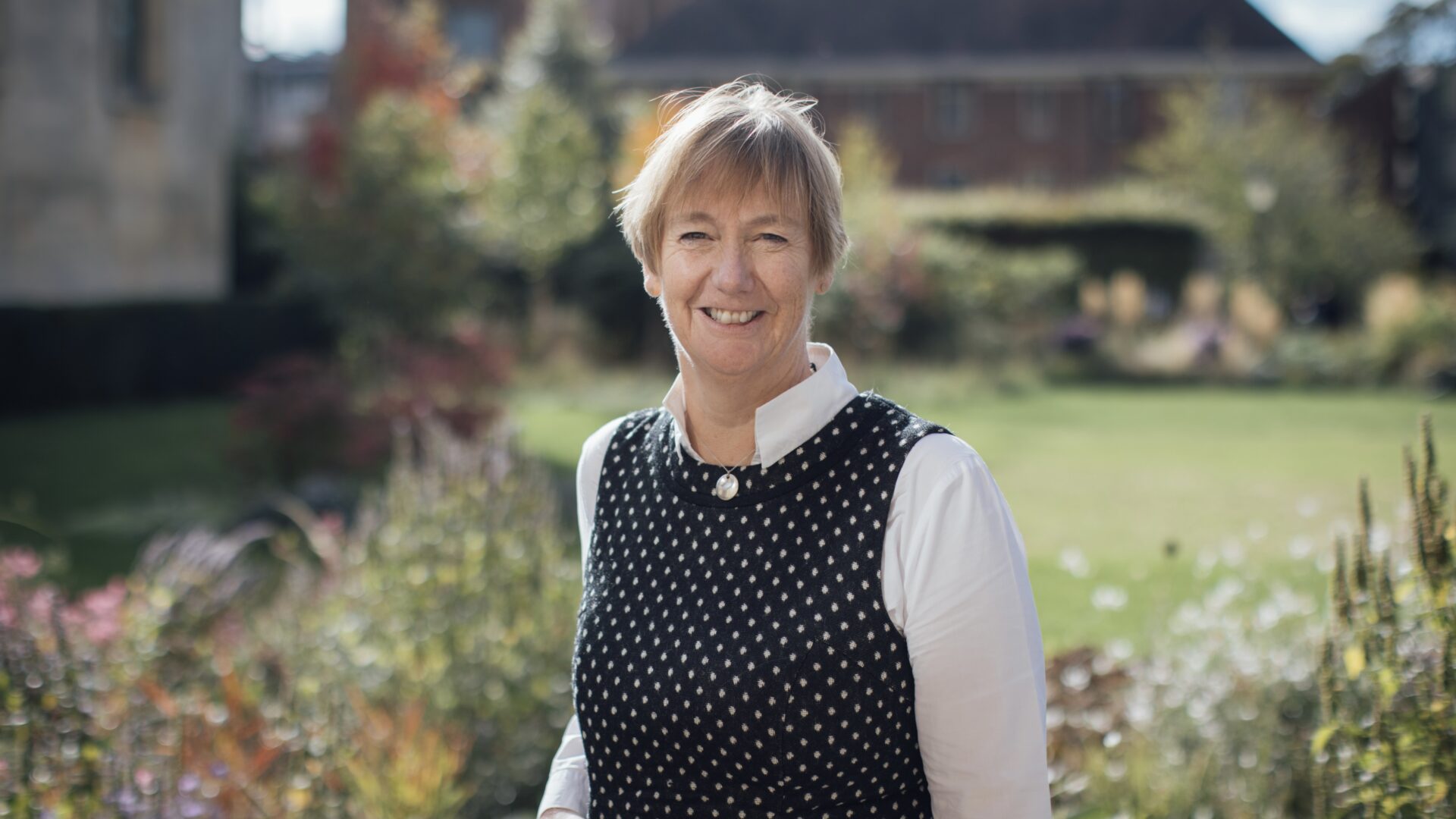
Sitting at a table in a sunny Somerville office, I get out my phone and ask Catherine Royle: “Do you mind if I record the interview?” I receive a diplomat’s reply: “I suppose not, but it will make me say different things, you know that? I have a lifetime of never saying anything you don’t want to see in print.” From the outset, it’s clear that Somerville’s principal continues to be shaped by her unique diplomatic experience. A career spent in the Foreign Office and then NATO means that Royle has lived all over the world, from Chile to Venezuela to Afghanistan. “I worked it out; until I got here, since 1997 I’d really lived in Britain for three years”.
Royle is a Somerville alumna, having studied PPE there before completing an MSc at Aberystwyth. She speaks of applying to Oxford with a casualness common to many students, yet I’m surprised by her modest dismissal of the barriers that she overcame. Her sixth-form experience at a newly converted grammar-to-comprehensive school was, she admits, “a bit of a mess, to be honest”. Her initial application to Merton College was (unbeknownst to her) doomed to fail because of “a philosophy tutor who didn’t agree with the college going mixed. He never let any women in”.
It’s clear that her time at university after being “picked up” by the then all-women’s Somerville was formative. She describes the unique experience of being surrounded by “exceptional” women, especially Daphne Park, the principal of the College at the time. In those days, Park was known for her distinguished career in the Foreign Office, but it was only when Royle joined the service herself that she learnt what Park was really doing: she was a senior spy controller for MI6. It’s clear that Park, described as both “extraordinary” and “terrible”, was an inspiration for Royle, and it’s a surprise to her that their relationship didn’t end with attempted secret service recruitment. She recalls going to speak to Park to ask for permission to become the Somerville JCR president. “Daphne Park… said ‘If you do this, you won’t get a first’. And I said ‘Well, I’m not going to get a first anyway… may as well have something good on the CV’.”
We naturally turn from the inspiration of Park to Royle’s own Foreign Office career. I ask about the decision to go abroad. Whilst Catherine was certain, her family was not, with her mother seeing it as “her idea of hell”. It’s difficult not to feel overwhelmed as Royle rattles off the countless postings, locations, and responsibilities of her varied diplomatic career. Yet it’s her very first experience in Chile that she draws out as a highlight. It doesn’t sound idyllic: she was given the placement suddenly, “had to go and learn Spanish in eight weeks”, and the lack of communication services meant that “as far as my friends were concerned, I just dropped off the end of the world”. But the experience of living through a turbulent time in Chile shaped Royle’s life. “It was a very formative experience and a fascinating period. When I arrived, Chile was a dictatorship. When I left, it was a democracy”. I get a glimpse of the extraordinary life of the diplomat, where one becomes a spectator to rare, epochal moments.
Our interview takes place only a few weeks after one such moment: Israel and the USA’s attack on Iran, which started in spite of diplomatic talks. How does Royle see the role of a diplomat in an increasingly militarised world? She defends her field: “I think it’s an absolute disgrace that the Foreign Office is cut to the bone, always underfunded… If you start with wars as the continuation of politics by other means, then you do need to do something other than fight…You need people who are able to work through the disagreements between states, it is a skillset.”
The potential drawbacks of relying on military power take Royle back to Afghanistan, where she was deputy ambassador and managed co-operation with the Afghan police during the US-led military presence in the nation. “Part of the problem of where we went in Afghanistan was that the diplomatic bit of it was really undervalued. The military were pushing things and doing things, thinking ‘well, actually we’re the policy makers here’. But they didn’t know how to do it… in particular, the American military, they don’t really think about working in partnership because they don’t have to, except that, if they did, they’d do better.” Royle feels that diplomats get a bad reputation; in her view their role as pragmatic consensus builders is essential. “My aim is to make everyone equally unhappy. Because, if I could make everybody happy, well, we’d just do that.”
Royle explains how she’s brought this diplomatic approach to her current position as principal. I ask what prompted this pivot in her career back to the world of academia, especially since earlier she contrasted the fields, claiming that, as a diplomat, “you’re absolutely not a specialist, in some ways you’re the antithesis of an academic”. The story of her return to Somerville foregrounds Royle’s straightforward attitude. Already an honorary fellow of the College, she was asked if she might apply for the role of principal. “I thought about it, what an honour, obviously, and a wonderful community to rejoin. So why not? … People in NATO were saying to me: ‘Do they know what they’ve done?’ And I said, ‘well, they know me quite well. So, it’s their own fault’.”
I ask about the strange experience of returning to her previous place of study. “Walking back in, it was really weird… But the College in many ways is similar in its approach.” How was it adjusting to the role? “There’s a steep learning curve, but I can still do things that go back to my old days… funnily enough, lots of people want to talk about the state of the world at the moment. I can still scratch that itch.” Yet grappling with the complexities of the college and university relationship hasn’t been easy. “[Oxford] is reckoned to be the best university in the world. I sort of think that’s possibly in spite of its governance rather than because of its governance.” Royle talks about the opportunities and challenges of being the principal with enthusiasm rather than apprehension. “It’s really exciting to look at the next generation, to think about the next thing coming up”.
I’m curious as to how Royle’s practical approach, useful in constantly changing international situations, might fit into a slower-moving, millennia-old institution like Oxford. Yet she’s already pushing for progress where she feels there’s a need: “The government postgraduate grants for humanities and the social sciences for Oxford have been cut 93% this year. They’re offering four for the entire University… We have had a conversation about setting up a new fund to support graduates and early career academics, because they’re under such pressure.”
To wrap up our conversation, I ask Royle what she’s proudest of in her varied life. She gives two values that she’s stuck to, neither of which surprises me. “I’m really proud of the fact that I have tried to stand up for what’s right and not for what’s easy.” Coupled with that is her desire to be a problem-solver. “I don’t tend to be somebody who comes with a problem; I tend to have a possible solution. And I think that’s so much harder.”
Throughout our discussion, it becomes clear that Royle’s approach towards her role is both pragmatic and principled; a respect for tradition combined with an excitement for the future. She unwittingly sums up her attitude best in an offhand comment: “We need to keep the important values… and value the history, but not get stuck in it. That’s always Oxford’s challenge, to keep moving forward.”


