

Originality could be dead in pop music. The genre is so self-referential that it feels like an endless borrowing game, buying into nostalgia for bygone times outside of our own. Artists’ branding in the 2020s has featured copious archival fashion pulls and pop culture iconography, while dominant music trends have included the excessive sampling of throwback hits and iconic melodies. This is an unavoidable aspect of pop, and not necessarily a measure of creative lack. However, it can either give long-forgotten tracks a necessary boost of life, or appear as a cheap way to chase the ever-elusive ‘hit’.
Yet, as the decade is proving, generic boundaries are once again breaking down, with dance and electronic sounds becoming the pop standard, and people longing for artists at their most genuine. Of course, this was demonstrated most prominently by Charli XCX’s shift between the ultra-conventional Crash and the more personal and re-focused Brat. However, she isn’t the only person creating from a place of greater authenticity, over the pursuit of musical trends.
Catherine Garner, known as Slayyyter, has been chasing fame for almost ten years now. She started out making ‘lo-fi pop’ from her bedroom closet, before bursting onto the music scene in 2019 with a string of electro-pop tracks such as ‘Mine’, ‘Daddy AF’, and ‘BFF’. Though her songs all proved TikTok-popular, they never seemed to translate fully out of a chronically online space into the cultural mainstream.
Slayyyter’s previous works were great projects that felt authentic within their self-aware pastiche, but all tied themselves to various personas; the music did not necessarily represent the creative voice behind it. Their inability to produce the success she’d hoped for, even when striving for commercial viability, drove her to make a decision – her next album would be the last, one final go at being a star before she called it quits. After an edgier sonic shift in a single she dropped in 2024 titled ‘No Comma’, Slayyyter began working on her third studio album, WOR$T GIRL IN AMERICA. The first single, ‘BEAT UP CHANEL$’, was noticed by Columbia Records, allowing her career trajectory to finally change.
The album is an advent of originality, reconnecting Slayyyter to her Missouri roots and the rawer and previously unseen parts of her life, while refusing to chase trends. She focused instead on her own interests and ended up producing her most unique work, unplagued by formula. She describes it as “iPod music”, a “sweet spot of 2010s indie electronic”, encompassing songs she would’ve curated in her teenage years, when individual songs were bought and not readily available as in the streaming era.
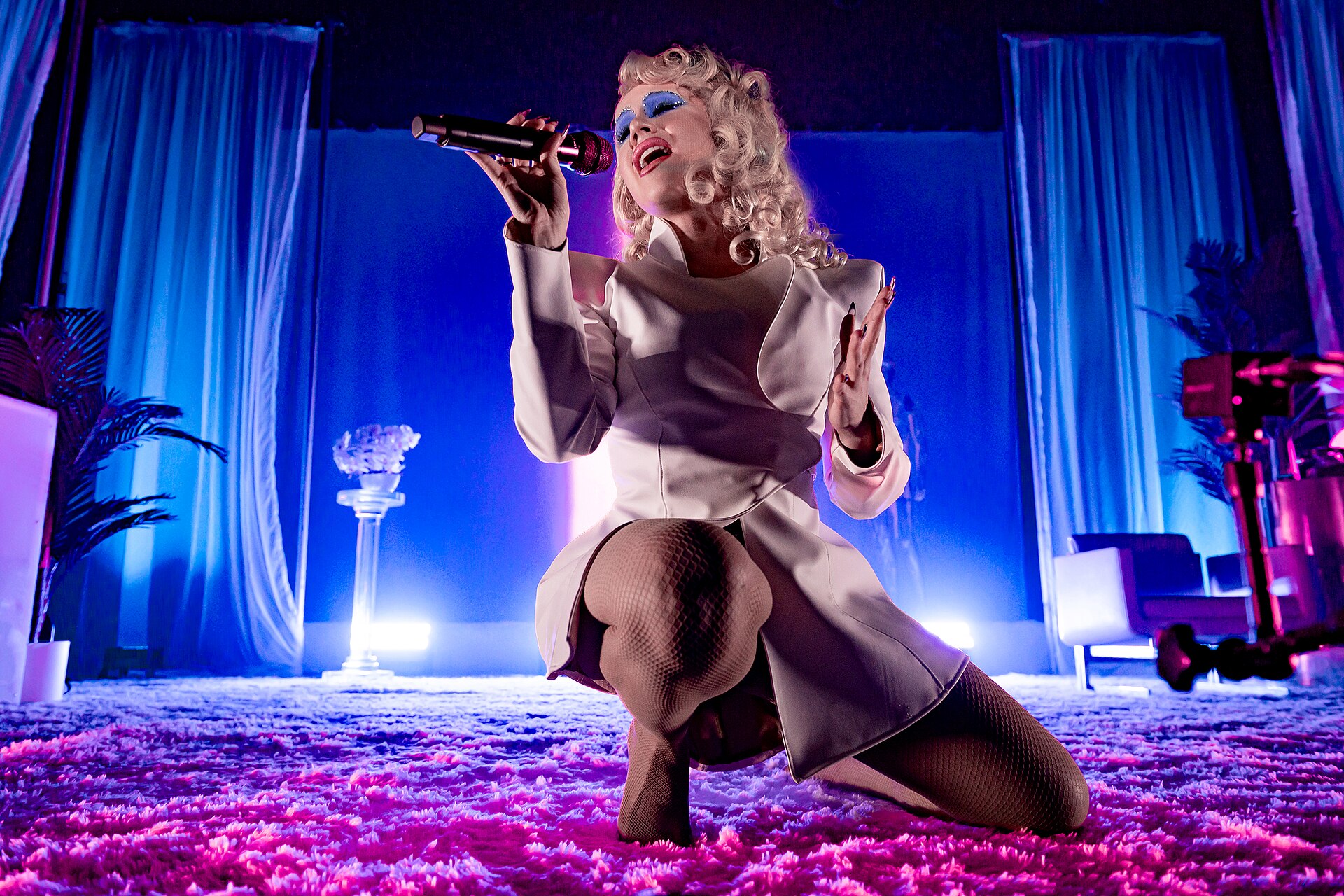
WOR$T GIRL is intrinsically tied to its DIY approach to visuals. Each song has a self-directed music video, while costumes are hand-made or utilise pieces from her own wardrobe. Nothing feels too put together; instead, it is a patchwork of influences, from her Midwestern upbringing, to Tumblr mood-boarding and her music and film literacy (note the frequency of Lynchian rabbit imagery). She is still provocative and ‘trashy’, but forgoes hyper-feminine glam and seeks imperfection, her lyricism newly exposing. This is not just an additional layer to the album, but helps to form its thesis.
The album’s cohesive through-line does not prevent it from textural layering throughout its 14 tracks. Distortion is a sonic mainstay, with songs entrenched in grime and aspiration. The album’s opening track, ‘DANCE…’, cuts in at almost five minutes, its long intro crescendoing into a thumping bassline which transports its listeners to an unrestrained club atmosphere. ‘CRANK’, ‘OLD TECHNOLOGY’, and ‘YES GODDDD’ are aggressive, the sound dialled up to 100 with maximalist production, heavy bass, and gritty and intense synthwork. Slayyyter is keen to prove her own musical capabilities, the album paring back with dreamy indie electronic as in ‘GAS STATION’, and the wistful, nostalgic ‘UNKNOWN LOVERZ’, while ‘CANNIBALISM!’ is more rock-focused but vocally driven, oscillating between screams and hypnotic crooning. WOR$T GIRL seeks out the personal and sometimes ugliest parts of success, lyrically wavering between self-assertion and profound insecurity on ‘WHAT IS IT LIKED, TO BE LIKED?’ and the satirical, spoken-word hallucinatory journey of ‘I’M ACTUALLY KINDA FAMOUS’.
There is also something personal enclosed here, best represented by the final track, ‘BRITTANY MURPHY’. Slayyyter has remarked that it encapsulates the album’s overall feeling and reflects the message she tried to get across. Its summery atmosphere and almost-robotic vocals conceal an inner depth, with the artist at her most vulnerable, as she ponders on feelings of inadequacy and suicidal ideation. The patchwork of WOR$T GIRL finally converges here, allowing the artist herself to shine through.
Maybe pop is a borrowing game, but when influences are being used like in Slayyyter’s music, it is difficult to say there isn’t still something unique to be found. Perhaps the problem is not creative pastiche itself, but the constraints of formula imposing themselves in the streaming era, making the genre so homogenous. It seems as though audiences respond far better to work that doesn’t try to mould itself, but goes against the grain through the expression of artistic freedom. In Slayyyter’s case, authenticity is the motivator, and her refusal to conform seems to be paying off.