

It has been 93 years since the first performance of Bertolt Brecht’s The Good Person of Szechwan at Schauspielhaus in Zurich. Many critics cite Brecht as the pioneer of the genre of ‘epic theatre’ – that is, a theatre which tells, instead of shows. The protagonist Shen Te frequently changes costumes in front of the audience to become her alter ego, Shui Ta; characters address the audience, changing the set mid-scene. Anthony Lau’s 2023 production featured giant frogs and saw characters entering the stage via a slide. Brecht’s theatre seeks to constantly remind the audience of where they are: in a theatre, watching a play, and not immersed in a mock-realistic depiction of the world. It rewrote the rules of what theatre had been up until that point (in the western world, at least). In 2026, both nothing and everything has changed: theatre continues to constantly re-write and re-perform itself, and thus evades any kind of all-encompassing definition.
A few years ago, donned in a light rain jacket and battered walking boots, I stood amongst a captivated crowd at Green Man Festival, watching Kae Tempest perform from his album The Line is a Curve. Their powerful, spoken-word performance both shook me to the core and rooted me to the spot. It bothered me. It was like nothing I’d ever encountered before – which perhaps reveals my somewhat sheltered view of the musical scene – but it got me thinking about the lines we draw around performance, the role of the audience, the simple idea of telling something to someone, and when this becomes theatre.
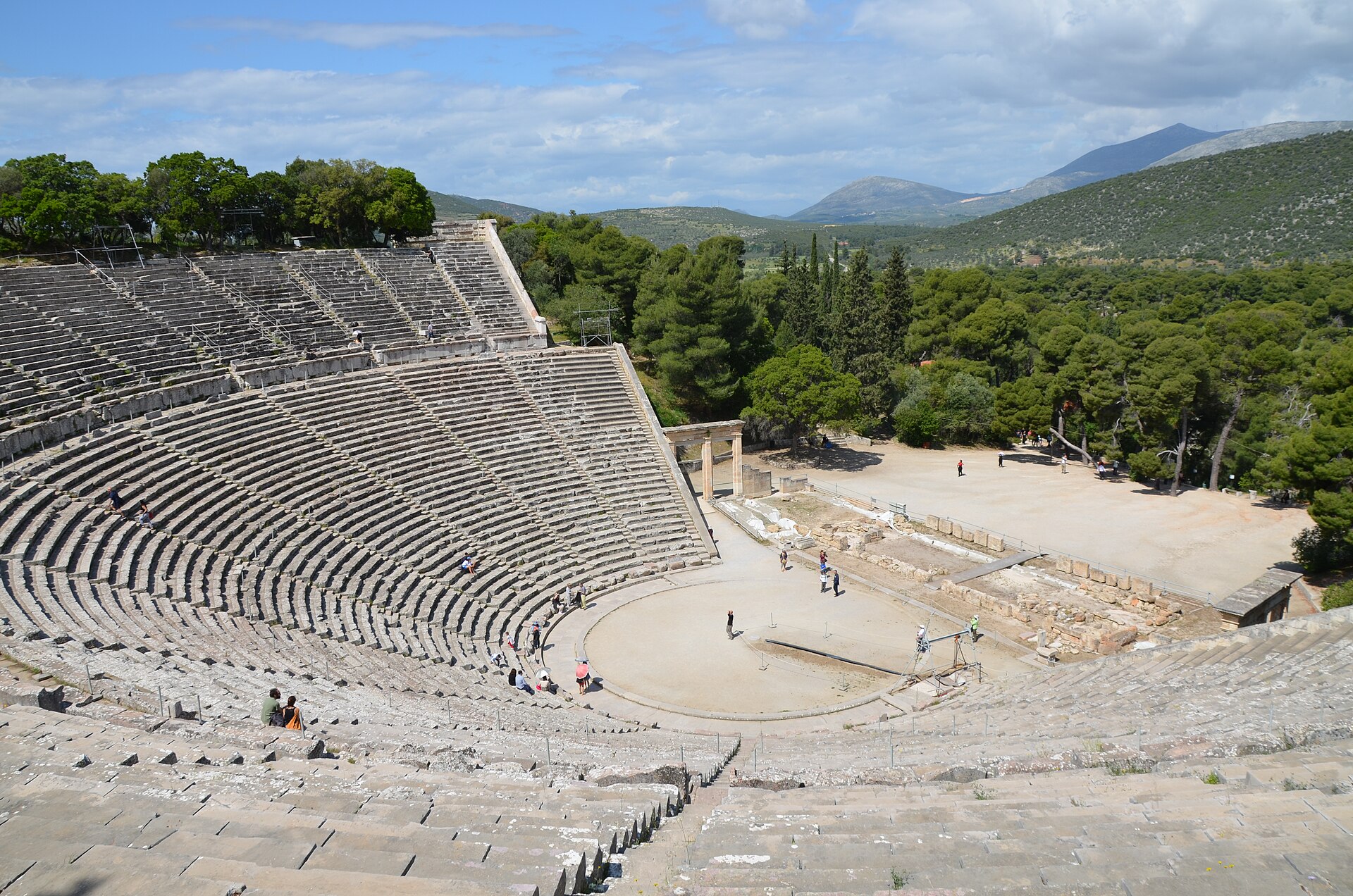
As a serial user of etymology websites, I did what I do best and looked up the origins of the word, discovering that it comes from the Greek theatron, which literally translates as ‘a place for looking’. This piqued my curiosity. To all intents and purposes, a discussion of Kae Tempest’s The Line is a Curve should be in the Music section of Culture – right? Tempest has been nominated twice for the Mercury Music Prize, as well as receiving a nomination at the 2018 Brit Awards for Best Female Solo Performer. Then again, he was also named a Next Generation Poet by the Poetry Book Society… so perhaps Books?
This impulse to categorise Tempest’s work was, inevitably, what was holding me back from fully enjoying the experience. Since that year at Green Man Festival, I’ve (somewhat) expanded the horizons of my theatrical experience and, each time, I’ve been confronted again and again with the same question of categorisation – by stand-up comedians, by drag artists, by the chorus in the Greek play I saw in my first year at Oxford. They are all connected by one fact – there was an audience, and there was a performer.
If theatre is, at its most basic level, ‘a place for looking’, then every iteration of it that I’ve mentioned ticks that box. But not all looking is the same, and this is what Brecht grappled with.
Among other things, he wanted to reject the kind of looking which is passive, which gives way to complete immersion, and, as such, does not incite the audience to action. His refusal of a ‘passive’ theatre can be seen everywhere. In a form like stand-up, the audience takes an active role, with their reaction shaping the performance in real time. Even something as simple as asking a member of the audience where they’re from, or what they do, can completely derail the show – as I discovered at a recent Mike Rice gig in Oxford, where a particularly buffed guy in the front row (think somewhere between a gym regular and Jacob Elordi’s hulking, reticent Heathcliff) became the butt of a plethora of jokes – and it’s up to the comedian to decide whether they want to detach or reroute, integrating the new material into their set. Or, the audience can be directly involved in a production itself, with aspects like karaoke and PowerPoint being employed to extract a storyline from those who are, in traditional terms, supposed to be just ‘looking’.
Oxford itself is a place full of performances which blur the boundaries of simply looking. Think of the Oxford Medieval Mystery Plays at St Edmund Hall, where last April, for the fourth year running, multiple locations around the college hosted a series of biblical plays in various medieval languages. The setting was often intimate, with audience members seated on the grass, or simply wandering in and stopping to look, even joining in at points. The idea of a fixed theatre is unsettled, and it becomes less a location than a series of encounters. Improv shows like Austentatious (which returns to the New Theatre this May) are driven by the audience, who submit a novel title which the cast then begin to perform. Student theatre often uses seemingly unconventional spaces, like college bars, gardens, and chapels, to perform experimental pieces.
If theatre seems to resist definition, then it is not because it lacks one, but because its definition is deceptively simple. The ‘place for looking’ embedded in the word itself is never neutral – it can be passive, it can be an environment where empathy is built; detached or participatory, fixed or constantly shifting, it always demands that an audience bears witness to a moment in time, it demands that they do not look away. From Brecht’s insistence on a self-aware audience in his innovation of epic theatre, to Kae Tempest’s genre-defying performances, to the improvised and experimental work which fills Oxford’s stages and spaces, theatre emerges where people gather. Perhaps the question to ask is not what ‘counts’ as theatre, but where and how we choose to look.