

For £5 (and a 42p booking fee), I found myself in a room full of theatre kids who had finally attained that cherished jewel of our modern world: a job. I first heard about Work.txt when I was asked by a friend (or coworker?) if I was free Saturday night. Being instinctively adverse to clubbing, I was, indeed, free. Unemployed, even. And this was a gilt-edged proposition I just couldn’t turn down. At the mention of the name Ted Fussell, I threw £5 (plus the emphasised 42p booking fee) of my student loan at Ticketsource, completely unaware of what I was getting myself into. All I knew was that I was expected at ‘The Place of Work’ (Lecture Room Six at New College) at 8pm that Saturday. Since punctuality is one of the traits that makes me such a team player, I met Teddy Farrand (or the receptionist?) outside the lodge ten minutes early, presented him with my ticket, and announced that I was clocking in for my shift.
Upon entry, I followed the instructions on the screen, placing the book that I was asked to bring with me onto the growing pile in the centre of the stage. I struck up a conversation with my fellow audience members, or coworkers, as we began to immerse ourselves into this bit to which we had already committed £5 plus (say it with me) a 42p booking fee. “It feels like we’re talking around a water cooler”, Rebecca Harper remarked before she mimed holding a little paper cone. We speculated about whether this would count as work experience on LinkedIn. The audience was already taking the “play performed entirely by its audience” pitch very seriously.
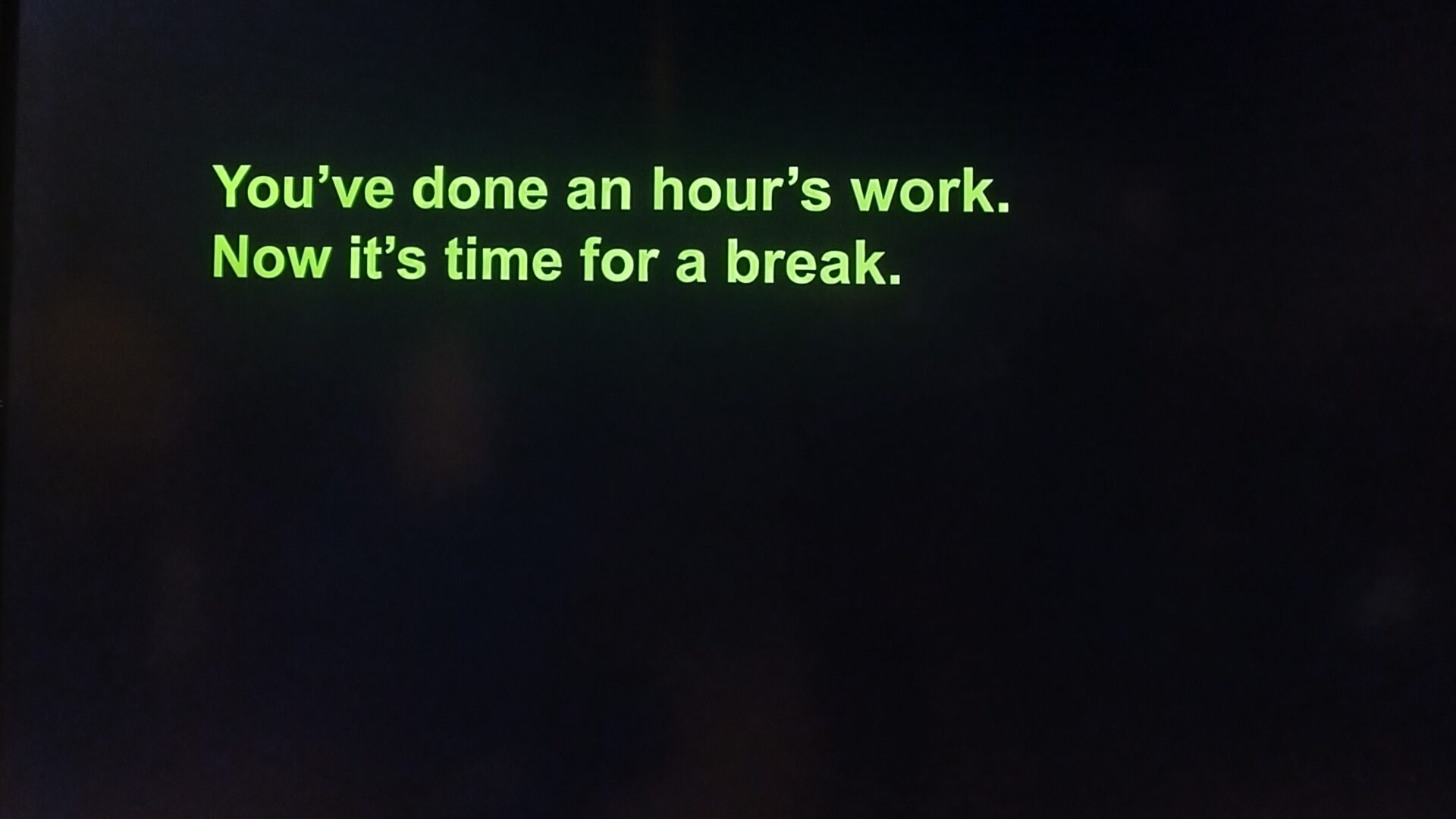
The show centred around a script-cum-PowerPoint presentation. Yellow text flashed on a black screen, encouraging either the whole audience to speak or only a specific group who had something in common. The categories ranged in specificity, from “runners” to “people who don’t sleep well”. This technique was rather revealing: you never knew whether your voice was going to be part of a chorus or if you would be reading a line alone. You could learn a lot about how your fellow audience members characterised themselves through their silences and their responses with this technique, and you shared a lot about yourself in return.
Work.txt often works metatheatrically and draws attention to its scripted nature. The stage manager’s digression about Gilmore Girls, for example, then diverged into something along the lines of “I haven’t even watched Gilmore Girls. This is just what the screen is telling me to say”. The screen could also edit your perceptions of a character trait with which you had already aligned, gradually revealing information after you had already committed to reciting the assigned script. For example, I took on the role of “a person who hasn’t said very much yet” and was caught off guard when this character then spiralled into one spouting criticism against the show. I found myself complaining that this wasn’t real theatre, that it wasn’t Mamma Mia the Musical, regardless of the fact that I (the individual, not the character) was having a great time.
The show emphasised the £5.42 ticket price as a way of pointing out the peculiarity of the fact that we had paid someone else to let us do work for them. This was likened to the structure of university; we get loans to do work that will eventually help us do more work and pay back the loans until we are sixty years old. For now, though, that £9,535 a year is only a number on a webpage, and we can forget that the drudgery of our degrees is not only self-inflicted, but something we pay for.
These more bleak illuminations were mingled alongside other excellent comedic moments, executed successfully thanks to the energy of the audience. This article would not do the show justice without a nod to the single best moment of student theatre I have ever experienced, as either cast, crew, or audience. The screen flashed up with these words on separate lines: Every. Night. In. My. Dreams.
The melancholic whistling of the opening notes radiated from the screen before us, and the slide changed into a karaoke video of Celine Dion’s ‘My Heart Will Go On’. We sang all 4 minutes and 40 seconds. Arms swayed. I turned to the others in my row and began to dedicate my performance to Maggie Kerson, who likewise responded with a dramatic air grab, as she informed me her heart will, in fact, go on. We turned our phone torches on and waved them in the air. It was a live concert on a small scale, but the energy could have filled Wembley Stadium. I choose to believe that this was an accurate reflection of the corporate world, that each working day is punctuated by the collective belting of 90s pop classics.
At the end of the play, the humour melded with an unsettling bitterness. It jumped from the subtle commentary on the working world and our place within it, not as human beings, but as employees, and shifted to a more blunt, bleak outlook of the world. Our main character and fellow audience member, Holly, lay on the floor and told us all the reasons she wanted to “stop”. The printer, which had been inconspicuously set on a table in the corner of the room for the duration of the play, then took over as the narrator, providing an epilogue. This speech moves beyond the end of the working day and blends cosmic existentialism with meaningless corporate speak. It tells us about the destruction of the natural world, the death of the human race, yet the persistence of work nonetheless. “God tries lateral thinking”, the audience is told. “Sound gets put on a zero-hour contract.” It was bizarre yet depressing to hear this workplace jargon being applied to the world beyond humanity. The universe became a workplace, striving towards nothing in particular. It was a reminder of how far we have come from where we started as part of the natural world, how we have produced our own prisons in the form of deadlines, networking, and contracts.
While my heart will go on, so will the corporate cesspools we have built for ourselves, but Celine Dion has only sung a power ballad about one of these things. Still, Work.txt provides something of a solution to the horrors of the modern workplace in its call to inaction in a world of hustle culture and relentless productivity.


 if I was free Saturday night. And this was a gilt-edged proposition I just couldn’t turn down.)