

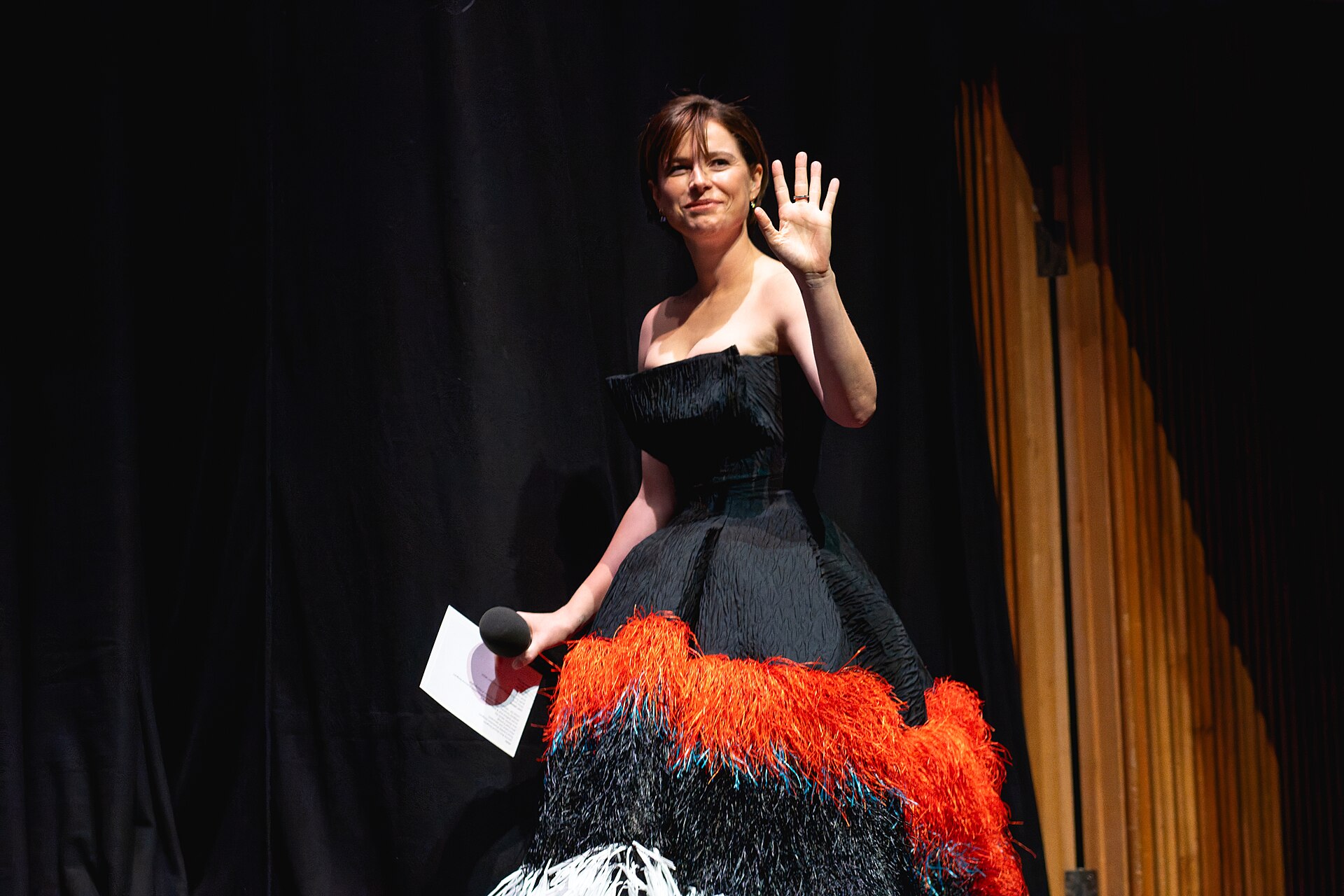
A couple of days ago, I saw an Instagram reel (in the Friends tab, no less) regarding Jessie Buckley’s recent Best Actress win at the 2026 Academy Awards. The reel was praising Buckley for the apparent embrace of her most important role as wife and mother, highlighting her talking adoringly of her months-old baby, addressing her husband and exclaiming “I want to have 20,000 more babies with you!” in her acceptance speech. The caption on the reel recalls Michelle Williams’ Best Actress acceptance speech at the Golden Globes in 2020, wherein she discussed how her abortion allowed her to advance her career, as if to say ‘look how far we’ve come!’ It is impossible not to be reminded of that meme, which has now been played for irony, depicting two clipart-style women with one holding a trophy and crying, “I won!”, while the other swaddles a baby and retorts, “No, you didn’t.” If not claiming that a successful career and familial bliss are mutually exclusive, it seems clear that within this narrative, one is being valued far over the other.
The discourse surrounding motherhood is a strange one. The cliché that the left’s weakness is its inability to reach a consensus certainly holds some truth, and the issue of reproductive rights is proof of it. For decades, feminists have oscillated between pro- and anti-natal stances, and the crackdown on access to abortion services in recent years has shifted people both ways along the axis. At the same time, the right has unfailingly tokenised the mother figure as a paragon of Biblical femininity, lamenting how she has been cheated and let down by those supposed women’s rights activists, whilst they themselves simultaneously strip her of her essential rights and prohibit her from taking on any other label. As a result of this dichotomy, depictions of motherhood in film occupy an equally strange space in the mediascape.
Buckley swept this year’s award season for her performance as Agnes in Hamnet, Chloé Zhao’s adaptation of the Maggie O’Farrell book of the same name. The film centres around Agnes (more commonly known as Anne Hathaway), a magical healer, and her romance with the then unknown town tutor William Shakespeare. The crux of the film comes when Agnes and William’s 11-year-old son, the titular Hamnet, passes away. The remainder of the runtime explores how each parent deals with the grief as it threatens to tear them apart, both from each other and their own senses of self. It seems unbelievable that even this – a historio-fictional account of Shakespeare that centres not him, but a woman in a relationship with him, which has led not to the hunky white-boy-of-the-month lead receiving accolades, but his relatively less-talked-about co-star – can be milked for ‘tradwife’ content. Yet it is not the tragedy of the plot or even Buckley’s vast success as a result of her performance (one that, by virtue of her gender, she could not have taken on in Shakespeare’s time) that people are ooh-ing and ahh-ing over.
Whether by chance or by Freudian fate, I have ended up watching every recent blockbuster concerning motherhood (of which there have been, perhaps suspiciously, quite a few) with my mum. When we watched Lady Bird (2017), which consensus dictates is Greta Gerwig’s magnum opus, I remember both of us shifting awkwardly in our seats and sniffling as we lamented our failure to understand what all the fuss was about. I managed to get through most of Everything Everywhere All at Once (2022) by myself before she wandered in right as the gorgeous final montage was playing on screen. It took her at least 15 minutes to stop pattering about her day and notice the tears streaming down my face. I hadn’t seen her in four months when we sat down to watch Hamnet together, one of the longest spans of time we’ve been apart, and I could anticipate the pain I would feel in my chest in roughly two hours before we even hit play.
On the one hand, I sympathise with the kind of cognitive dissonance showcased in that reel about Jessie Buckley. I, too, want to see my beliefs platformed by individuals with influence, and I, too, want people with the power to do so to speak out for the betterment of society. It is maybe a simple matter of chance that I’ve escaped the logical fallacy of using Buckley as a defence for wanting women to return to their rightful places in the domestic sphere, though she is anything but exemplary of that in practice. But the pathos to which these movies appeal by depicting the complicated but ultimately incomparably rewarding relationship between a mother and her child, along with Buckley’s dedication of her award to the “beautiful chaos of a mother’s heart”, makes me momentarily wonder whether it is a necessary part of my journey through womanhood to experience that dynamic on the other side of it. It makes me question whether I am a worse feminist for not wanting it.
I am my mother’s only child. She had already been in the workforce, earning a steady income for ten years before I was born. She was financially independent even before that – together, she and my father paid for their wedding by themselves, having saved up a small portion of the stipend they received as government scholars while doing their Master’s degrees here in the UK. In her career spanning three decades, she has achieved more success than most, if not all of the mothers in the films we’ve seen together. Though I am biased, I can make a strong argument for her doing a fine job at balancing her professional growth with her role as a mother. I am certainly a better person for having been raised by her, and I believe she would agree that our relationship is mutually beneficial. However, I think I would be doing her a disservice if I placed myself at the centre of all that makes her a valuable member of society.
In the final scenes of Hamnet, Agnes attends the first performance of her husband William’s new play Hamlet at the Globe Theatre. The film conjectures that Shakespeare wrote his masterpiece as a way of processing and dealing with the grief of losing his son. The credits roll to the sound of Agnes’ laughter, as she is finally able to experience catharsis and let go. Her story is as much about loss as it is about overcoming, about reconciling the complexities of your identity before and after tragedy strikes. Ultimately, a mother is not nearly all that Agnes is. I bet Jessie Buckley, a woman who has been pigeonholed rather than appreciated for her multifariousness, would agree with me.