

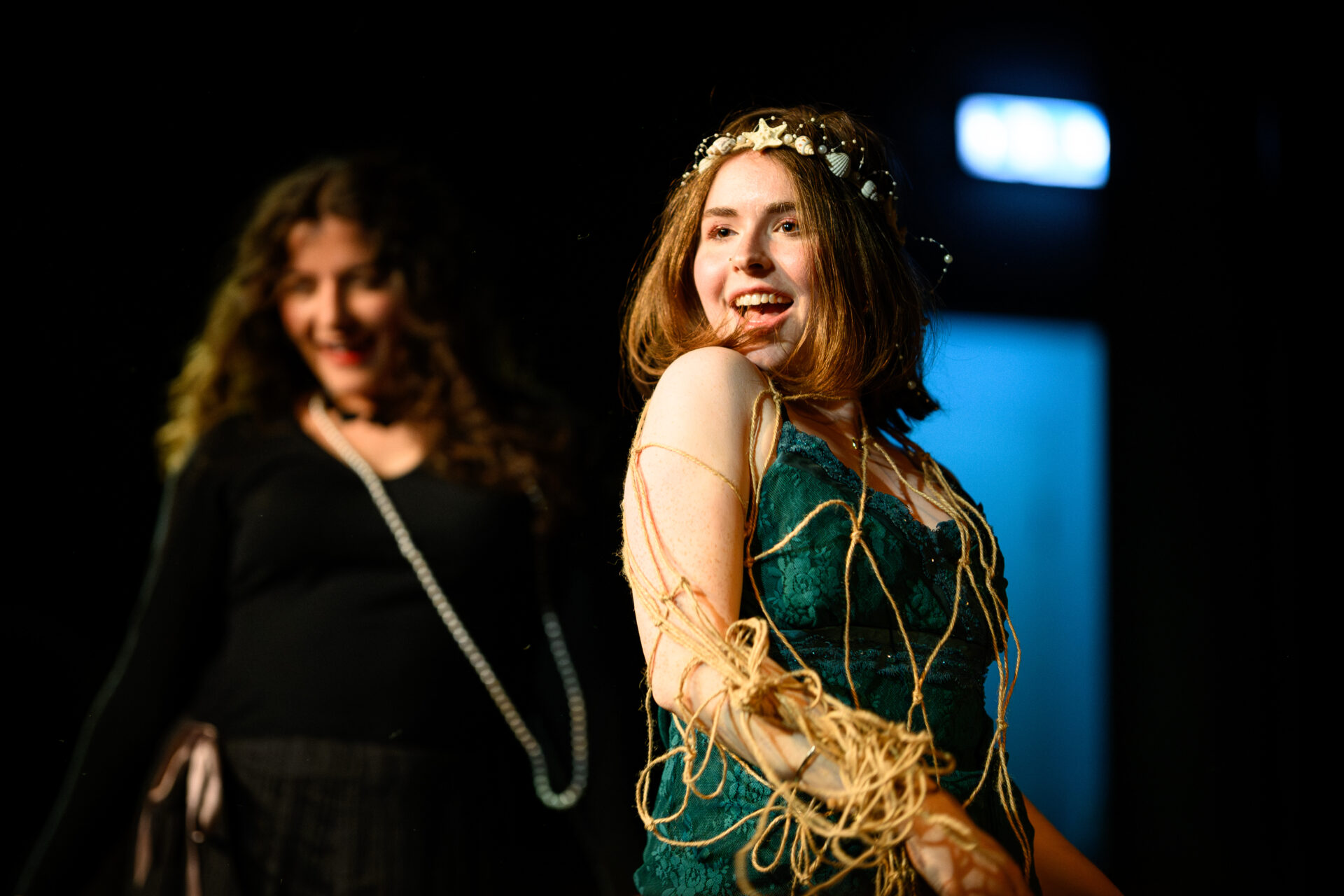
Crazy Child Productions’ Stories From an Abandoned Warehouse was a surreal, emotionally-charged spectacle that blurred the line between expressionist nightmare and dark comedy. Through its distorted and emotionally charged aesthetics, the production transformed the Michael Pilch Studio Theatre into something dreamlike and unsettling, where memory, grief, absurdity, and humour collided with a startling intimacy. The result was a theatrical experience that felt less like watching a conventional narrative unfold, and more like wandering through the fragmented subconscious of its characters.
As a Spanish speaker, I was particularly struck by director Patryk Winiewski’s in-house translation of the play, which paid careful tribute to Ramón Griffero’s original Historias de un galpón abandonado. Although occasional Latinisms slightly disrupted the rhythm of the dialogue, these moments ultimately reinforced the play’s Chilean origins and lent the production an added sense of cultural specificity. This felt particularly special given that Winiewski’s production is the first time that this work of Chilean fringe resistance theatre has been adapted for the English stage. Rather than distancing the audience, the translation captured the rawness and volatility of Griffero’s writing, preserving both its poetic fragmentation and emotional immediacy. The student cast approached the material with confidence, fully committing to the play’s surreal tonal shifts and expressionist style.
The Pilch’s stripped back, warehouse-like setting also enhanced the material, honouring Griffero’s original production staged in the titular abandoned warehouse ‘El Trolley’. Griffero’s play was a means of resistance against the horrors of General Augusto Pinochet’s military dictatorship in Chile (1973-90), with the plot reflecting a society fractured by repression and violence. But rather than depicting these realities directly, both Griffero and Winiewski filter them through surrealism and fragmentation, allowing trauma to surface obliquely through distorted characters, disjointed dialogue, and moments of absurd humour. The warehouse emerges as a microcosm for Chilean society under Pinochet, as the omnipresence of the ruling class (‘The Council’) behind a cabaret-style red curtain served as a constant reminder to the audience amidst the rest of the stage’s muted sepia.
Winiewski’s adaptation heightened this tension between political despair and theatrical excess with remarkable precision, embracing a deliberately exaggerated performance style that he described in the programme notes as “the heart of my vision”. In doing so, the production transformed overacting into something active and purposeful. Characters moved with stylised physicality, enhancing the political caricature that Griffero is drawing upon in the original play. These exaggerated elements helped to democratise the production, and as a result, there was no need for background knowledge of Chilean history. Instead, the oscillation between genuine comedy and despair did all the work, pioneered by stellar acting from the whole cast. Each character fits into the production like a puzzle piece, with each line of dialogue contributing to the production’s constantly shifting theatrical rhythms.
Camilo (Sam Drury) and Carmen (Savannah Lollo), both teachers, are the first to arrive at the abandoned warehouse. Searching for absent students while passionately extolling the value of literature and formal education, the pair embody a fragile belief in culture, learning, and continuity within an increasingly fractured society. Their inability to find anyone to teach reinforces the play’s presentation of characters as isolated archetypes, trapped within identities shaped by occupation and survival. Drury and Lollo’s grounded performances anchored the production emotionally, providing moments of sincerity as the constant arrival of new characters throughout the first half continued to add new layers to the atmosphere of the warehouse.
The performances by Genevieve Kidd (Lady Carla), Seb Foster (Mr Fermin), and Diandra Kočan (Madame) were particularly compelling. Together, Kidd and Foster brought a decadent theatricality to the stage, with Lady Carla embodying the hedonistic excess of the ruling class through a performance charged with both seduction and menace. Her seemingly insatiable sexual appetite remained deliberately unresolved by the end of the play, adding a strangely human vulnerability beneath the character’s otherwise grotesque extravagance. Kidd handled these competing layers in Lady Carla’s character exceptionally. Paired with Mr Fermin’s fake nails, stiletto boots, and exaggerated flamboyance, the duo introduced an important alternative dimension to the portrayal of The Council. Their performances suggested that authoritarian power in the play operates not only through fear and violence, but also through spectacle, performance, and excess.
Kočan’s Madame is also clearly drawn toward these qualities, ultimately aligning herself with The Council by the play’s conclusion. As an archetype, she exists in deliberate contrast to both Lady Carla and The Woman (chillingly portrayed by Nicole Choi), positioning her between competing models of femininity under the dictatorship: motherhood, submission, desire, and power. Kočan navigated this ambiguity with remarkable subtlety, allowing Madame’s gradual attraction to authoritarian excess to emerge less as a sudden transformation than as an unsettling inevitability. In doing so, the character became one of the production’s most compelling reflections on complicity, suggesting how easily systems of repression sustain themselves through seduction as much as fear.
Grace Weinburg’s The Child was, arguably, the most memorable performance from the production. Present on-stage in a baby’s cot before the play even begins, Weinberg’s character has a distinct connection with the audience from the outset. Through eerie monologues and consistent interactions with the fourth wall (including rummaging underneath audience members’ seats to find props for the Council’s ‘party’), The Child became a deeply unsettling presence that hovered between innocence and omniscience. Weinburg’s performance captured the play’s surrealism at its most disturbing, transforming childish vulnerability into something uncanny and quietly threatening. This was undercut by the play’s conclusion, as she is cruelly excluded when the Council takes leave, replaced by Madame, despite her undying loyalty to the Pinochet-adjacent dictator, Don Carlos (Henry Cane).
Crazy Child Productions has staged something genuinely daring. It was not simply a revival of an important piece of Chilean resistance theatre, but a demonstration of the enduring power of experimental performance to articulate political and emotional truths that realism alone cannot capture. Stories From an Abandoned Warehouse embraces excess, fragmentation, and absurdity without ever losing sight of the human suffering beneath them. Camilo’s death is perhaps the production’s most devastating example of this, as his body lies motionless onstage while the surrounding action continues in grotesque indifference.
Strange, unsettling, and often deeply moving, Winiewski’s adaptation lingers long after the final scene fades – not because it offers easy answers, but because it forces its audience to sit within the instability and contradictions that define both the play’s political world, and our own.