

An issue that has been encountered by authors since the dawn of time, perhaps one that feels too obvious to even state, is that some readers will not enjoy their books. This can result from many issues: maybe some don’t like an author’s style of writing, or the genre they tend to write in. In these cases, readers tend to avoid those texts whilst easily acknowledging that others may enjoy them (with exceptions, of course). However, the point at which readers will not simply ignore the existence of a text they don’t like seems to be when it displays a political or social opinion that they disagree with.
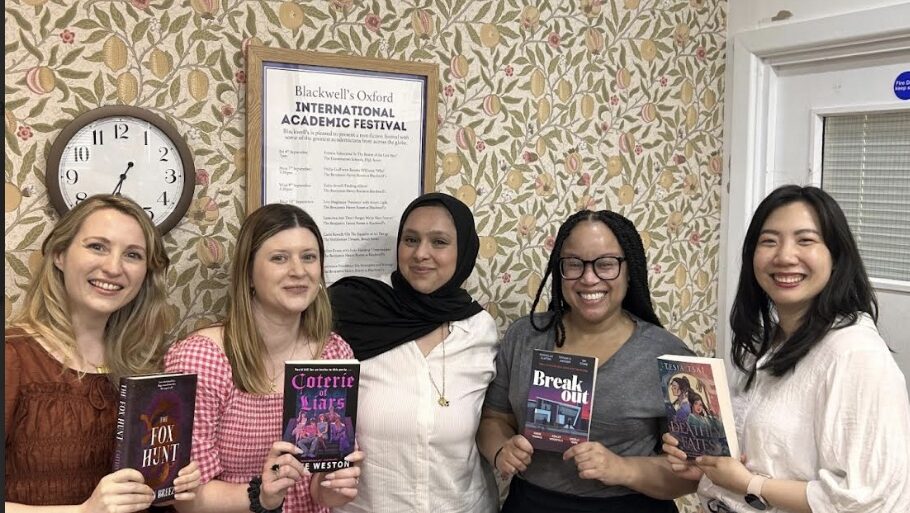
At Blackwell’s, a group of four YA authors, Tesia Tsai, Dhonielle Clayton, Caitlin Breeze, and Kate Weston, came together in a panel to discuss their novels. They talked about their inspirations, writing processes, and character development. The aspects of their discussion that most gripped me were twofold. The first was the extent to which each felt they had placed themselves into their texts, and how emotionally baring this must feel. The second is the need they felt to provide some level of removal within their books in order to avoid criticism for any commentary their books may provide on society.
The former idea is one that each writer experienced on a very individual level, as would be expected. Yet, in a way, the explanations of each made it clear that the writing process involved an inevitable soul baring. Tesia’s experience of the pandemic inspired her to write her novel Deathly Fates. When discussing her novel-writing process, she explained, “a lot of my frustrations end up being poured into my writing”. Her experience during the pandemic greatly influenced her writing process for Deathly Fates, increasing her awareness about the fragility of human life and opening up a fear of her own father passing away. This theme is clear throughout Deathly Fates, in which the main character must undertake a journey in order to save her father.
Rather than a fear of a possible and ever-nearing future, Caitlin instead discussed how her experience of the past is what inspired her to write her novel The Fox Hunt. She reflected on her time at university, noting especially the experience of women within age-old institutions like Oxford and Cambridge. Despite increasing attempts to move into the present, she discussed how entrenched in the past such ancient institutions tend to be, and the consequences for their students. As with Tesia’s fears for the future, Caitlin’s experiences of the past make themselves clearly present within her work.
Kate also talked about the extent to which emotional vulnerability went into writing her novel. She discussed her struggles with mental health, which were especially difficult during the writing process of her novel Coterie of Liars. Her struggles went into her characters, a process which is incredibly soul-baring. In a more comedic turn, she also admitted that many of her characters (those who meet less favourable ends) have been ex-boyfriends of hers. At its core, though, does this not share key elements with putting her experience with mental health into her novels? The writing process seems to be one for her which offers a kind of catharsis.
Dhonielle’s writing process was unique among these authors since she collaborated with five other people in order to write this book. Each person had one character from their novel, Breakout, which they wrote. Dhonielle describes the extent to which this writing process required incredibly careful organisation among the six of them. This careful collaboration was balanced, however, with its own soul-baring moments. Dhonielle explained how, in a strategy similar to Kate, she went through her old high school journals and picked out those she felt had most done her wrong during her childhood, and turned them into characters. As with Kate, at its surface, this appears comedic, but underneath it reveals the depth of personal experience each of these authors put into their writing.
Ultimately, the main message I took from this panel was the extent to which authors place their personal experiences, and themselves, into their work. Yet, another element of their discussion is the simultaneous removal from reality that each inserted into their texts. Tesia and Caitlin began this discussion, given that they have a more obvious removal from reality in the supernatural elements of their books. They discussed the protection this provided them in offering social or political criticism within their texts.
The fact that the society they offer within their texts is not one that exists in real life means that any complaint they receive about the comments on the state of the world their novels provide can be easily waylaid by the fact that they are not real worlds. I enquired further, with Kate and Dhonielle, whether they felt they had any parallel situation in their novels despite the fact that their novels do not contain supernatural elements. I received an answer in the affirmative, that the placement of their characters physically away from society, either on an island or in an elite party away from regular society, provides a parallel experience. Each group becomes an exaggerated microcosm of society, which cannot necessarily be seen (if the authors wish to avoid criticism) as a true reflection of society because of their intensely exaggerated nature.
These authors, then, showed me the delicate balance required within novel writing: a simultaneous baring of the soul and an attempt to hide away, to pre-provide an excuse for themselves in the case that they may receive criticism. Although this process may seem emotionally exhausting, it was clear from the words of each author that novel writing provides an escape and a catharsis which they would struggle to find in any other activity.


