

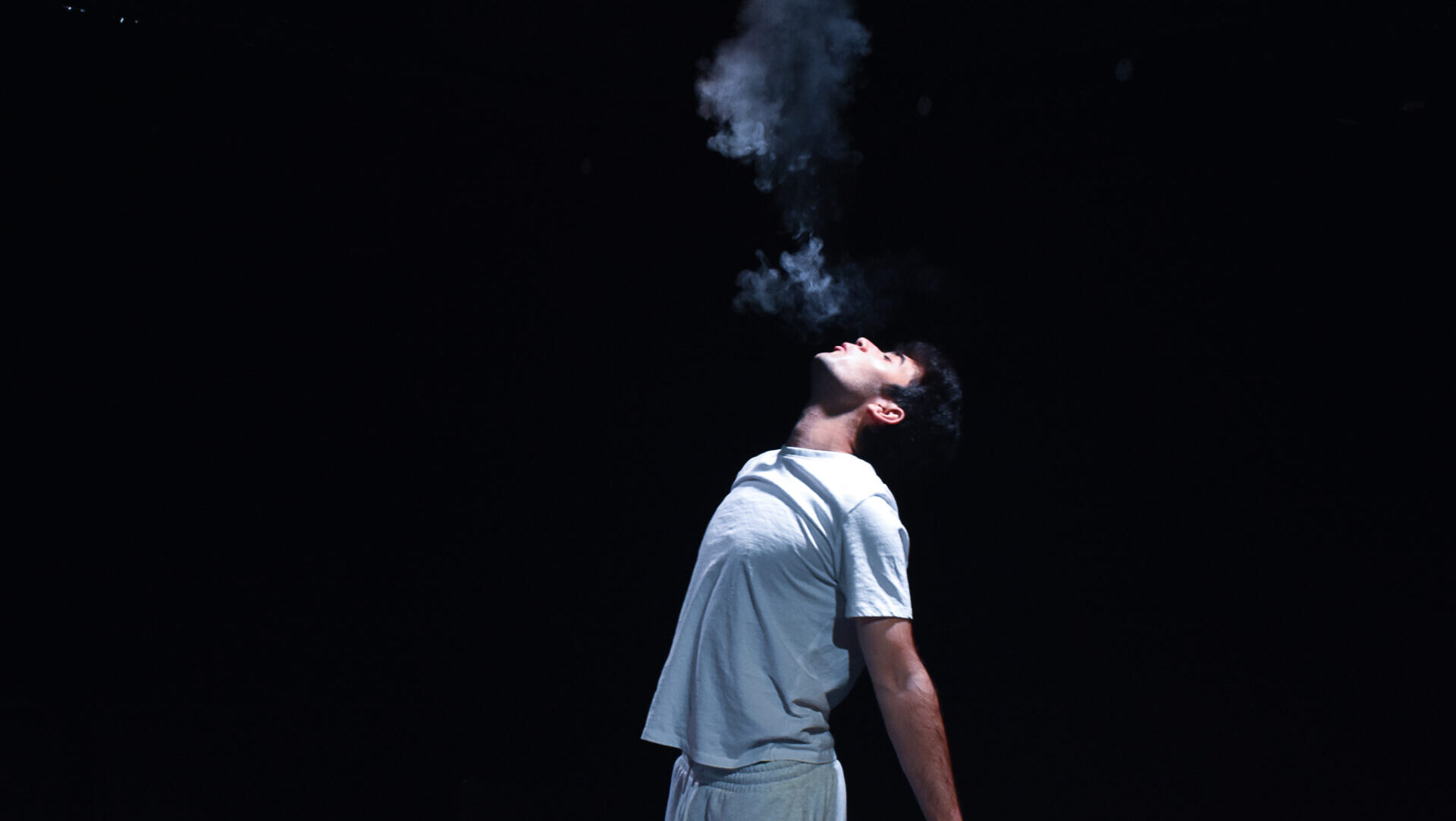
It is always refreshing when a company chooses to stage a contemporary play, as if they are deliberately ignoring the expansive backlog of canonical theatre. This affront to the canon is made particularly exciting since, for me, Lucy Prebble’s The Effect (2012) was unfamiliar. It imagines two patients taking part in a drug trial for anti-depressants, exploring whether we can reduce our feelings to chemical processes, and whether this question really matters. Tristan claims “I can tell the difference between who I am and a side effect.” This is an unfortunately one-dimensional premise. The characters of the text are largely symbolic, and though this might prove a challenge for a director wanting to present convincing depictions of real people, the depth which was brought to each role was astounding. Thanks to the steering of director Joshua Robey and producer Sanaa Pasha, Fennec Fox Productions have done a remarkable job in presenting an enjoyable and immersive production at the BT Studio.
The stage is set in traverse, and it is clear that Fennec Fox have thought deeply about their use of space. It’s confrontational – a word pertinent to their production – to see the BT rearranged in such a way. A projector tells us what we’re in for: ‘The Effect’, a helpfully ambiguous title which anticipates what’s left once the play has ended. It has a firm resonance with something, though Fennec Fox refuses to specify exactly what. This is, in part, enabled by Yusuf Naeem’s set, which is minimal and impactful. A tarpaulin lies across the floor, illuminated with soft white lighting; there is a sound of bubbling – ostensibly brewing suspense – and immediately the audience is struck by the importance of sound design in this production.
Ice Dob’s sound acts, at times, in perfect harmony with the text, whilst at others it grates cruelly against the scene. The production includes a striking motif: each time the anti-depressant medications are taken an all-encompassing wall of sound and light embodies the intensity and severity of the decision to swallow. When the actors throw the empty cups against the wall, they clatter whilst an ominous voiceover explains the ‘DOSAGE INCREASE.’ At times, the sound is a pounding bass, distinctly club-like and entirely antithetical to the scene at hand. But it works, because the sheer volume and intensity of the noise creates such an anxiety that, even though nothing has happened, there is the sense that something is bound to go wrong.
Robey knows how to keep everyone, including the actors, engaged throughout. As Dr James (the marvellous Robyn Hayward) stands assuredly still at one end of the stage, she interrogates one patient while the other turns to the audience and idly invites us into their character. Connie, played by Rose Martin, is agitated and unsettled whilst Alec Day Greene’s Tristan waits with cool indifference, his demeanour telling us at once that he isn’t concerned about the drug trial. Dr James is introduced to the patients as a blank wall, Hayward playing her as an uninterpretable page which resists the patients’ attempt to read her. She is effective in asserting her institutional power, embodied perfectly through her rejection of the patients’ jokes, and her laconic, almost lethargic authority. Martin and Greene’s energies play off against one another perfectly, her restless uncertainty absorbed by his relaxed and rebellious composure.
A sincere life is brought to the characters, especially in the case of Greene, who was repulsive and entrancing in equal measure. The dance number (if one could call it that) was unexpected, a startling juxtaposition to the chaos which was to follow. Martin looked genuinely enamoured with Greene’s impression of a mating bird. The sexual tension between the two was palpable and well-illustrated in a vignette sequence which saw them engaged in various moments of intimacy between blackouts.
Alongside this ostensibly harmonious relationship, power dynamics are a persistent theme accentuated by Fennec Fox’s production. The physical positions of the actors on stage corresponded well to where the characters saw themselves standing, socially. By the end of the play Hayward is so far hunched into the wall that she is easily forgotten until she speaks again. Her progression from monolith to husk was wonderfully pitted against Martin’s gradual assertion of power, tenderly and subtly expressed at the play’s ending. Up to this point, Martin has reminded us that Connie is not altogether sure of herself – “What if I take advantage of you,” she asks meekly. It is clear that this cannot be the case.
Dr Toby Sealey (Rohan Joshi), the nepotistic counterweight to James’ institutional upset, did a remarkable job of navigating the awkward traverse staging to give an exceptionally compelling presentation about his father. Holding a brain aloft, like some STEM Hamlet, Joshi made Sealey’s revelation that it was his father’s truly unsettling. He was sympathetic when necessary, and yet, condescending in other moments as he seemingly disregarded the opinions of James for the sole fact that she is a woman.
However, it is in moments like this that the text resists the complexity of Fennec Fox’s production; the takeaway is so straightforward that it is almost disappointing. Susan Sontag says it better in Against Interpretation: “Sometimes a writer will be so uneasy before the naked power of his art that he will install within the work itself […] the clear and explicit interpretation of it.” Fennec Fox retaliate against the text’s simplicity by utilising the absolute force of theatre. Lights and sound are violently deployed against bare set, insisting on an experience of the play that is sensational rather than analytical.
Altogether, the production is a successful one; this is largely owing to the performances of Greene and Hayward who commit to such a convincing, almost aggressive realism that one is compelled to check if the actors are doing alright afterwards. Necessarily navigating the difference between ‘side effects’ and reality, the play strikes a fine balance between what one thinks and what one feels.