

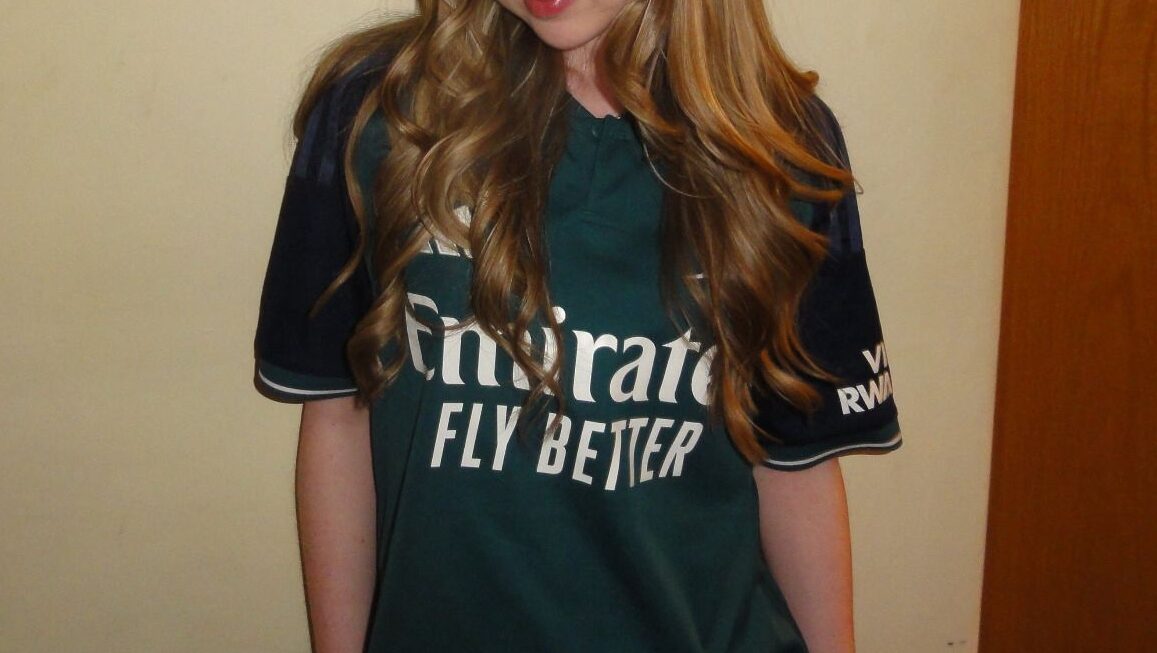
With the FIFA World Cup 2026 having just begun, I’m reminded of a question a friend once asked the group chat: “If I buy a Lionesses shirt, do you guys think I’ll be called a pick-me?” Her words, though coloured by her sense of humour, nevertheless speak to a real problem within football. From the hardcore Gooner to the casual Bellingham admirer, female fans of men’s football often fall victim to being categorised into one of two derogatory camps: the ‘pick-me’ or the WAG. A fashion choice as simple as donning a football shirt can push the unassuming wearer into either side.
Despite the immense success of the Lionesses in recent years, culture has not caught up with reality, and football is still seen by many as a man’s sport. Misogynistic harassment of female fans at men’s football matches has been well-documented, and women are also the victims of a horrifying pattern in which domestic violence spikes during international fixtures, even when England wins.
Many women, including myself, had very similar experiences to boys growing up – we were surrounded by male family members who were diehard fans, we constantly had matches on TV, and we had dads playing in and coaching Sunday league teams. Maybe we didn’t play the sport or collect Match Attax in primary school, but football culture has always been around us, and a sport which, in principle, is ‘the people’s sport’ is bound to be enjoyed by women as well. But the sport hasn’t always received female fans warmly. Just last year, Sky Sports launched and quickly deleted its women-oriented TikTok page, Halo, following criticism of its patronising and misogynistic content. If encouraging female interest in football was the goal, then dumbing down the sport to pink, sparkles, and matcha was not the way to achieve it.
Is there a danger in knowing too much about football as a woman? On the surface, of course not. If anything will truly ‘unite the kingdom’, it will probably be football, especially if England brings it home at this year’s World Cup. But this camaraderie, bolstered by many a pint in a beer garden, offers no protection from accusations of performativity. The assumption is that football is necessarily masculine, always perceived through a masculine filter, to the extent that women who show an interest in the sport seem to do so for the male gaze. With this mentality, held not only by men but also by many women with internalised misogyny, football remains an exclusive club, whose entrance is guarded by the question: “name five players”.
But positive strides have been made in recent years with the increasing overlap of football and women’s fashion. Does anyone remember ‘blokecore’? Think vintage, or even designer, football shirts (thanks, Dad, for the 2001 Liverpool shirt), Adidas Sambas, and baggy jeans. Adapted into a further microtrend, the short-lived ‘blokette’ introduced bows, frilly skirts, and hair ribbons to the ensemble. A microtrend, yes, but women were nevertheless included in a football-inspired trend, and treated as equals rather than ‘male-centred’ or ‘pick-me’. For every guy dressing like prime Beckham, there is now a girl wearing the same outfit, albeit with a feminine flair, perhaps.
But if knowing too much about football is the hallmark of a pick-me, then knowing too little is just as ridiculed. Herein lies a social history of the WAG, or the ‘Wives and Girlfriends’ of football players, often seen in an incredibly fashionable ensemble but perceived to know nothing about the sport. While America had Britney and Paris rocking Juicy Couture tracksuits and Dior saddle bags, the UK had Victoria Beckham and Cheryl Cole doing the same with a British twist – often with a figure-hugging England tank top. WAGs, while at the time commonly seen as gaudy, are retrospectively viewed with the Y2K nostalgia that dominates the aesthetic of the 2020s. They’ve even had a resurgence in recent years, with modern English WAG style being adapted to the modern woman: it-girl Tolami Benson, fiancée of Arsenal’s Bukayo Saka, was often seen in the stands of the 2024 Euros donning a corset, crop top, or leather jacket adorned with the Three Lions badge.
But the term ‘WAG’ has been criticised heavily, especially by those the label has been placed upon – even the Equalities and Human Rights Commission (EHRC) described the term as sexist in 2010. Let’s not forget that Victoria Beckham and Cheryl Cole were successful in their own right, being members of the Spice Girls and Girls Aloud respectively, and were just as brand-conscious as their modern counterparts, including Little Mix stars Perrie Edwards and Leigh-Anne Pinnock. Technically, even Taylor Swift is a WAG, though her fashion sense may not live up to the connotations of the term. The trickled-down use of WAG to describe any girlfriend of a football-loving man is similarly derogatory, and reduces a woman to the interests of her boyfriend. Instead of enjoying the sport herself, by wearing his Liverpool shirt she merely participates in the man’s world.
In truth, this article began in my Google Doc as a fun list of World Cup pub looks – think flag-inspired nails, cultural hairstyles, and cute summer skirts – but I simply couldn’t ignore the inherent politics of being a female fan in a football kit. The worlds of football and fashion overlap in several ways, from ‘blokette’ to the immense influence football has had on men’s street style (I’m constantly thinking about 2010s Balotelli and, currently, Noni Madueke). Girls, let’s promise to wear our kits proudly this summer, and not let the judgemental old men at the pub get to us.


