

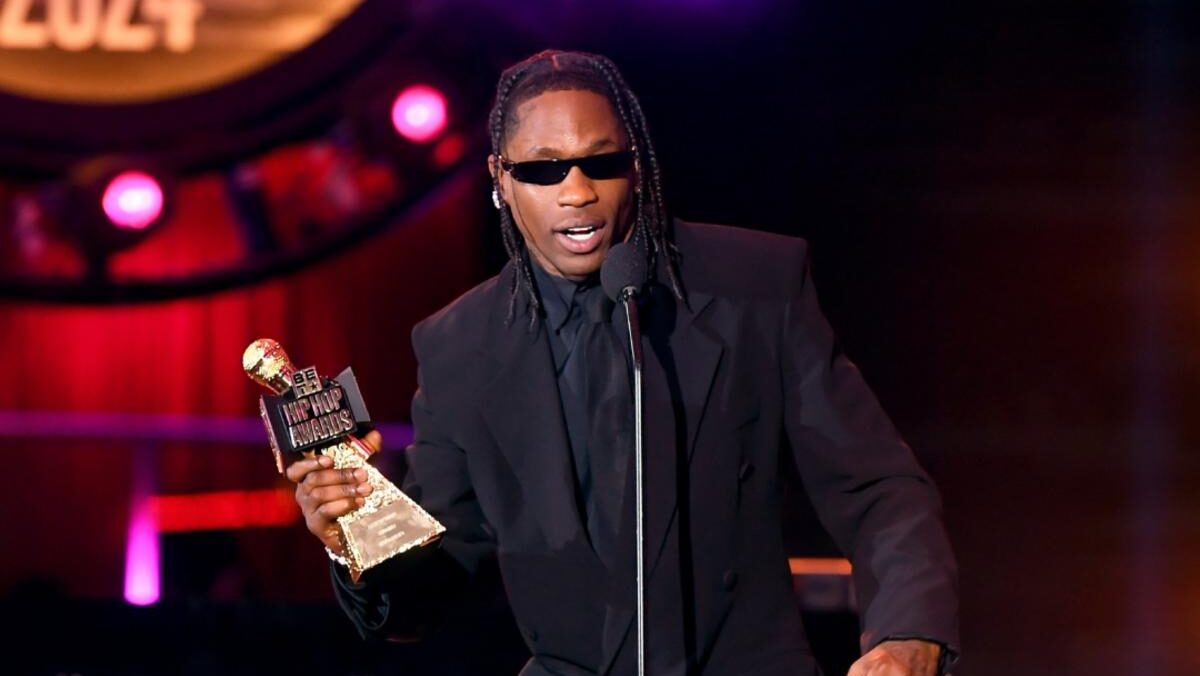
When interviewed on his decision to cast Travis Scott as a bard figure in his upcoming The Odyssey adaptation, set to release on 17th July in the UK, Christopher Nolan stated that “I cast him because I wanted to nod towards the idea that this story has been handed down as oral poetry, which is analogous to rap”. This statement has provoked reactionary backlash on social media and within cultural conversation. The film is clearly not claiming to be a faithful representation of Grecian warfare with negative commentary particularly revolving around Nolan’s diversion from traditional adaptation. This aversion to Scott’s casting, in spite of his previous work with Nolan on Tenet (2020), works alongside an anger at the film’s casting of non-white actors as figures in the Homeric epic.
This is certainly not a novel perspective; ever since the ‘Golden Age’ of hip-hop, spanning from the mid-1980s to the mid-1990s, the genre has rapidly innovated in both style and lyricism. Not only was it drawing upon the beats and riffs of other genres like jazz and soul, often sampling from these areas, but its technique shifted, increasing in complexity. Later, rap became far quicker in pace and flow, popularised by hip-hop visionary Rakim, who introduced a soft-spoken style of rapping and popularised the flow credited to this Golden Age. Lyricism drastically evolved also: variations on rhyme were popularised, with more internal rhyming, off-beat and multi-syllabic rhymes. These lyrics also became less focused on the “party rhymes” of the old-school era, but were highly conscious of sociopolitical issues, particularly racial politics, crime, religion, and the failures of government. Sounds were determined by the building of community spaces in specific areas, rather than being defined by marketing strategies.
Notably, this combination of developments within the genre also brought about the emergence of something even more overtly literary in its approach. It would be impossible to note down every prominent entry into this Golden Age and post-Golden Age canon, which utilises complex poetic techniques. And yet, MF DOOM’s ‘My Favorite Ladies’ is an extended metaphor where he appears to speak about relationships with various women, who are actually all personifications of drugs, considering his dependency on them. Lauryn Hill uses similes on ‘How Many Mics’ to show bravado, rapping that “me without a mic is like a beat without a snare”, but also to display angst and betray vulnerability when she says “loving you is like a battle/and we both end up with scars” on ‘Ex-Factor’. Jay-Z has always been known for his slick entendres, like on ‘Brooklyn Go Hard’: “I father, I Brooklyn-Dodger them/I jack, I rob, I sin/Aw, man, I’m Jackie Robinson/’Cept when I run base, I dodge the pen”. The intricacies of rap lyricism should require no justification; take one look at the giants of hip-hop, and it’s written all over their work.
As a result, since the 1990s, more scholarly work has been written on rap’s relationship to poetry. Brent Wood highlights its proximity to ‘folk-poetry’, with its “relatively free borrowing of music and words between practitioners”, it being “locally-oriented”, not assumptive of literacy, and “a union rather than a separation of music, dance, and lyric”. Folk-poetry, a more traceable evolution of the ‘oral tradition’ Nolan refers to, indicates a liberation of poetry from academic application, existing outside of a canonisation of what is considered literary art. The foundation of rap in the 1970s was on the back of political poetic heritage of the 1960s and various African-American traditions such as Signifying, playing the Dozens, and Toasting, which all showcase verbal dexterity and prowess in exchanges of ritual insults. What emerged was rap, all about the ‘power of the word’, creating a new oral tradition that was reliant upon rhyme and rhythm, just as poetry is.
The other thing worth noting is that often, contemporary poetic works forgo meter and the stricter rhythmic techniques which categorised earlier iterations of the medium, instead latching on to a writing style that is far more abstract. ‘Tipp-Ex-Sonate’ by Koos Kombius is a poem infamous for completely forgoing words altogether, a punctuation-based form that is praised as a commentary on censorship and segregation. Contemporary poets feel no need to abide by formalist structures, and if the boundaries of the medium can be disturbed for their creative license, why would we not extend music artists the same grace of medium? Musical backing could be seen as a literalisation of the rhythm implicit in metre and rhyme. Examples of poetic formations within rap appear potently and often. Wu-Tang Clan’s ‘Triumph’ utilises internal rhymes sibilance and fricative alliteration to execute with explosive power their erudite understanding of sound and speech: “I bomb atomically, Socrates’ philosophies and hypotheses/Can’t define how I be droppin’ these mockeries/Lyrically perform armed robbery/Flee with the lottery, possibly they spotted me”. Dr Marcyliena Morgan called rap the “poetry of generation”, but it may be more than that. Rap has become so influential to the cultural consciousness – shaping fashion, slang usage, and seeping so far into the mainstream musical landscape – that it has dominated every aspect of it. Its prowess in pop culture is so much so that Nolan’s decision could be read less as an artistic one but more as pandering to popular demand. It is difficult to diagnose how rap music will factor into The Odyssey until its release, but the statement alone, however genuine it will prove to be, honours an evolution in the legacy of oral storytelling.
It seems obvious that the aversion to making such a comparison between the long-standing poetic canon and the rap tradition as we know it, is on the back of a racially charged understanding of what are considered ‘low’ and ‘high art’ forms. Rap is implicitly working class in its thematics of social justice, racial politics, and institutional indiscretion. NWA pioneered this explicitly with their 1988 album Straight Outta Compton, later adapted into a social realist, award-winning film, bridging the boundary between the higher and lower mediums. More recently, ‘Cop Shot The Kid’ by Nas and Kanye West discusses the murders of Aiyana Jones and Aderrien Murry: “Tell me, who do we call to report crime/ If 911 doin’ the drive-by?” Music is community-based, and rap has been a method of expression among the Black working class since its conception. Its popular appeal and anti-elitist thematics has historically lowered its status as a medium. Right-wing presenter Geraldo Rivera famously said “hip-hop has done more damage to young African Americans than racism in recent years” in response to Kendrick Lamar’s BET Award set. The irony of this sentence is obvious, but it also indicates a stance taken within Western culture.
Comparisons between the two were marked out around 30 years ago, and in all accounts, the idea that rap and poetry are crucially linked is well-established. The refusal to believe this, in spite of its backing in scholarship, comes as an almost elitist impulse. To say that rap is less impactful than its ‘proper’ poetic predecessors is to fundamentally misunderstand the purpose of literary art.


