

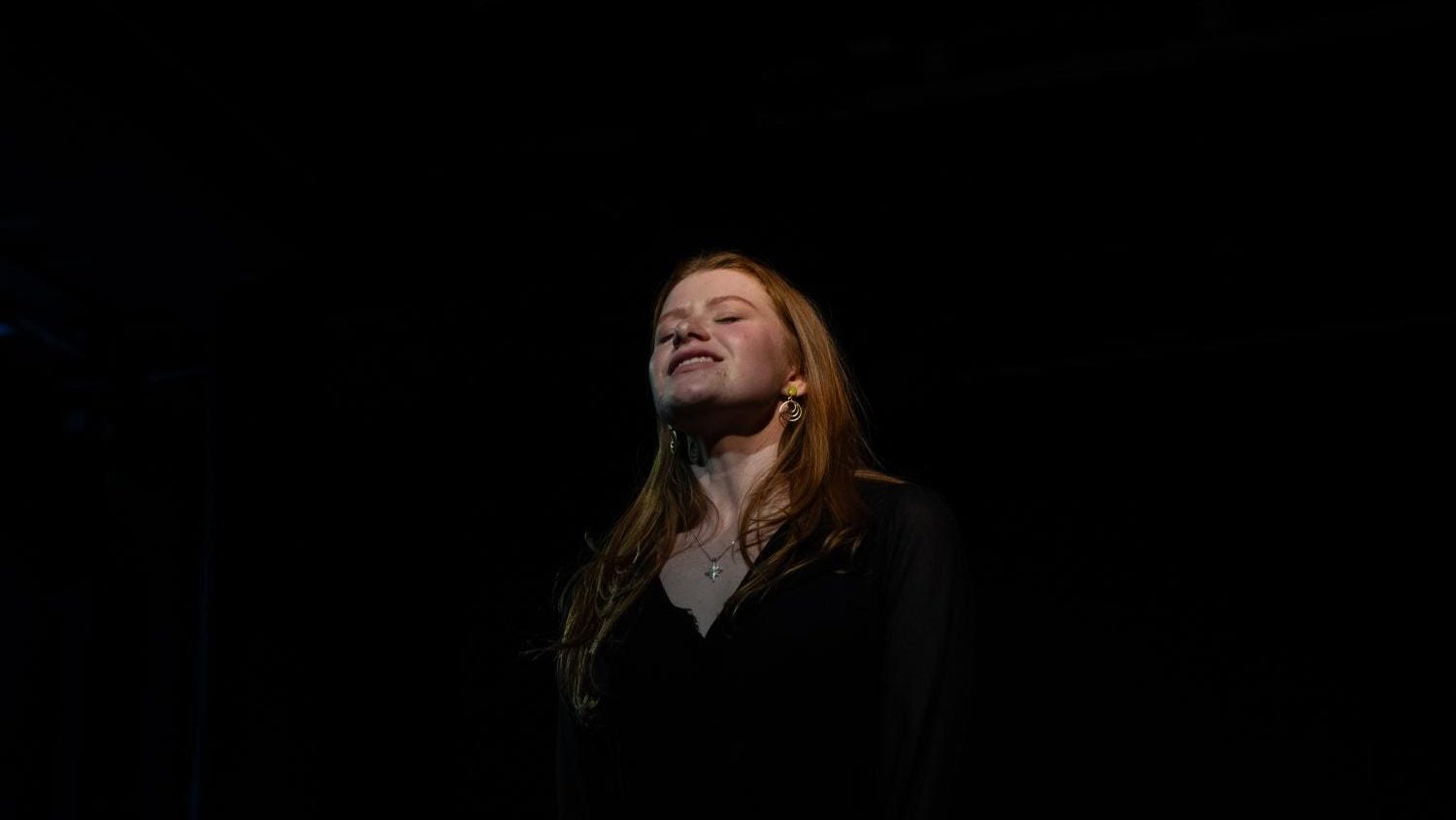
Tiptoe Productions’ Hedda Gabler, co-directed by Ollie Gillam and Gilon Fox, delivered a strong version of the classic text, impressive in its ability to make the differences between characters so comic. Laughs were consistently drawn from the audience, balancing out the fact that some moments lacked polish.
Hedda Gabler follows the strife and eventual downfall of aristocratic Hedda (Georgina Cooper), confined unhappily to a marriage with George Tesman (Sam Gosmore), reimagined as an uninspiring and, bumbling economics academic in the political setting chosen by the directors. As they return from their honeymoon, Hedda’s discontent with her life manifests in a series of elaborate manipulations centred around her past lover Eilert Loevburg (Rohan Joshi) and his new fling Thea Elvsted (Thalia Kermisch).
Cooper played the titular role wonderfully. Every movement was poised and calculated, reflecting her control over the play’s disastrous events. She was outstanding at appearing focused and unfazed as chaos unfolded around her, and her ability to maintain this stance enhanced the comedy of Gosmore’s George Tesman.
I have no doubt that the audience would agree that Gosmore was sensational. In a play that has the potential to become stagnant due to its dark themes, his version of George Tesman brought genuine hilarity. There was a constant sense of not knowing what he would do next, as he seemed willing to push his physicality to a comedic maximum: he cheered for joy, hung his head in upset, and jovially patted his wife on the head as she spoke to another man. He brought humour even to the more dramatic moments simply by making Tesman so unaware.
Commendation ought to be given to Thalia Kermisch as Thea Elvstead. Her approach to the role made Mrs Elvstead seem wide-eyed and fearful, consumed by love for the wrong man. Her convincing portrayal of worry served to emphasise the relative lack of concern of her false friend Hedda. Likewise, Ezana Betru as Judge Brack brought the calm certainty required for his role as confidante and bearer of bad news. He was the only man in the play that seemed to have some control over the direction of the narrative: the only one, in other words, who held some power l against Hedda, and his more relaxed tone of voice matched this.
In this adaptation, it was the women who held the power onstage. Rather than making the men’s control over their lives seem sinister, it was presented as nonsensical: neither Tesman nor Loevburg were able to contain childish outbursts of emotion. Memorably, upon finding out that Hedda has destroyed Loevburg’s manuscript, Gosmore as Tesman put on a face of exaggerative upset, only to be placated by Hedda very briefly being sexually suggestive towards him. His failure to match the patriarchal masculine ideal was reinforced by Cooper’s constant disdain towards him, which reached into the entirety of her physicality.
Another man whose emotional instability contrasted the steadfastness of the women surrounding him was Eilert Loevborg (Rohan Joshi). Joshi had less onstage time than the other actors, making up for this with the fact that every line was delivered with a splitting emotional intensity. His confrontations with his past love Hedda and current fling Mrs Elvsted were placed centre stage, allowing the audience to closely observe the consuming nature of his anger: a loose canon in comparison to Hedda’s calm certainty and Elvsted’s determined attempts to hold their relationship together. Making the male characters so vocally and physically unstable was effective, given that Ibsen’s focus on writing women who defied the patriarchal standard and made the men around them seem less entitled to their high social status.
The acting in the production was impactful, but I felt some of the directorial aspects adhered too closely to the script at the expense of originality. For example, the scene t in which Judge Brack and George Tesman have a drink offstage was taken so literally that it distracted from the central onstage conversation. Similarly, the moment where Hedda burns Loevburg’s manuscript, professing that she’s “killing” his “child” felt like it was included out of necessity rather than being carefully thought out, as it created some unnecessary emptiness onstage. The set was functional rather than original, but this is likely justified by a need to focus on the raw emotion of the actors’ interactions.
Overall, Tiptoe Productions, while not quite adding the originality promised, created a portrayal that balanced tension and hilarity.


