

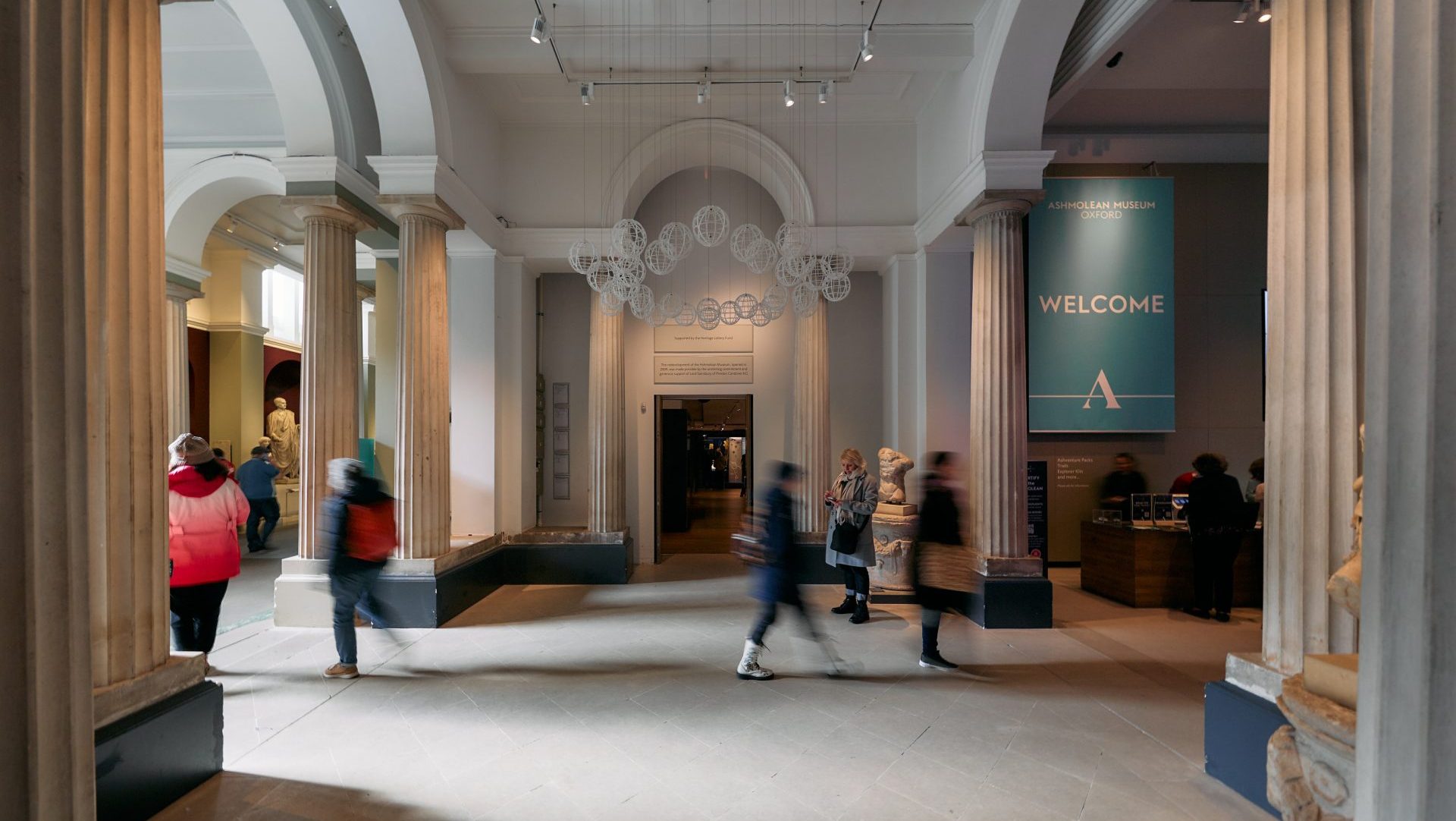
The Ashmolean Museum, the UK’s oldest public museum and the University of Oxford’s leading institution for art and archaeology, has welcomed more than one million visitors this year, its highest annual total in 16 years.
The figure marks a continuous upward trend in visits to the Museum in recent years, with 900,277 visitors recorded in 2023 and 942,692 in 2024. Passing the one million visitor mark means that the Museum is now roughly 14% ahead of the same point last year, when 879,077 visits had been logged by the end of November. The Ashmolean also reports that its audience is becoming more diverse, noting “proportional increases in overseas visitors, visitors from Oxfordshire, and families.”
Oxford Central remains the Museum’s largest source of Oxfordshire visitors, followed by East Central Oxford and then Radley, Wootton and Marcham. A cluster of areas, including Islip, Arncott, Chesterton, Barton, Wallingford, and Brightwell, collectively rank next. Internationally, the Ashmolean continues to draw in substantial numbers from the United States, Australia, Germany, Italy, and France.
A recent survey suggests that free entry has played a significant role in this rise, especially during the ongoing cost of living crisis. The Museum maintains free general admission, accommodates both bookings and walk-ins, and has hosted several free exhibitions this year. These include current displays by Irish artist Daphne Wright, US-based Hong Kong artist Pat Suet-Bik Hui, and three artists exploring the Chinese “three perfections”, alongside object-based exhibitions such as a collection of Roman coins from Oxfordshire.
Alongside its free offerings, the Ashmolean has continued to draw audiences through ticketed exhibitions. One of this year’s displays, This Is What You Get, focuses on the visual art of Stanley Donwood and Thom Yorke, whose collaboration of over 30 years has shaped Radiohead’s distinctive style. Running from 6th August 2025 to 18th January 2026, the exhibition features more than 180 works, from original album-cover paintings and digital compositions to etchings, unpublished drawings and handwritten lyrics.
Curator Lena Fritsch describes the collaboration at the heart of the exhibition as a synthesis of sound, image, and text – a Gesamtkunstwerk that highlights the experimental nature of Radiohead’s music. Tickets remain free for members, under-12s, and museum colleagues, with various concessions and half-price categories available. According to figures shared with Cherwell, the Ashmolean has issued 32,370 tickets to date, indicating strong and sustained public interest in the exhibition.
Another key element behind visitor growth has been the museum’s newly redesigned Rome and the Roman Empire gallery, which opened on the ground floor earlier this year. The gallery examines the Roman world at its height in the first and second centuries AD, tracing the lives of people across the empire, from emperors to the enslaved, and following its reach from Oxfordshire to Syria. The space broadens the traditional boundaries of Roman art by displaying not only frescoes, sculptures and tombstones but also household objects and interactive features designed to appeal to visitors of all ages.