

Sometimes, great works of art emerge from surprising sources. Consider the celebrated teen rom-com Ten Things I Hate About You (1999), loosely based on Shakespeare’s 1590 play The Taming of the Shrew. While Katherina’s transformation into smart-mouthed American teenager Kat Stratford may read to literary purists as a ‘dumbing-down’ of the original source material, the film is memorable and packs a punch with its larger-than-life characters and unlikely love story, claiming a cultural legacy of the sort similarly enjoyed by Shakespeare’s play itself.
From the initial inspiration to its creation, art’s journey to conception is often no less predictable than the artwork itself. Nowhere is this clearer than in the exuberant and diverse world of musical theatre, which seems an art form uniquely able to set almost anything to song and dance. The writing of a musical, as with the creation of all art, calls for the spark of inspiration, for which the kindling has often been found in classic literature. Take, for example, the recent sensation of The Great Gatsby, based upon F. Scott Fitzgerald’s famous 1925 tragic novel of the same name, which has dazzled audiences both in London and New York. What, therefore, are the ingredients for a perfect literary-to-musical adaptation? In considering two of my favourite musicals, let’s chart how speech becomes script, how characters become embodied, and how emotion becomes song.
Les Misérables: An on-stage revolution
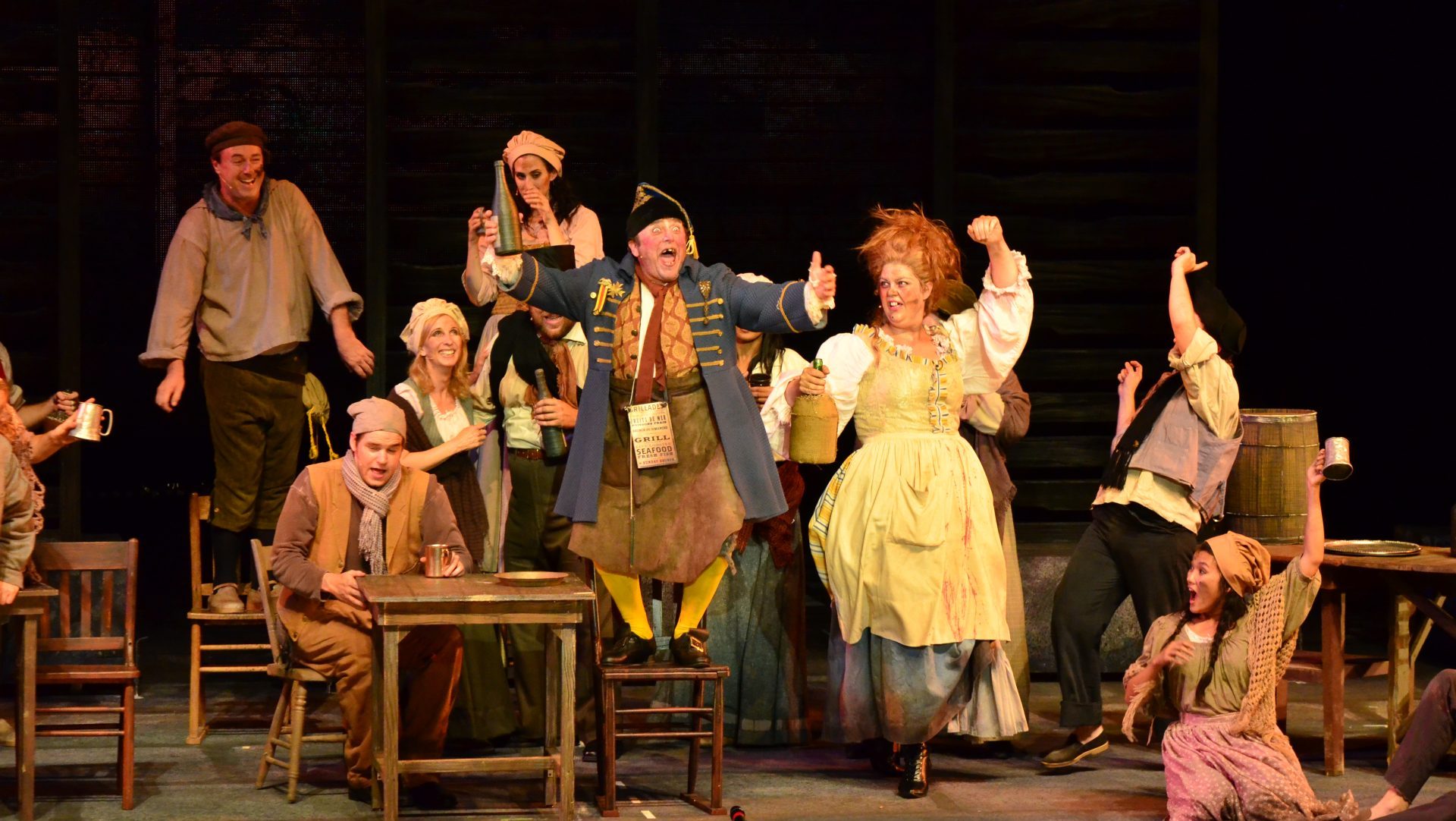
I’ll never forget the feeling of seeing Les Mis on the West End for the first time on my twelfth birthday; before this point my exposure to musicals had consisted solely of frequently re-watching the films The Sound of Music, West Side Story, and Annie. The first stirring notes of the ‘Prologue/Look Down’ were captivating, and ‘One Day More’ was a personal moment of musical rapture at the end of Act I.
First performed in 1985, it has become one of the most beloved and well-known musicals globally. Based upon Victor Hugo’s 1862 novel, it follows French peasant Jean Valjean’s efforts to reinvent his life after 19 years in prison, set against the backdrop of the 1832 Paris Uprising. Hugo’s novel is a long, complex, and interwoven book, yet I was struck by its vivid use of characterisation. Indeed, this complexity of plot, language, and syntax is why it is such great source material to translate into song. The novel’s strong emotions and characterisation, when set to music, are distilled into a spectacle that not only has something to say, but the power to be emotionally moving.
The tension at the heart of Les Mis is Inspector Javert’s fanatical obsession with hunting down Valjean. It’s this very tension that allows Les Mis to work so well both on the page and in song. It provides an energy that pulls the narrative onwards while building momentum within it, creating scope for character development and emotional exploration, until we reach the climactic finale. Condensing a two-thousand-page long 19th-century French novel into a three-hour musical is an impressive feat, yet the richness of Hugo’s original text would offer ample inspiration to any artist.
Spring Awakening: From 1890s Germany to Broadway
Perhaps it’s ironic that Spring Awakening, a musical which I’ve never actually seen, is among the musicals closest to my heart. While I have only ever experienced the show through a mixture of grainy early-2000s YouTube clips and the Spotify recording of the original Broadway cast, its diverse range of moving songs have stayed with me ever since. Spring Awakening’s score was influenced by rock, folk, and electronic music, giving it a sound which was different to the majority of musicals at the time. Because of its youthful, rebellious energy, Spring Awakening resonated strongly with a generation of young people.
The musical is adapted from Frank Wedekind’s 1891 German play of the same name, and it is simultaneously very true to and a complete reimagining of its original source material. Appropriately for a musical, this paradox is best encapsulated in its songs. Rock-inspired numbers such as ‘The Bitch of Living’, ‘Don’t Do Sadness’, and ‘Totally Fucked’ are worlds away in tone, language, and sound from the stiflingly repressed and authoritarian atmosphere of the musical’s setting. Here, adults view the teenagers’ budding sexual curiosity and questioning of societal norms as a threat to the established order. These songs don’t take place within the show’s core action, but instead in a kind of ‘alternate reality’, or space of psychological revelation. In the original Broadway production, characters would pull out hand-held mics from their clothing and sing directly to the audience. Entering their own personal ‘song-world’, each teenager expresses the thoughts and feelings that they are forbidden or unable to articulate in their ‘real’ lives.
Once I’d read a translation of Wedekind’s play, it dawned on me how perfect it was, if unexpected, as the source material for a modern rock musical. The musical retains the energy and authenticity of the original play’s young voices, many of which Wedekind based on sketches from his own childhood, and the core themes of censorship and repression which evoke a need for alternate forms of expressing pent-up emotion. After all, what could be more expressive or angsty than rock music?
The final chapter, and the closing scene
Musical theatre owes a great debt to the literature of preceding centuries. There are countless more examples of classic literature which have been transformed into modern musical phenomena. Overall, it comes back to one word: inspiration. Often, all we need is one idea to ignite a spark that leads to something greater.