

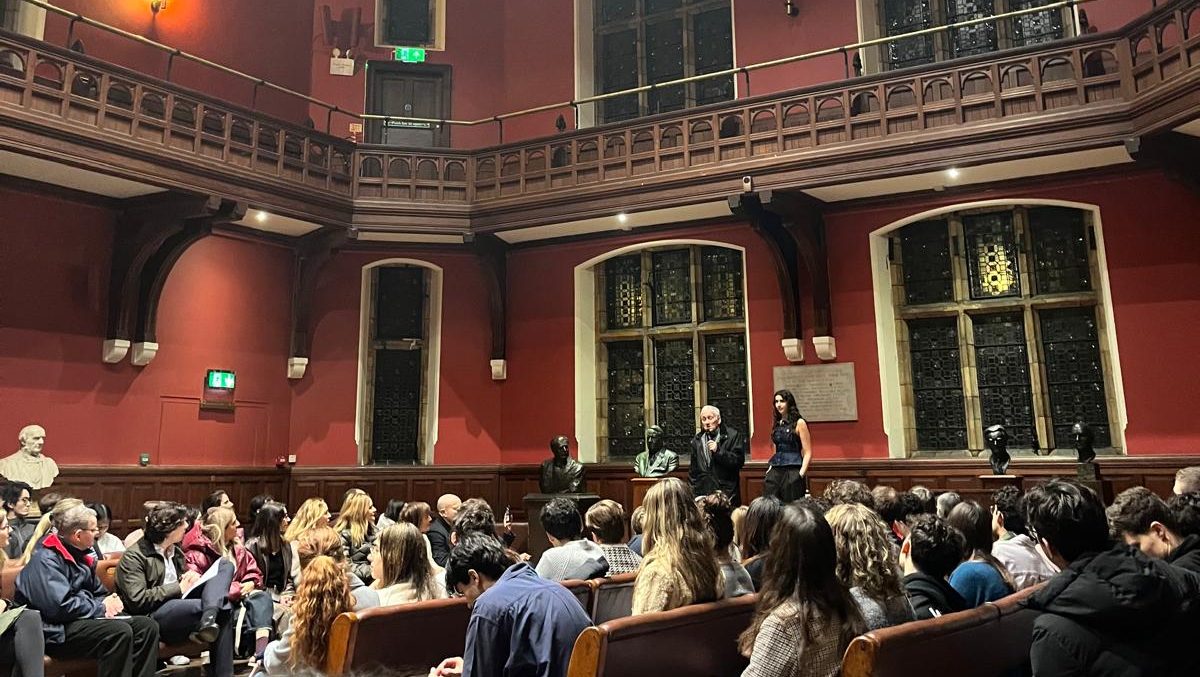
Holocaust survivor Robert Slager shared his story in conversation with his granddaughter, Lady Margaret Hall student Grace Steinberg, at an event held at the Oxford Union on Monday 2nd February. The talk, organised by the Union of Jewish Students and Oxford Jewish Society to mark Holocaust Memorial Day, reflected the theme of this year’s commemorations, ‘Bridging Generations’.
Holocaust Memorial Day is observed on the 27th January each year, the anniversary of the liberation of Auschwitz-Birkenau, the largest Nazi death camp. It commemorates the six million Jewish people murdered during the Holocaust as well as the millions more killed by Nazi persecution and in later genocides in Cambodia, Darfur, Bosnia and Rwanda. This year’s theme of the Holocaust Memorial Day Trust, emphasises that “the responsibility of remembrance doesn’t end with the survivors – it lives on through their children, their grandchildren and through all of us”.
Slager, who was born whilst his mother was in hiding in Amsterdam in 1943, explained that his father was deported to Auschwitz in 1942 and that his mother had only escaped . deportation herself thanks to an administrative error.
In an extraordinary sequence of events, Slager’s foster family would move across the Netherlands to protect him, facing constant dangers – at one point, they had a Nazi officer stationed in their house. Following the war, he was reunited with his mother and given the middle name ‘Bartholomew’ in honour of his foster father.
Steinberg, who is the Vice-President of Oxford Jewish Society, then delivered her reflections on the story of her opa (Dutch for ‘grandfather’). In a moving speech, she emphasised the role that chance had played in her grandfather’s survival. She then read out two letters she had written: the first to her great-grandfather David Slager, telling him about his son whom he never got to meet. The second was to the Protestant couple who hid her grandfather, thanking them for their bravery during the war.
Steinberg emphasised that Holocaust remembrance involves “not only learning from suffering but learning from courage” and that “living Jews are the most effective monuments” for commemorating the Holocaust. For Steinberg, the Bakels’ example showed the power of small “good deeds” in saving lives.
She also recalled her shock at seeing a swastika sprayed on Oxford’s David Slager Jewish Centre, named after her great-grandfather, in 2024. The mark left by the symbol after it was washed off was, she said, a “scar” for the Jewish community in Oxford.
When asked by the audience about hope, Slager admitted that he was “disappointed” about the recent rise in antisemitism and acknowledged that there was an “uncertainty that hangs over our heads” about what the future will bring. Hearing Slager speak was a particularly special opportunity for those present, since he does not regularly talk in public about his experiences, finding the process of revisiting the Holocaust too “depress[ing]”.
Oxford Jewish Society told Cherwell: “It was such a pleasure to be able to welcome so many people to our event commemorating Holocaust Memorial Day. Given the few opportunities to hear from Holocaust survivors, we were delighted to be able to put on this event for the Oxford student community, and we hope that the lessons of the Holocaust were clear to all those who came.”
Grace Steinberg told Cherwell: “It was an absolute honour to share the stage with my opa tonight. This year’s HMD theme, Bridging Generations, reminds us that the responsibility of remembrance doesn’t end with the survivors, it continues with their children, grandchildren, and all of us. Therefore, I am incredibly grateful over 350 people heard his survival story, and educated themselves on the Holocaust, as it’s only this active remembrance that will keep the stories of the Holocaust alive when we are the eldest generations in this room. As I mentioned in my talk, I think the most important part of opa’s story is that it’s not only a Jewish story, a Christian family hid him. This reminds us that our survival as Jewish people has often depended on the kindness and courage of people of other faiths, and the unimaginable impact of one good deed.”