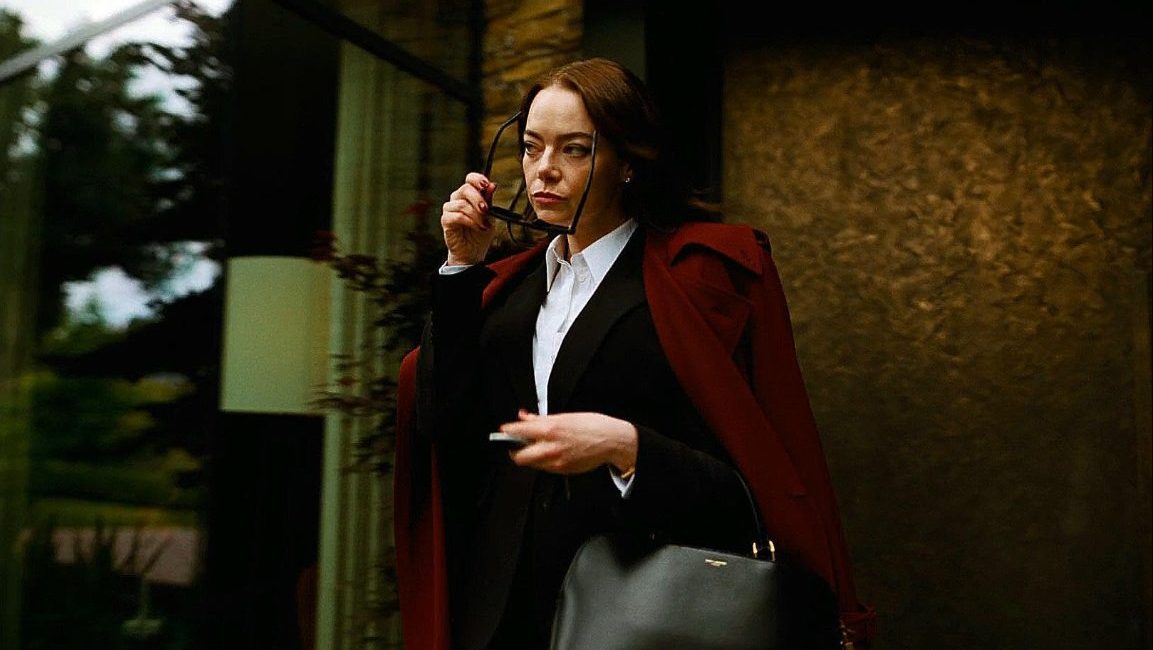

Bugonia is yet another triumph for director Yorgos Lanthimos and his collaborators. With his distinctive blend of comedy, tragedy, and absurdity, Lanthimos has remade a 2003 South Korean film, Save the Green Planet!, and in doing so produced a cynical but ultimately rewarding reflection on the human condition. His film centres around the kidnapping of a powerful CEO by two men convinced she is an alien plotting to destroy the Earth, in a story which strikes the right balance between farce and realism.
Lanthimos and screenwriter Will Tracy made a few important decisions when adapting Save the Green Planet! Most importantly, they changed the genders of key characters, with the CEO (Emma Stone) now female, and the kidnappers (Jesse Plemons and Aidan Delbis) both male. This turns gender into one of the film’s core interests, with Lanthimos exploring the misogyny powerful women can face, and the link between violence and ‘incel’ culture in America.
But, as ever with Lanthimos, none of the characters are treated with a sense of moral superiority. They are all flawed and ambiguous, with the audience’s emotions split between horror at what the CEO is subjected to, and pity at the mental illness of the kidnappers, one of whom is cognitively impaired and is effectively controlled by the other. This fits into Lanthimos’s broader interest in manipulation and the power dynamics of relationships, as well as themes of loneliness and emotional fragility.
Teddy, the lead kidnapper, is clearly deeply troubled. Over the course of the film, Lanthimos treats his story with the seriousness it deserves, chronicling a history of sexual abuse, bereavement and childhood trauma. In doing so, the film raises questions about how many people have failed Teddy, implicitly criticising both his community and the state for turning their back on him. Teddy is presented as a broken man who cannot escape his past, someone left behind in society’s emphasis on material gain, competition and self-interest.
Jesse Plemons’s brilliantly intense performance as Teddy is matched by an equally impressive turn from Emma Stone. Her portrayal of CEO Michelle Fuller is nuanced and considered; she is neither an innocent victim, nor a greedy corporate boss who got what she deserved. Nonetheless, she is emotionally distant, and lacks concrete remorse or empathy for Teddy’s mother, who is in a coma because of a drug trial run by her company. She therefore represents the personal cost of ambition, and, perhaps, in a nod to one of Lanthimos’s favourite themes, the corrupting influence of power.
Underlying all of this is the film’s interest in the environment. Teddy’s enthusiasm for beekeeping and anxiety about the decline of bee populations makes him a more sympathetic character, while echoing his concerns about the end of humanity. He even compares the division of roles in a bee colony to human society, casting Fuller as the queen bee which all the other bees tirelessly, and mindlessly, work to feed. Fittingly, the buzz of bees is the overwhelming sound at one of the film’s most dramatic moments; for Teddy, beekeeping represents a means to escape and process trauma, and chaos in the bee colony reflects chaos in his mind. Bees are hence woven into the musical fabric of the film, in one of the many clever elements of Jerskin Fendrix’s remarkable score.
The film meditates on some of the darkest aspects of modern America: its lack of concern for the environment, its interest in profit over human relationships, its lack of care for the most vulnerable. Even its title is existentialist. ‘Bugonia’ refers to the ancient Greek belief in bees spontaneously generating from the carcasses of sacrificed cows, perhaps hinting at the idea that new life will always emerge, even if humanity is doomed to extinction. The planet might even be better, the film hints, if it were free of humans.
The film’s use of the absurd has its own important function. It links to the idea of challenging conventions, as well as echoing the chaotic and seemingly meaningless nature of human life. Lanthimos wants his audience to reconsider every aspect of how they have been told to live, to stop copying others and to start thinking for themselves. His film debates conformity versus rebellion, and the collective versus the individual.
Bugonia is not a perfect film, but it does not need to be. Some aspects of its depiction of gender, mental illness and manipulation may strike some viewers as exploitative, and its ending may prove frustrating for those who favour realism over allegory. But its genius lies in its tackling of the human experience in a way which is not only darkly funny, but also philosophically resonant, and at times deeply moving. Lanthimos has announced he will take some time off to creatively recharge after Bugonia; it is a break he very much deserves after producing such a dark, twisted but ultimately hugely clever tour-de-force.
A twisted tour-de-force: ‘Bugonia’ in review