

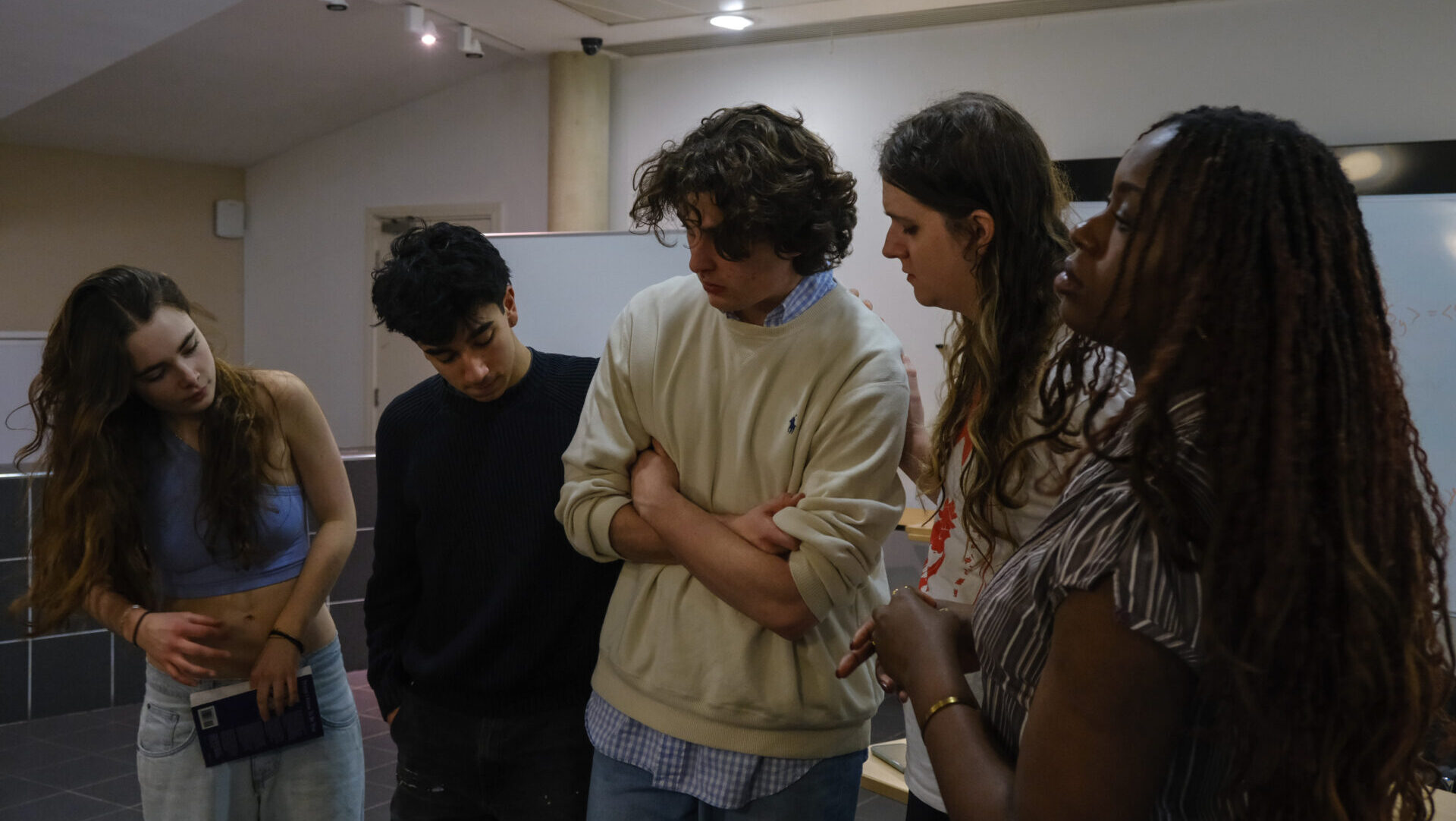
Fresh from the success of their debut production, Lighthouse Productions are set to deliver their second show: Andrew Bovell’s Things I Know to Be True (2016). “Bob and Fran are dealing with the unfathomable: their children are growing up.” Speaking to Cherwell between rehearsals, co-directors Ivana Clapperton and Alys Young teased their nostalgic, 2010s interpretation.
Moving from the Burton Taylor Studio to The Grove Auditorium has given the company momentum: they’ve moved from a mere 50 seats to a venue housing 160. Things I Know to Be True is also set to be the inaugural OUDs performance at The Grove.
Clapperton and Young are keen to explore themes of generational trauma, familial love, and what it means to (never?) grow up. “Fundamentally, we want to put on theatre that makes you feel something,” says Young, with “warm and fuzzy” as a guiding principle.
Young and Clapperton are evidently attached to Bovell’s play. Young says she was enamoured by the script when she first encountered it. “It’s got these beautiful monologues that are fleshed-out characters in themselves,” says Young. For Clapperton, the appeal lies in the deep-seated nostalgia and “recreation of childhood” that the play evokes: “[The play draws] people back into the state of growing up.”
Soon we were joined by Lucía Mayorga (Fran), Sam Gosmore (Bob), and Hope Healy (Rosie), arriving back to Lincoln’s EPA Centre with lunch. Gosmore, Lighthouse’s first pick for Bob, was apparently poached for another show, before he returned to the cast. “People are always trying to poach him!” says Young, laughing. But Gosmore seems grateful to be back, calling the team one of the kindest he’s worked with. The cast provided Cherwell with some insight into their characters. An exploratory, incisive, and at times personal conversation followed. The cast members cut right to the heart of who the Prices are, and why they behave the way they do.
Healy is the first to appear onstage as Rosie, a 19-year-old who has just returned from a not-so-successful gap year. “Some of her language I wasn’t quite used to,” says Healy, laughing. “[Although] I sometimes speak to my parents in the same demanding tone.” Healy told Cherwell that Rosie embodies the play’s “grass is always greener” theme. She continues: “Rosie spends her whole life wishing she was older, [but realises that] life is right now. The boring bits are what life is.” On Rosie’s distinctiveness, Young cites her “mammoth monologues,” which allow the audience to “see the family through Rosie’s eyes.” Clapperton agrees that “she observes a lot.” Healy concludes that Rosie sees some character development. “By the end there are some learning curves… I’m the least mentally unstable!”
Mayorga (19) and Gosmore (20) are exploring age through physicality and emotion to depict Fran (57) and Bob (63). Mayorga explains that “Fran’s delivery of lines is different to how we might react, [since she and Bob share] decades of familiarity.” Mayorga muses on how an older relationship manifests onstage. “[Fran and Bob have a] constant awareness of each other,” she says. “There’s less of the playful, tentative vibes.” Young says they’ve also thought about how age creates a “shorter fuse,” describing how “everything just takes that little bit [longer].”
Gosmore describes Bob’s character as lost at the point when we meet him, having just retired. “He has a lot of free time,” says Gosmore. “This is the first time he’s ever had leisure time, [but] it’s not all it’s cracked up to be.” Bob spends most of his time gardening; Gosmore says “he’s just waiting for the time [to pass],” creating “a kind of crisis.” Clapperton adds that Bob has been “on autopilot” for so long, that he jars against his new life. When I suggest this is an intensely familiar figure – a retiree who’s into gardening – Young laughs in agreement, saying she regularly thinks of Bob in relation to her own grandparents.
On the topic of parenthood, Gosmore says that the Prices are “both very proud of having children.” Mayorga agrees, but says Fran has a “more complicated” relationship with motherhood than Bob does with fatherhood. “She places so many expectations on [her children],” says Mayorga. “[Being a mother] was never really a choice.” It seems that Fran’s excess love can often lead to an over-protectiveness, and a possessive imposition of control. “A lot of the time the concerns or the missteps are informed by love,” says Clapperton. In the same way, Gosmore says that “[Bob is] quite strict with his son [but] kinder to his daughters.”
A particularly tense relationship in the play is between Fran and her daughter Pip (Gabriella Ofo). Pip is a big-city career woman, often at odds with her mother’s traditional values and expectations. Fran loves Pip, but struggles to reconcile feelings of pride with lingering disappointment. “There’s a lot of bitterness there,” says Mayorga, citing a disparity in gendered values. Clapperton says that Fran “sees [Pip’s] reasoning in herself,” with the irony being that “Pip is strong enough to make decisions that Fran doesn’t approve of.” Inherited female identity is a key theme in the play, with Young summarising: “We are our mums, but we’ve come so far, politically… [maybe] we are our mums, but more?”
The Price family garden is set to appear in an “ambitious set design” by Erin Cook. Young says it will form a place where “indoor and outdoor spaces have collapsed in on each other.” A wooden house with gauze windows will create a literal “window to the past”, where memories appear as silhouettes, enabling “a mirage” reflecting memories whose “meaning you can’t fully grasp.” Clapperton similarly emphasises a “conflict of interior versus exterior.” In regards to Ben Adams’ costume designs, I’m promised bootcut jeans.
If the play’s aesthetic is set to take us back to childhood, then its characters’ puerility will fit right in. “They’re adults but they’re still children,” says Young on the characters’ lapsed maturity whenever they’re around their parents. Gosmore notes “a teenage dynamic” that he says he’s experienced himself: “[When I go home], I revert to quite stroppy.”
According to the cast and crew, the production promises to deep-dive into child-parent relationships. Nostalgic, cosy, and tense, Things I Know to Be True will remind us, if nothing else, that “your family will always see through you.”
‘Things I Know to Be True’ shows at The Grove Auditorium, Magdalen College, 4th-7th March.


.)