

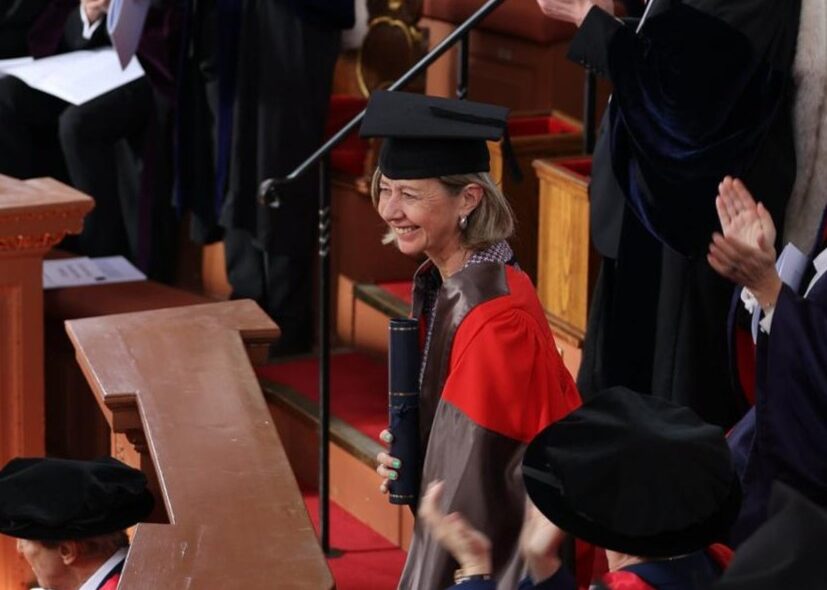
Christina Lamb started her career as the Cold War was ending. She saw the fall of dictatorships in eastern Europe and Latin America, and the end of apartheid in South Africa. “It felt like things were going in the right direction”, Lamb tells me. But in all her 38 years as a foreign correspondent covering countless conflicts – from Libya and Iraq, to Afghanistan and Sudan – “the last few years have been the busiest”. Reflecting on Ukraine, she said: “I never imagined that I would be covering major land war in Europe.”
Lamb always had a passion for storytelling. She came to the University of Oxford in 1983 to study Chemistry at University College, a course “which I hated”. Smiling over her menu at the Queen’s Lane cafe, Lamb tells me that, initially, she was unable to change subjects, “but after the first year exams they were quite happy for me to switch”.
Cherwell was a big part of Lamb’s time at Oxford. She edited Arts and News before becoming the paper’s Editor-in-Chief. Lamb initially wanted to switch to Philosophy, Physiology, and Psychology (PPP), but her tutors presented her with an ultimatum: she could switch to PPP, but only if she stopped her work at Cherwell. “It seemed wrong”, Lamb says. “Part of [going to] University is doing other things and I didn’t see why I should have to give it up.” So she changed to Philosophy, Politics, and Economics (PPE) instead. “PPE didn’t care that I was doing Cherwell.” I’m sure our current editor can attest to this.
Of her own admission, “I didn’t know anything about journalism when I came here. I was always interested in stories but not really the news”. But an invite to Cherwell’s infamous cheese and wine parties (an event of the 1980s which I personally believe should be revived) introduced her to the student paper. “Different editors spoke and talked about what they did. I thought ‘I really like writing and I’m really curious about people’ so it seemed like something that I wanted to do.”
When I meet with Lamb she is visiting Oxford to receive an honorary Doctorate of Letters as part of a special ceremony to mark the Chancellor’s first year in office. Lamb was the first in her family to attend University, so, for her, attending Oxford was “already very special”, and when she was contacted about an honorary degree she was “astonished”.
Lamb gave me a snippet of her recent travels before returning to Oxford. “My life’s kind of crazy”, she says. In the weeks before the ceremony she had been reporting from Iran, Ukraine, and the Chad-Sudan border. It was whilst reporting in Ukraine, only a few days ago, that she realised she didn’t have anything to wear to the ceremony’s black-tie dinner.
But, as luck would have it, she was returning to her car in Kyiv after visiting Maidan Nezalezhnosti (also known as Independence Square) when she spotted a green dress in a shop window. “Within ten minutes I bought it”, she says, “but it felt very odd because I’m in a war zone carrying all my body armour but now I’m also carrying this designer dress”. Such is the life of a busy foreign correspondent.
Reflecting on what the honorary doctorate meant to her, Lamb tells me “sometimes you feel like ‘what’s the point of doing this?’ You’re taking a lot of risks, putting other people at risk, and it doesn’t feel [like] you’re making a difference.” So, for Lamb, Lord Hague’s recognition of her work was “particularly special. It was kind of recognising all of those people that I write about – that it meant something”.
When Lamb first graduated she thought she was going to be a novelist: “My plan was to spend a couple of years doing journalism, preferably abroad, so I could have some adventures and make a bit of money. I wanted to rent a garret where I could write my novels.” But what started as a weekend invite to a wedding in Pakistan became the beginning of a life-long career.
Lamb fell in love with Pakistan and moved to Peshawar, near the Afghan border. Several newspaper editors said they would be interested in articles featuring Afghanistan, which was under Soviet occupation at the time. The conflict was covered mainly “by freelancers because it was considered too dangerous to be done by staff”.
She quickly learnt that Afghans are amazing storytellers. “So many of the people that I met were totally illiterate, but they have this great oral tradition.” Lamb said she was “fascinated and I thought, ‘I can’t actually make up stories like this – these are really interesting’. I’ve been a journalist ever since, telling other people’s stories. I feel very lucky”. Lamb has visited Afghanistan dozens of times since, earning a reputation for her focus on the effects of war on women and the use of rape as a weapon.
Initially she didn’t think she was doing anything differently. But, after a while, she became more conscious that, in her words, “there weren’t many people writing about women”. She wondered “why is the paper only full of pictures of men? Why aren’t we writing about women? They’re half of the population and actually in a lot of these war zones they are the ones trying to protect and educate children. We should be writing about what happens to them”.
She tells me that she feels “heartbroken about what’s happened in Afghanistan”. For Lamb, the withdrawal of Western troops in 2021 was inevitable, but “it was the way that it was done, so precipitously” which was problematic. “It will be five years this summer since the Taliban took over… I don’t hear anybody talking about Afghanistan and I find that difficult to understand”.
Life in Lamb’s field isn’t easy. “I basically see the best and worst of humanity.” But, she remarks, “in most places you find really inspiring people.” For Lamb, Ukraine is no exception. “Ukrainians get annoyed about this now”, she says, “because everyone goes on about the resilience of Ukrainians. It’s probably irritating for them. But it is true”.
During Lamb’s most recent visit to the war-torn nation, the temperature hit a staggering -21 degrees celsius. But in a country where “a lot of people don’t have electricity”, people “want to show that they’re having a normal life”. Lamb described busy restaurants, theatres, and discos.
Unlike much war reporting, Lamb’s work often focuses on life away from the frontline. In Ukraine this is partly because “you can’t go anywhere near the frontline now because of the drones”. But in general, Lamb is keen to emphasise that war isn’t all about combat: “People often think there’s war and everything stops. But in fact people still go to work, get married, have babies, and go to school. All of that still happens.”
Our meeting coincides with the fourth anniversary of Russia’s full-scale invasion of Ukraine and I was keen to hear Lamb’s thoughts on how things have changed. “Four years is a long time”, she remarked, “people are very tired. Every night there’s air raid sirens and your sleep is constantly broken”. She added that “people don’t particularly see an end” to the war. “Nobody believes that Putin has any interest in peace.”
Setting her teacup down gently, Lamb’s expression became particularly serious. She emphasises that “the nature of war has changed enormously which is something I think people don’t necessarily understand. They’re still thinking of how war used to be with tanks and guns, and it’s not. It’s a totally high tech drone war”.
Although the trenches which stretch along the frontline make it “kind of look like the First World War”, there are also “people sitting there with joysticks, almost like a computer game. It’s just very different. It’s how warfare will probably be in the future. We’ll have a lot to learn from Ukraine and it’s changing all the time”.
Whilst Lamb describes Ukraine as “extremely different” to any war that she’s covered before, some things don’t change. “Like most of these wars”, Lamb tells me, “women and children are often the victims”, and Ukraine is no different. She says that “we have seen Russians using rape as a weapon” and “domestic abuse increasing because a lot of the men fighting are often traumatised and sometimes take that out on their loved ones.
“Even if the war were to end today, which would be wonderful, there’s so much destruction and trauma. Nobody really knows what it will have done to the children to have gone through this. It’s hard to be very positive.”
With the conflict entering its fifth year, I was interested in how Lamb keeps stories like Ukraine alive. As she laments, “most of what I write is very depressing. You can’t keep endlessly depressing people or outraging people”.
So what do you do? Lamb admits that “it isn’t easy”, but “that’s our job, to find ways to make people interested”. Throughout her career Lamb always used to think of her mum as her reader “because she was somebody who didn’t know that much about the world. So I would think ‘is this something that would interest her, make her read something?’ Why should she care about Afghanistan, for example?”.
In order to keep stories alive, Lamb tries to approach them from different angles. When writing about Gaza, she got in touch with Gazan students who held offers to study at UK universities. “We sort of campaigned for them”, she said. “I went and spoke to some of them and it was a good way of writing about what was going on… if I’d just written a story about the horrors of Gaza some people might have just switched off.”
We live in an unprecedented era of conflict. There’s never been so much fighting this side of the Second World War. So I was also interested in how Lamb chooses which conflicts to cover and which stories to tell. “Sometimes something happens and so we sort of have to go. If someone’s just invaded a country or something – then it’s just reacting”, she says.
Other times, “like with Sudan, we haven’t reported on something for ages so it’s good to go there and see what’s happening. I feel like that about the West Bank at the moment. I’ll probably go there fairly soon because there’s been all this focus on Gaza, but the situation in the West Bank is also shocking. I went and did something maybe 18 months ago but it’s been a while now and it’s gotten worse”.
One of the many things that Lamb has learned over the past 38 years is to “never go anywhere thinking that I know what the story is”.
Of course, sometimes “people will say ‘where are you going? What’s the story?’”, but “I always think when you get on the ground, it’s there that you know”. Fortunately, Lamb reflects, “my editor is very supportive”. But she notes that that’s not always been the case. “I’ve had struggles in the past”, she says, “when I started there were very few women doing what I do”.
Reflecting on her career and the changing dynamics in global politics, for her, “it does feel like a different time”. She notes that “things that we’ve been used to – assuming that the United States was our trusted ally – we can no longer assume”. She describes being “at the mercy” of the White House with few people having any idea of what’s coming next.
“Sadly we’re seeing a lot more autocracy, a lot of democracy being rolled back”, she says. “It doesn’t feel like the world is in a good place.” But despite these turbulent times, Lamb emphasises the importance of having “confidence in doing what you believe in”, telling me we shouldn’t be “pushed into things because you feel that’s what society expects of you”.
With a nod to her own journey, she remarks: “I just really believed that I could write and that I would find interesting people to write about. Everybody has a story. It’s just a matter of having the patience to sit and listen, to care.”