

It’s a different emotion whenever I read the Urdu language. I’m not a native speaker, nor have I actively pursued learning the language, but as someone who finds solace in reading shayari (Urdu poetry), I wanted to follow it even in Oxford. I have friends who can speak and read the script brilliantly, and I have always envied them. Not because knowing another language adds feather to their cap, but because it allows one to feel differently, or rather multilingually. It’s like being multilingual in emotions.
Urdu has a certain gravitas to it – gherai, or depth. I had started reading Urdu poetry during my undergraduate years, and that is when I came across a few poets who wrote on love (mohabbat, ishq) and separation (firaq). In that sense, coming to a new city and joining my dream university was ishq for me, but leaving behind my country and loved ones was firaq.
When reading Urdu poetry, one often encounters poets residing in a no-win situation: there is neither love nor forgetting; neither acceptance nor forgiveness; neither destruction nor sanctity. Instead, it leaves the reader suspended in a state of emotional encumbrance. Feeling too deeply, and yet nowhere to settle, and that is the crevice where most admirers of Urdu poetry wish to stay.
On some days as I amble around Oxford, I’m struck by a reality that I rarely focus on– I am in Oxford. I had longed for it, desired it, and adored it (but maybe just never enough).
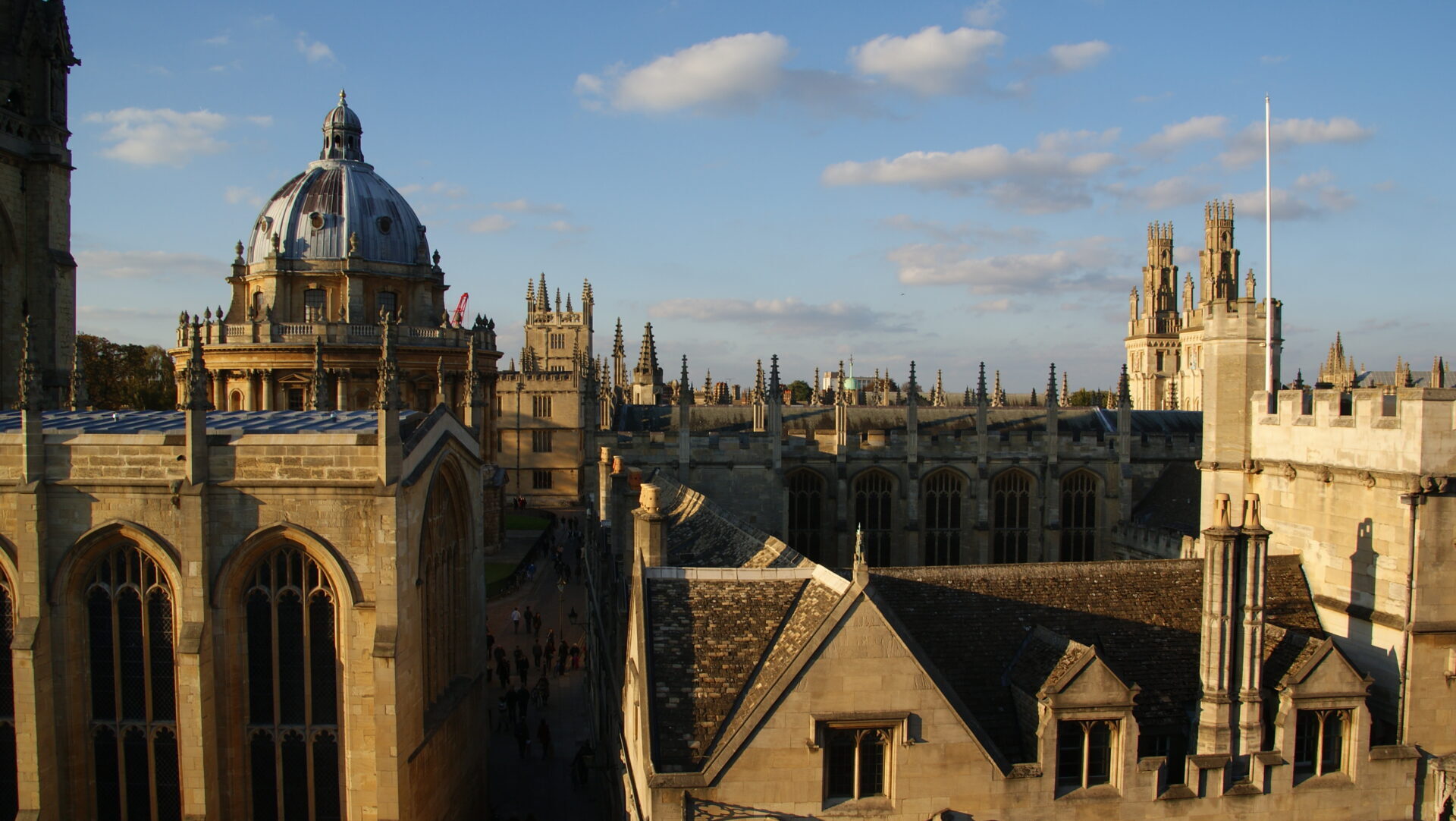
Firaq Gorakhpuri, an Urdu poet, writes: “Ek muddat se teri yaad bhi na aayi aur bhul gaye ho tujhe aesa bhi nhi” (“It’s been a long time since I even remembered you, but it’s not as if I’ve forgotten you either”). That is exactly how I feel for Oxford on some days. I haven’t still figured out which part of Oxford these lines speak to: the city itself, or the experience of being a member of this institution? Yet, on walks to Tesco on Magdalen Street, I rarely pause consciously on this feeling. It is only when I see something as magnificent as the Christ Church dining hall, Duke Humphrey’s library, or the Radcam that I’m nudged in the arm by this reality.
Urdu is often called the language of love, and rarely does it speak without invoking a beloved. The beloved is omnipresent in its poetic universe: sometimes distant, sometimes cruel, sometimes divine, but always there, shaping longing and language alike. As a reader of Urdu, I have always filled the beloved’s space with my own meanings. The beloved, in that sense, becomes less a human and more a vessel for desire, devotion, and imagination.
But this makes me wonder: must the beloved always be human? Can objects ascend to that almost sacred rank? I have always found a similarity between Urdu and Sufi poetry – a form of mystical Islamic devotional literature – in the ways in which the interpretation of the beloved is neither fixed nor singular. Either the divine is the human, or the human is the divine. Perhaps, in both forms the beloved has always been a metaphor expansive enough to hold whatever the heart chooses to sanctify. For me, the beloved is the experience that this city and institution offers to me.
In his ghazal, Jaun Eliya writes: “Tum haqiqat nhi hasrat ho…” (“You are not the reality, you are a longing…”) And then you would ask me to what extent does a person love something? Maybe it is always in the longing. All desires wane once the longing is fulfilled, once the dream materialises. I’d say keep chasing, keep longing, because that is how you preserve its kadar (value).
Writing about the prospect of seeing his beloved, Ahmad Faraz begins his ghazal with: “Sunā hai log use aañkh bhar ke dekhte haiñ so us ke shahr meñ kuchh din thahar ke dekhte haiñ” (“I’ve heard that people gaze at them to their heart’s content, so let us stay a few days in their city and see”). Faraz has only heard of his beloved’s beauty and presence. There’s curiosity, admiration, and desire to witness her directly. Though convention often renders the beloved as ‘her’ in translation, I prefer ‘them’. It preserves the ambiguity and expansiveness that make the ghazal form so enduring. Whenever I read this ghazal, I’m always reminded of this city as my beloved and I, as a traveller, visit it for tales of its splendor echoing far beyond borders and seas.
Sometimes I’m astonished by how much a language, through literature, can offer; I came with it to Oxford, and now I’m living Oxford through its lens. In between journal entries, I find myself using these poems more for this city than for my beloved. Perhaps at this stage, my love for both Urdu poetry and Oxford is interdependent; one cannot grow without the other.


, and wanted to follow it even in Oxford.)