

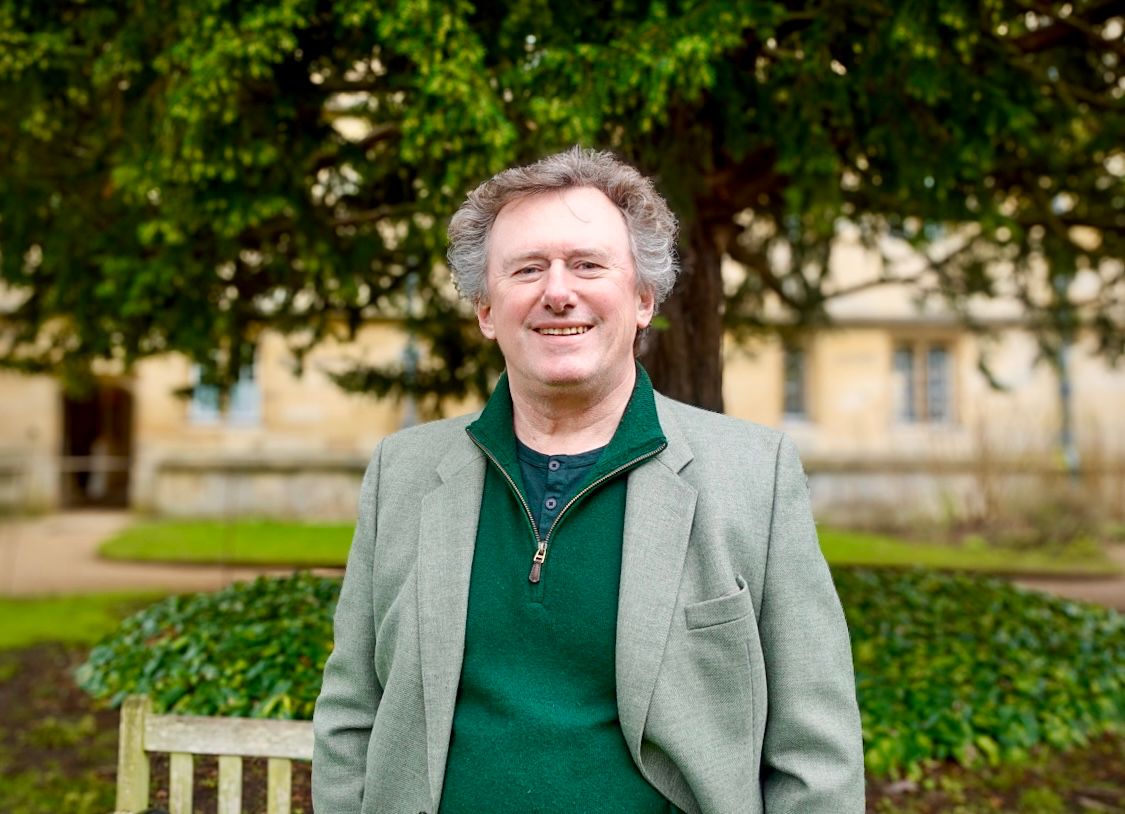
Professor Lee White – a conservationist, scientist, and politician – does not like talking about himself. White came to Oxford to deliver a lecture, at which I learned almost nothing about Lee and a great deal about the trees found in the Gabonese rainforest. Only very briefly, towards the end of the event, did White talk about himself.
For White, trees – and nature – are more important than him, and so they are the focus. It would not occur to Lee to speak in any other way. He finds people without his sense of perspective frustrating. In conversation with White before his lecture, he recounts negotiating at the United Nations Framework Convention on Climate Change: “I’d rather face Boko Haram terrorists trying to shoot me really than go to those climate negotiations.”
You are likely wondering, as I was, how a boy born in Manchester ended up facing Boko Haram terrorists. The story begins with a chimpanzee named Cedric who White refers to as his “brother”. Cedric was adopted by White’s family, after they moved to Uganda, when he was a small child. White recalls how his “mother would walk around with my sister on one hip… and Cedric the chimpanzee… on the other hip.”. This close proximity to nature instilled in White a sense of duty to the natural world, and left him with a deeply seated understanding of the interconnectedness of the planet.
The following decades were spent learning about the natural world through experience and academia. White describes his life in conservation as a struggle to balance documenting the natural world as a researcher and campaigning to preserve it. Whilst studying the trees of Gabon, White opted to preserve the natural world and entered politics. His great achievements in protecting Gabon’s rainforest were made into a documentary in 2024.
In the documentary, Gabon: Earth’s Last Chance, the most thrilling moment is when White manages to convince the Gabonese President Omar Bongo in 2002 to create 13 new national parks. When I ask White how he managed to do this, he describes Bongo’s long-standing interest in nature, recalling trips spent whale-watching with the President and he pays tribute to Bongo’s many speeches on conservation. If White had been directing the documentary, I suspect we might have learnt rather less about White himself and more about the trees of the Gabonese rainforest. White’s understanding of the complexity and interdependence in nature translates into a deeply seated belief in the unimportance of the individual.
Yet, in spite of this, White’s achievements in Gabon are incredible. White worked with the Gabonese government for decades. He fought Boko Haram terrorists who profited off of poaching, reduced illegal logging, and became the Gabonese Minister of Water, Forest, the Sea, and Environment. The positive effects of his efforts in preserving biodiversity are incalculable.
A concrete product of White’s efforts is the Reducing Emissions from Deforestation and Degradation agreement (REDD+), which he helped to negotiate. Formalised in 2015 by the Paris Climate Agreement, REDD+ incentivised protecting trees by paying countries per ton of carbon sequestered. The Gabonese rainforest, where White spent 45 years researching and conserving, reduced carbon in the world’s atmosphere by 187 million tonnes each year. However, the money agreed under REDD+ was never fully paid – Gabon was paid for only 3 million of the 187 million tonnes that it had removed from the planet’s air.
White sees failures like this as a question of incentives. He contrasts the political systems of China and Britain and describes with excitement China’s success in stabilising temperature and improving air quality by planting vast numbers of trees. It is the frequent election cycles of many western nations that White sees as culpable for the short-term thinking of many western governments.
Yet there are still things an individual can do. White emphasises the importance of taking public transport, recycling, and thinking about sustainability. White points out that students at the University of Oxford have an outsized impact upon the world, and that they could therefore have an outsized impact on improving sustainability.
If White was writing this article, my suspicion is that he would like something more to be said of the trees of the Gabonese rainforest. His favourite tree is the Bailonella Toxisperma. In White’s lecture to the Environmental Change Institute of the University of Oxford, he walked out from behind the podium so that the audience could see as he acted out the gleeful manner in which an elephant he befriended, named Billy, would break open the fruit of the tree with his tusk.
Talking to White, one is left with the sense that he is slightly uneasy in the human world. For someone with such a deep understanding of nature, I can imagine how the lack of urgency around him is unsettling. As White puts it: “We are in the sixth major extinction that this world has seen over the last five billion years, and we human beings are the reason for it.”