

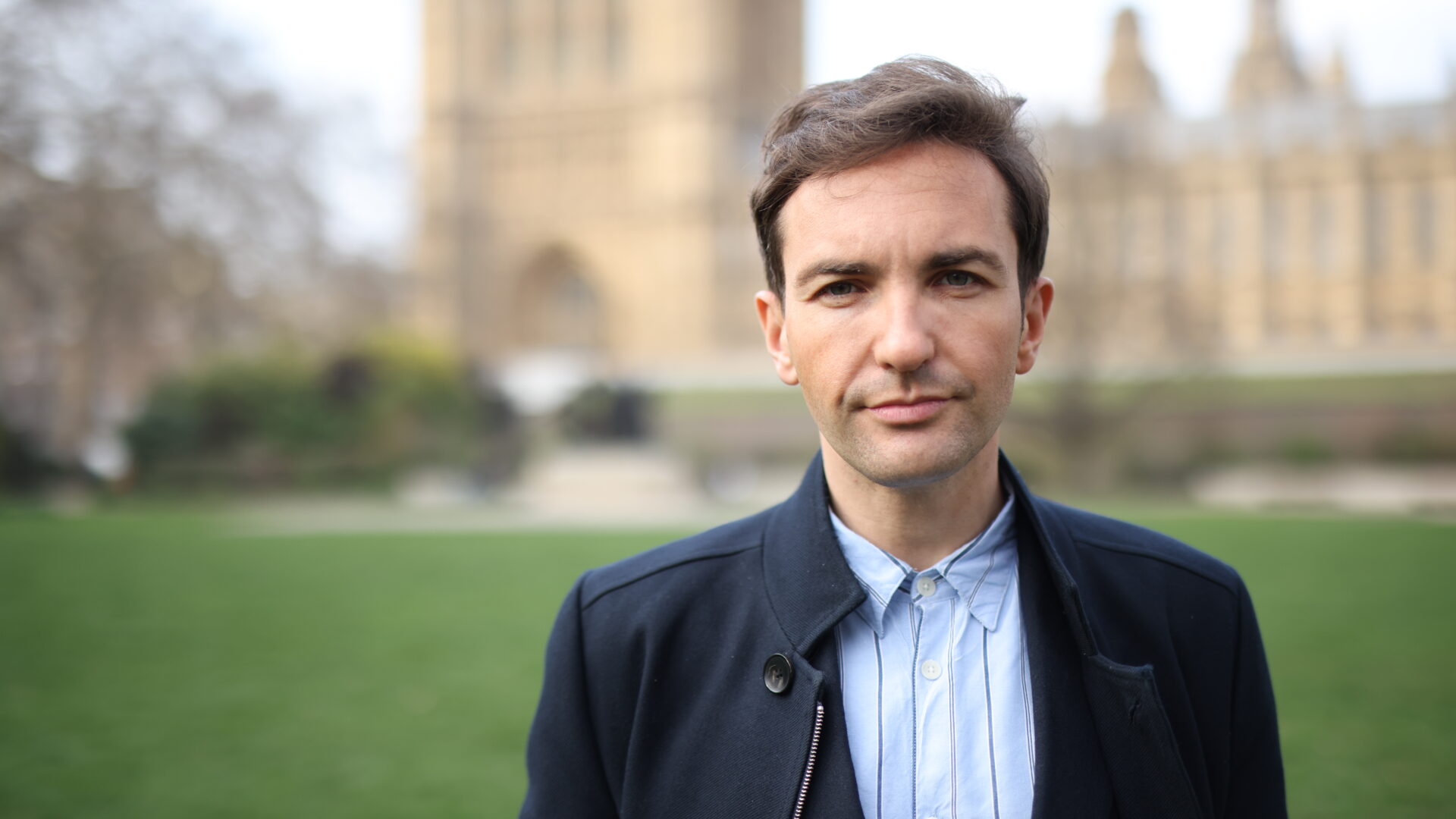
Lewis Goodall is a very busy man. Between co-hosting the hit daily podcast The News Agents, starring in LBC’s flagship Sunday radioshow, and winning awards for exposing government cover-ups, the journalist and broadcaster has very little spare time. So I’m grateful when he squeezes in a half hour Zoom call with me in the middle of his work day. He may be on a break but he remains professional; his demeanour as we make small talk before the interview is the same as when he presents a podcast to millions of listeners. Energetic and conversational, you get the sense that he is always firing on all cylinders.
Goodall, aged just 36, has already had a distinguished career, being at the centre of what is often described as the ‘podcast revolution’ in British media. In 2022, Goodall left a prestigious job as policy editor of the BBC’s Newsnight in order to start The News Agents with veteran journalists Emily Maitlis and Jon Sopel, a decision he says was regarded by many at the time as “a little fringe, a little eccentric”.
Nearly four years later, you can tell that he is happy with the gamble he made. In his view, not only have podcasts become “utterly central” to the way in which we consume news, but individual hosts “have become enormously influential, way more than a lot of legacy shows”. When you compare the dwindling viewership of Newsnight to the success of The News Agents, which boasts four million monthly listeners, it’s hard not to agree. Nonetheless, Goodall hasn’t entirely thrown his lot in with the ‘new media’ format. Regularly working with Sky and Channel 4, he keeps one foot firmly planted in the more traditional media world, giving him a unique vantage point from which to assess the shifting sands of British journalism.
Goodall, however, doesn’t view his career in terms of clear distinctions. “All these barriers between media are dissolving, integrating, coming to nothing”, he tells me. He points to the fact that podcasts are increasingly mimicking traditional news shows, with hosts shelling out enormous amounts to pay for cameras and professional studios. “Apple and Spotify, in the last three months, are moving to basically video-first platforms for podcasts”, he points out. “You’re watching TV news, it’s just taking a different form.”
To him, the key developments in the industry are less to do with the format, and more to do with the constant demand for news that social media has created. Instead of producing work for regularly scheduled deadlines, journalists now have to be constantly on it, ready with a special report or ‘emergency podcast’ whenever news breaks. “You are everything, everywhere, all at once”, he says. “That’s what modern media shows have to be. It means you have to have a visual offering, an audio offering, a social media offering in each and every direction, because it’s an utter competition for eyeballs in the attention economy in which we live.
“It’s exhausting, and it’s frustrating, and it’s relentless sometimes. But it’s also very exciting because we’re at a genuine moment of evolution in a media landscape which doesn’t come along very often.”
Goodall’s ability to be at ease with this rapid change is likely the product of having lived a life defined by seismic political and economic transformations. Goodall was raised by young parents on an estate in southwest Birmingham, experiencing a childhood shaped by de-industrialisation and the constant threatened closure of the Rover factory which employed his father. He was 7 when the Blair government came to power, ending 18 years of Tory dominance in British politics. For Goodall, this altered the direction of his life. Encouraged by Labour’s programme to increase the number of first-generation university students, he secured a place at Oxford University, studying History and Politics at St John’s College.
It’s clear that Goodall largely enjoyed his time at Oxford. “Look, as anyone who’s been there knows, it’s a deeply unusual place and a deeply unusual university experience”, he says. “There aren’t many times in your life where your job is to think about Thomas Hobbes, right? That’s a kind of really unique moment, which I realised about 18 months in, I think I enjoyed it a lot more when I did that.”
As was inevitable for a student from a working class background in the 2000s, Goodall encountered the prejudices of his more privileged peers. He recalls an instance where a “very charming guy” turned to him and declared “Oh Lewis, I love having you about. You’re the college’s bit of rough”. Goodall is remarkably relaxed about these run-ins, laughing the whole thing off: “That was the only time in my life, before or since, that I’ve ever been described as a bit of rough.”
If anything, Goodall’s background was a source of pride for him, rather than alienation. “I think what it gives you is just a license to be confident”, he reflects. “You’re gonna come across, both there and afterwards, some absolute chancers who, quite frankly, were it not for the circumstances of their birth, would probably not be where they were or are today.
“Sometimes they will realise where you’re from and try and intimidate you. I think, what Oxford does, it just gives you that iron clad confidence to be like: ‘No, I’m not going to be intimidated by you because I might not be where you’re from, but I’ve gotten where you’ve got to, at least on equal terms, if not actually with one hand behind my back’.”
After graduating in 2010, Goodall worked as a question writer for University Challenge, and then at the Institute for Public Policy Research, before landing a job at the BBC in 2012. He once again found himself at the centre of tumultuous change, as the BBC sought to get to grips with a news ecosystem being redefined by social media. “I remember when I started working in news because I was 24 and the editor was like: ‘So, I’ve done this thing called Facebook Live right? We thought maybe you could, like, be in charge of that.’”
So how exactly did these changes affect day to day reporting? “Without getting too History and Politics at Oxford about it, it’s just structure and agency”, he says. Social media, he recalls, enabled young reporters to build their own brand independent of their employers. “If I’d been a journalist 20 years before, and I wanted to do my story… I’d go through the processes. I’d pitch to my editor and then eventually the piece would appear on Newsnight. But of course, I was then coming through at a time where you were initially encouraged… to go directly to the viewers. So, by definition, you end up being more of a player and you yourself become part of discourse rather than the organisation you’re working for, who previously controlled all of that.”
After a while, he explains, the BBC sought to rein this in. Before long, Goodall found himself being called to meetings with higher-ups to discuss his social media presence. He tells a story of one instance in which he posted a run down about an election that had taken place in Norway and had to explain why he did so to his bosses. “I wasn’t being quizzed about the rights and wrongs of it, I doubt the BBC executive could even identify Norway on a map. It was more like, ‘why are you talking about that?’”
This is an issue which, to Goodall’s mind, the BBC still has not resolved. “Places like the BBC, they want to put the brand first, always. But people, intrinsically, for good or ill, when they’re going online now, look to individuals they identify with, and they like, and they respect. And the BBC, I think, in particular, has never been able to reconcile or find an accommodation between having those tall poppies, and letting them sit comfortably within the brand itself… My argument was always that organisations need to be able to harness that energy and harness that phenomenon, whether they like it or not.”
To Goodall, the BBC’s inability to get to grips with social media is an existential problem; one that reveals flaws in its model of impartiality. “I think these organisations have not thought enough about how to shift and change their journalism in this age in which everybody can have an opinion, in which everybody can complain to you absolutely instantly.” With the BBC, he says, “it became a question of ‘we need to manage perception’”, in which accusations of bias against reporters made on social media were automatically taken as valid, rather than investigated to see if they had any substance.
“There’s a difference between impartiality and neutrality. Anybody who is genuinely neutral is a block, you know, you’re brain dead. It would be bizarre if you went into journalism, particularly political journalism, to have no views, and no judgements about the political world around you. That makes you a worse journalist, a way worse journalist.”
As he speaks, Goodall becomes more and more animated, leaning into his laptop camera with his arms outstretched in front of him. It’s no wonder that his feelings are so strong on this matter, given the number of times he’s been at the centre of impartiality rows himself. Some of these were easily dismissed – he laughingly recalls when, while working at Sky News between 2016-2020, he was accused on social media of bias because he had served as a Youth Officer for the local Birmingham Labour Party when he was 15.
Others, however, were far more threatening to his career. In 2020, BBC board member and former conservative party communications chief Robbie Gibb publicly suggested that Goodall had a left-wing bias. Goodall clapped back, tweeting “thanks for this Robbie. Maybe one day, if I’m as impartial as you, I can get a knighthood too”. Goodall later stated that the failure of his editors to stand up for him, instead allegedly warning him to “be careful: Robbie is watching you”, motivated him to leave the BBC in 2022.
Our discussion comes only a few months after another impartiality controversy at the BBC, in which the BBC’s director general and as its head of news resigned after a memo by a former external advisor accusing the organisation of a left-wing bias was published in the press. I ask Goodall what he made of this episode, particularly in the light of his own experience at the organisation. To him, the BBC allows “impartiality to be a stick that is used to beat them, and they allow that because they basically subscribe to what I would describe as a completely hollow view of impartiality”.
He says that, during his time at the BBC, there was an obsession with the criticism coming from the right that “they were a bunch of liberal metropolitan elites or whatever. That was the bias of which they were most aware, and they were constantly guarding against. I can’t remember anybody being terribly worked up if we were being biased about the Green Party, or the Communist Party, or the Socialists, or whatever it happens to be”.
Goodall believes that the BBC continues to be far too deferential to criticisms levied at it in bad faith. “It got inside their heads far too successfully. They didn’t have a genuine theory of impartiality. Their theory of impartiality was defined by their worst enemies and continues to be. And guess what? They get no credit for that, none. Because their worst enemies continue to be their worst enemies. All day long.”
One gets the sense that Goodall could talk about this topic for hours, but with my allotted time fast running out, I steer the conversation towards another British institution which seems unable to adapt to a changing media landscape: the government. How well does he think the Labour Party has spread its message in the age of podcasts, reels, and social media? “I don’t think Labour have been very good at it partly because they’ve been worried about pissing off the newspapers too much”, he says. “I think it’s ridiculous, by the way, the power of the lobby and some of the established newspapers continues to be very strong, despite the fact that their readership has never been less.”
“For Labour, this current media environment actually should be a real opportunity for them”, he says. “Because one of Labour’s big structural problems historically has obviously been the dominance of the right wing press in British political media.” This, he argues, left them with two options: either reject it (à la Corbyn) or pander to it as Blair did, both of which have proved problematic in the past. “Now they’ve got a third option, which is that they can help create a new news ecosystem which is, if not more intrinsically favourable to them, at least less hostile to them… I have been surprised by how little those at the top of the Labour party, over the last couple of years, have been interested in developing that new media space to their benefit.”
This brings us to the topic of Goodall’s latest project; a Channel 4 documentary exploring why Keir Starmer’s government, less than two years after a historic landslide, is so unpopular. So, what exactly is it that interests Goodall so much about Starmer, a man that many describe as profoundly uninteresting? “I think there’s a sort of personal paradox… This is a man who’s reached the apex of our politics, who is clearly driven by a deep sense of personal ambition. And yet, he’s also a man who, in so many ways, I know this from personal conversations with him, loathes politics, abhors politics, is, in some ways, very anti-political.”
He points to the fact that even Morgan McSweeney, the former Downing Street Chief of Staff, supposedly could never reliably predict what Starmer’s thoughts on an issue would be, as a result of the prime minister’s lack of instinctual political beliefs. “That fascinates me. You have a man willing to make profound personal and familial sacrifices, because being Prime Minister is basically horrible, for all the glory of it, it’s basically vile, like day to day. So what sustains it? He’s a deeply unusual political figure, sphinx-like in that way.”
It is certainly an interesting time for this documentary to come out. Many had assumed, in the absence of Starmer’s own political beliefs, that McSweeney was setting much of the policy direction of the government. But with Starmer’s right hand man booted out of No. 10 earlier this year, no-one is quite sure who is now setting the agenda. “There’s a horrible cliche in politics”, Goodall says, “which like most cliches in modern politics, basically comes from West Wing: ‘Now you can let Starmer be Starmer’.
“But that’s the question, is there a Starmer to be Starmer? Without getting too Shakespearean about it, is there an authentic, real Starmer? I think it remains to be seen, the extent to which he’s just going to be moulded again, or whether he’ll try and finally do the moulding.”
It’s hard to know how all the ongoing transformations that we have discussed will play out. Will the government take a new direction? How will the media landscape continue to evolve? Will broadcasters like the BBC adapt, or end up on the scrap heap? One thing, however, is clear: Lewis Goodall is no stranger to rapid change and, as ever, he plans to make the most of it.
‘Keir Starmer: where did it all go wrong?’ is available to watch now on Channel 4.


