

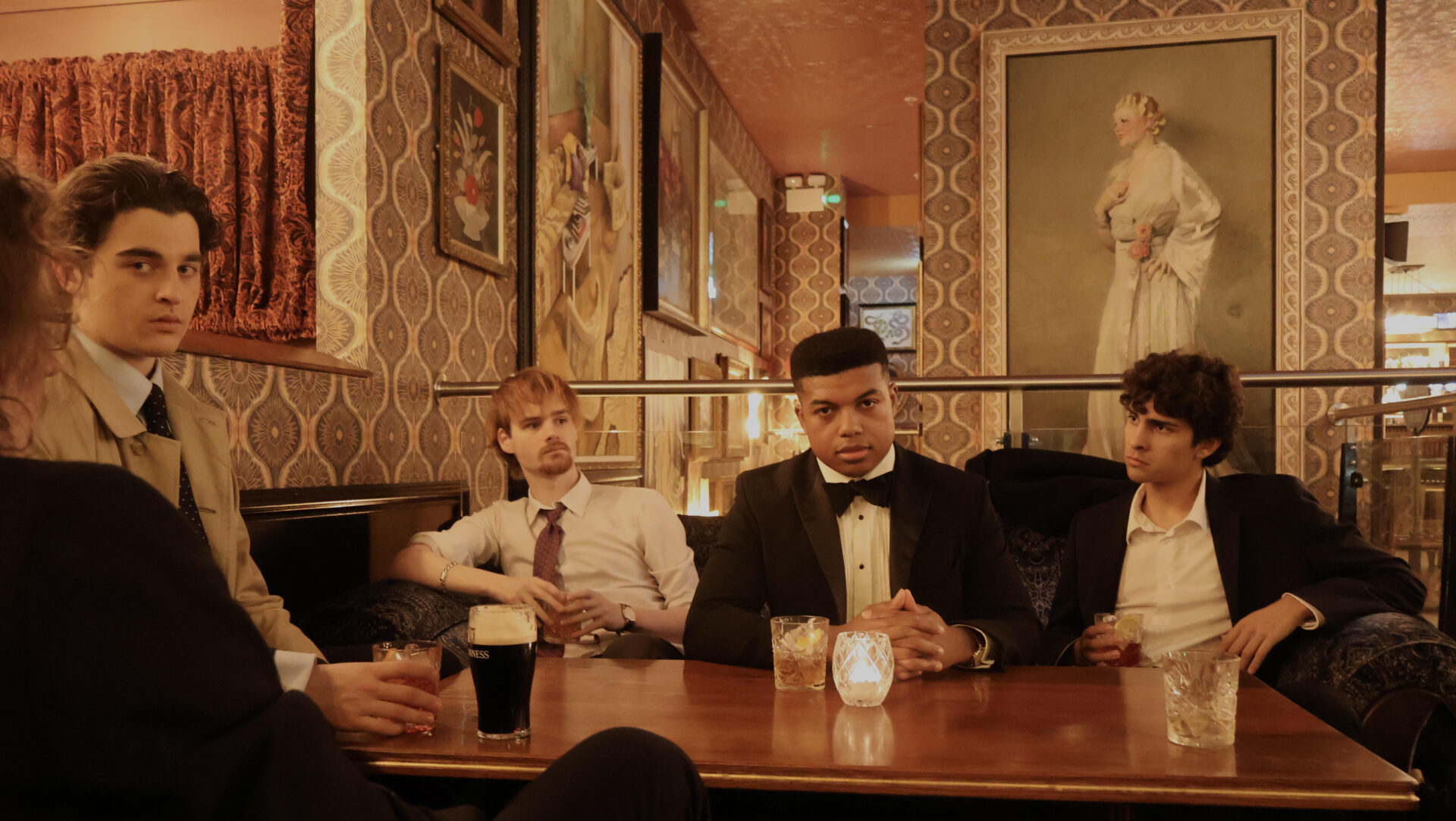
The directors, Cameron Spruce and Stanley Toyne, had previously sat down with me for a wide-ranging interview about their hopes and visions for their production. From issues with booking a space to the complexities involved in transferring an Elizabethan play set in medieval Scotland to the streets and backrooms of the mafioso lifestyle, their play was nothing if not ambitious. Both elements, the mafia and Macbeth, are common cultural touchstones, the former in such important works as The Godfather, Goodfellas, Casino, and The Sopranos, and the latter in countless renditions over the years and across the world. I entered the chapel with one question: how could a student production fare in attempting to combine these two?
The core plot points of Macbeth – the witches, Macbeth and Lady Macbeth’s overarching ambition, and how, in their moment of success, they confirm their downfall – don’t require excessive explanation. Most students will have looked at the play in GCSE English, but few will have seen it performed to such quality, and doing such justice to the Bard’s thematic vision, as the audience in Somerville Chapel. To get over my minor gripes with the play before discussing its numerous strengths, I must say that the shouting of both Tristan Morse’s Macbeth and Sam Gosmore’s Macduff grew slightly trying, and ended up harming rather than adding to the depth of their characterisation. Occasionally, the scene changes would take a beat too long but, given the size of this production, this is understandable. The lighting, again understandably for the first night of a production, would at moments settle on the wrong spot, including my face for about half a minute.
Having dealt with my concerns, the strengths of the performance’s design merit consideration. The lighting is dynamically done, aligning perfectly with Peter Hardistry’s organ score – which Toyne had previously called the “motivic glue” of the play – to draw the audience’s attention to whom the directors want you to focus on at any one time. It is used to particularly great effect during the scene with Banquo’s ghost at the feast, as he appears on the loft before the organ – an excellent use of the space’s inherent levels to capture Macbeth’s decline. The space of the chapel itself is also exploited well, with Duncan’s funeral capturing both the sombre passing of a king and the political scheming of a mafioso.
The performances themselves are all stellar, bar the aforementioned few small frustrations. Of particular note are Amber Meeson’s Lady Macbeth, Mary Stillman’s first witch, and Darian Murray-Griffiths’ Duncan. Meeson’s portrayal of one of the play’s core characters is nuanced and meaningful. It takes the undeniable ambition and excitement of the opportunity for advancement on Duncan’s death with a well-suppressed, yet present, self-doubt, with her viciousness towards Macbeth coming from a place of internal insecurity. As Macbeth gains more agency and begins conspiring – against Banquo and the Macduffs – her plans, and public edifice, begin to unravel, culminating in a very well delivered “will these hands ne’er be clean” scene. Murray-Griffiths’ Duncan has something of Marlon Brando about him, someone highly respected in his circles and affectionate towards his friends, but still a politician in his own world, and one whose absence is felt throughout the rest of the play. Stillman’s first witch, the leader of three who each capture a distinct element of the mob life, holds an authority and power that Macbeth desperately yearns for. The witches are the agents of Macbeth’s worst avarices, perfectly straddling the line between the mystical and the real.
Most intriguing of all the changes to the traditional performance, however, is Zoe Obeng’s Malcolm. Rather than being a relatively minor character, only present at the beginning by kickstarting Macbeth’s self-advancement, and usurping him at the end, Obeng’s prince dominates the entire plot. They are political in their own right, harrying Macduff to determine his loyalty before bringing him into their circle of amity once his family has died. It is a phenomenal change that brings meaning to an otherwise bland character.
Shakespeare revivals must tread a fine line: too often they turn into one-actor vehicles or experiments, or shipwreck upon the squall of their adaptation. Spruce and Toyne’s Macbeth does neither; it is well directed, confidently acted, and assuredly produced. It does right by the Bard’s legacy, giving a well-worn story a fresh lease of life.


