

When a Princeton student got into the University of Oxford’s visiting student programme at Worcester College, one of their first concerns wasn’t about housing or tutorials – but money. “At first, I wasn’t sure how much exactly Princeton would cover”, the student told Cherwell. “You have to make a budget proposal to them, itemising expenses like tuition, room, and board for your study abroad program”.
“Thankfully”, the student told Cherwell, they could afford it. “They actually gave me more than I needed”.
Unlike course fees paid by matriculated students – centralised by the University at £9,790 for home students and between £37,380 and £62,820 for overseas students – visiting student fees are determined independently by colleges. According to Freedom of Information requests by Cherwell, at least 24 colleges offer places for visiting students, five more than the 18 listed on the University’s website, which notes that the information is “indicative only” and “subject to change”.
As of 1st December 2025, 585 students were listed as “visiting, recognised or other” under the Visiting Non-Matriculated Programme, about 2% of Oxford’s total enrollment. Students with this status can attend lectures and use university libraries, and have full privileges at the colleges they attend, including joining the JCR.
Programmes offered
Many of Oxford’s visiting students come from direct partnerships or memoranda of understanding with other universities. Worcester, for example, has direct partnerships with Harvard, Princeton, Swarthmore, and Wellesley.
Most partnerships are with private American institutions, including Ivy League universities such as Yale and Dartmouth, and liberal arts colleges such as Sarah Lawrence College and Williams College – schools where the total cost of attendance can exceed $98,000. A few American public universities also have partnerships with colleges, alongside universities outside the United States, such as Tsinghua University and the University of Hong Kong. Some universities, like Sciences Po, also have partnerships with the University itself or affiliated departments, which assign colleges later.
For students whose home institutions lack direct partnerships with Oxford, the only opportunity to enrol as a visiting student is through a study abroad provider. For North American students, three main providers operate in Oxford: Arcadia Abroad, Institute for Study Abroad (IFSA), and Oxford Study Abroad Programme (OSAP).
Both Arcadia and IFSA offer placements at Herford, Lady Margaret Hall, Mansfield, St Anne’s, St Catherine’s, St Edmund Hall, and Worcester, while IFSA also offers additional placements at Regent’s Park and St Hilda’s. OSAP has partnerships with Magdalen and New, alongside “associate member” options at New, Oriel, and Trinity.
The Oxford Prospects Programme, meanwhile, offers year-long visiting student programmes for students from Chinese universities at Blackfriars, Mansfield, Pembroke, Regent’s Park, St. Anne’s, St. Peter’s, and Worcester.
Visiting students – both those from direct partnerships and study abroad providers – stay in Oxford for varying amounts of time, either for one or two terms or the full year. Hertford, Lady Margaret Hall, and St Anne’s also offer extended fall programmes that begin in September to align with some universities’ semester systems.
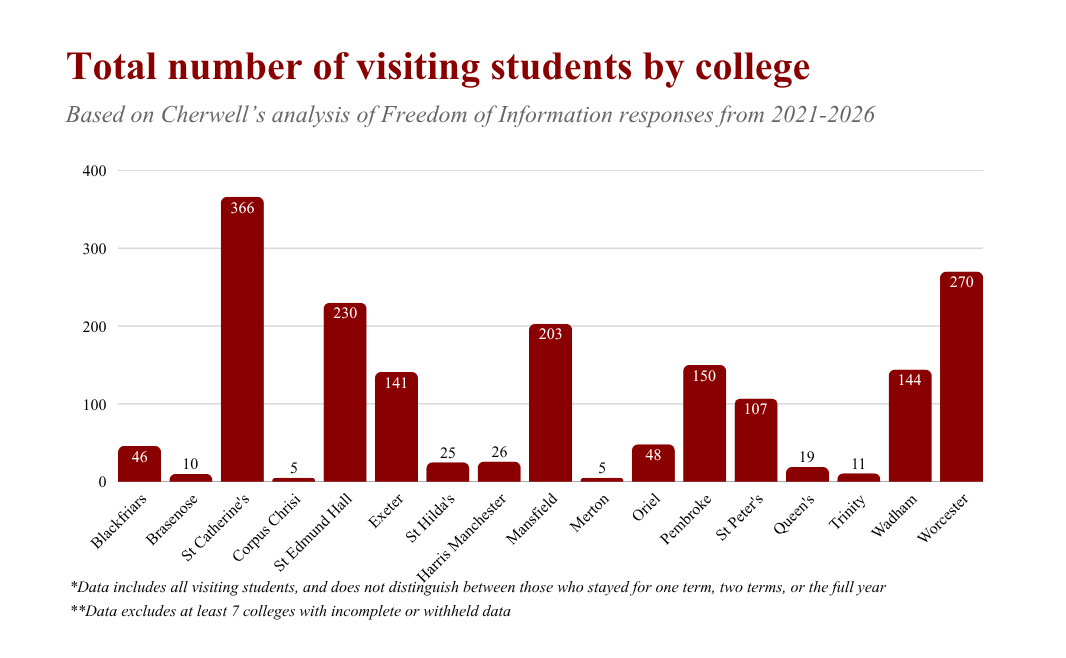
Among all 23 colleges with visiting students, the number varies. In 2025, St Catherine’s had the most visiting students listed with 55, or about 5% of the college’s total enrolment, having hosted 366 total visiting students since 2021. Corpus Christi, on the other hand, offers the fewest places: just one student per year from the University of Missouri.
Cost of attendance
In general, visiting student fees – for students coming from direct partnerships – are broadly comparable to overseas fees, which range from £37,380 to £62,820 in tuition costs. However, the cost of attendance varies by college, subject, and home institution.
For instance, some colleges, like St Edmund Hall, adjust fees on subjects, charging students between £50,391 and £63,381 per year, including food and accommodation. Other colleges have a flat fee regardless of course, such as Mansfield, which charges students £46,000 per year.
There is no central register of what colleges charge. The University’s website notes that “fees are set and published by each individual college”, and many direct partnerships involve their own financial agreements. Several colleges withheld fee arrangements from Cherwell under Section 43(2) of the Freedom of Information Act 2000, citing commercial sensitivity, meaning the cost of some programmes is not available through legal disclosure.
Still, a student’s financial situation might affect actual costs. St Edmund Hall, for instance, offers a scholarship fund for American students and one for students from UNC-Chapel Hill. Students may also receive additional funding from their home institution.
For example, the Princeton student at Worcester told Cherwell that Princeton – where they are on full financial aid – covered all tuition and accommodation costs, as well as an additional stipend for living costs. “I was surprised by the leeway they gave me”, the student told Cherwell, though the student added they are “not sure if they do this for all students on full financial aid”.
For visiting students enrolling through a third-party provider, the costs are higher still.
At both Arcadia and IFSA, the fees paid differ both by college and the program. For instance, the total programme fee at Arcadia ranges from $73,995 at Mansfield to $87,995 at Worcester. IFSA, meanwhile, ranges in price from $69,095 at Regent’s Park to $81,085 at Worcester, with premedical students at St Anne’s paying $90,505.
The breakdown of fees into tuition, food, and accommodation also varies among colleges. For example, Arcadia students at Mansfield pay $53,705 in tuition and $20,290 in food and accommodation, while the same visiting students at Worcester pay $77,155 in tuition and $10,840 in food and accommodation. Among all colleges with Arcadia and IFSA programmes, tuition fees range from $49,850 to $78,645, while food and accommodation fees range from $7,790 to $20,375.
For both Arcadia and IFSA visiting students, the price remains higher than direct partnerships or applications to Oxford. For example, Mansfield costs $73,995 for Arcadia students and $70,225 for IFSA students. Converted to roughly £54,200 and £51,500, the price is more than what regular visiting students at Mansfield pay, set at £46,000 per year.
OSAP’s fees are higher again. Registered visiting students pay $89,400 per year, with an additional $6,000 surcharge for certain STEM subjects. Even associate members – who have fewer privileges – pay $23,700 per term, leading to a yearly cost of $71,100.
For visiting students coming through third-party services, one reason for the higher cost is the additional support and opportunities the organisations provide. For example, a spokesperson for IFSA told Cherwell that “all IFSA students receive a bespoke 3-day orientation from IFSA in Oxford” alongside other benefits, like health and safety support, private insurance, an IFSA staff member in Oxford, and the transfer of academic credit.
One visiting student who enrolled in Oxford through IFSA told Cherwell that financial arrangements have been “fairly straightforward” with IFSA acting as “a middleman”. “I can imagine how, if I were dealing with this directly through Worcester, I would be incredibly frustrated.” The student added, “since they have made it so difficult to get anything done”.
Total revenue
Across colleges that disclosed figures in response to Cherwell’s Freedom of Information requests, visiting student fees have generated substantial and growing income.
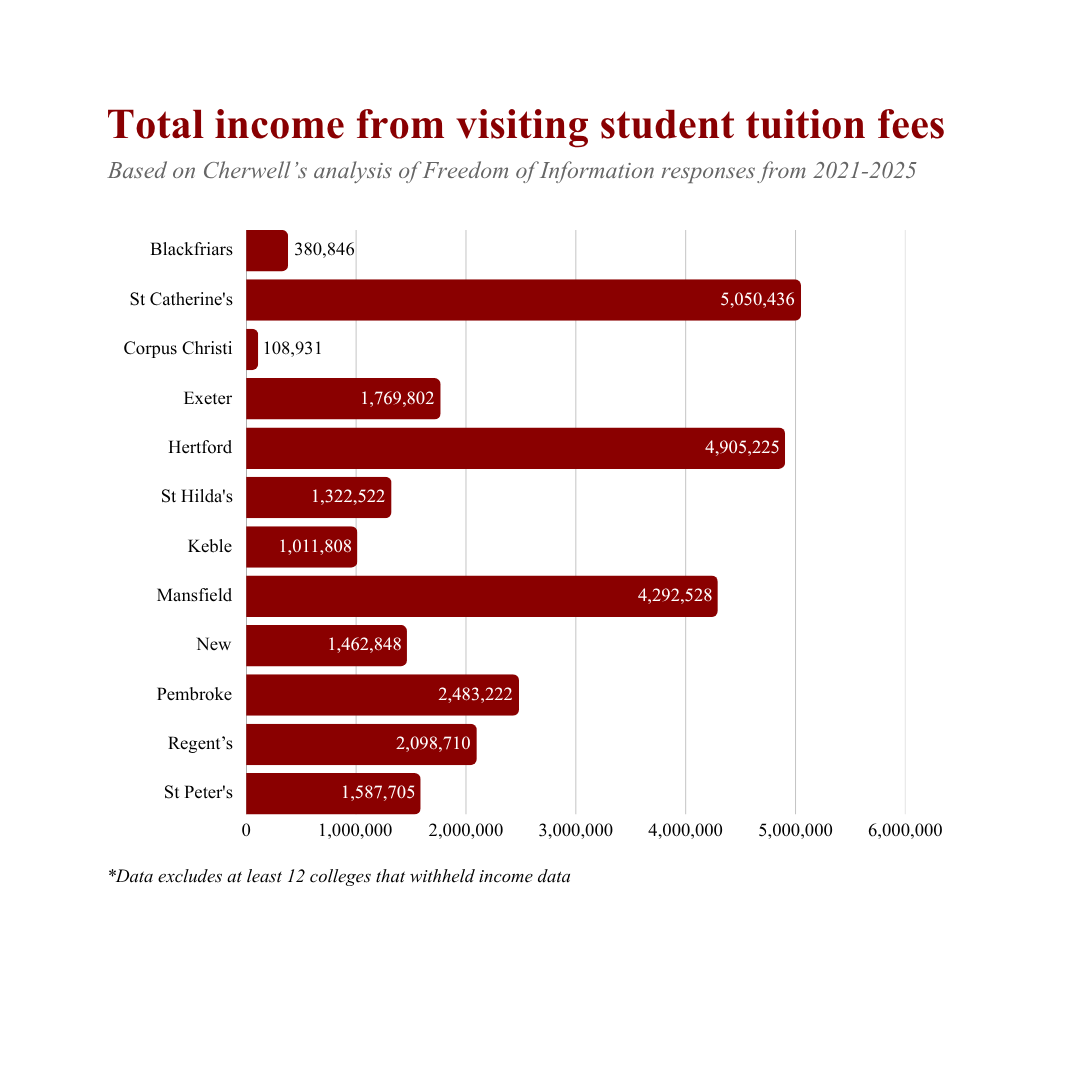
St Catherine’s collected more income from visiting student tuition fees than any other disclosing college, earning £5,050,436 from 2021 to 2025. During the same period, Mansfield took in £4,292,528, while Pembroke collected £2,483,222.
Income collected from visiting student fees has also grown at several colleges over the last few years. For instance, St Peter’s earned £233,101 from visiting student fees during the 2021-22 academic year, compared to £573,760 in 2024-25. Meanwhile, St Hilda’s income rose from £200,292 in 2023-24 to £500,730 in 2024-25 – a roughly 150% increase.
Across the twelve colleges that disclosed figures, the total income from visiting student tuition fees from 2021 to 2025 amounted to £26,474,583. As a number of colleges withheld total figures, this figure likely underestimates the actual amount earned by Oxford colleges.
Still, one visiting student from a European university told Cherwell they found the fees they were paying their college “disproportionately high”. “I find it lamentable”, they added, “how visiting students have … contracts which are clearly motivated by colleges’ interest to earn more money”.
Arcadia and OSAP were contacted for comment.


