

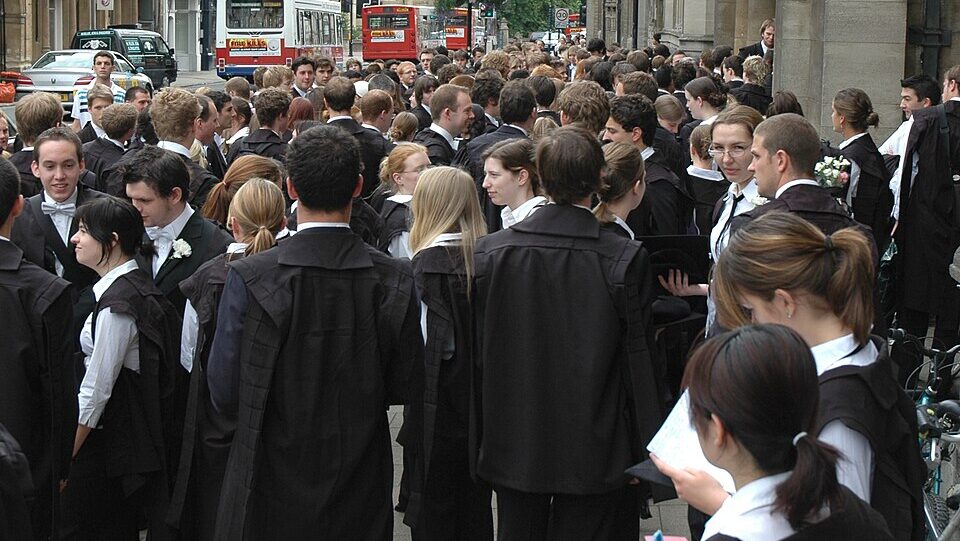
At my matriculation, I remember laughing with my friends about how it seemed that the entirety of Oxford had been “overrun by penguins”. Everywhere you looked, you would see sub fusc, that bizarre getup that the University demands be worn for its official ceremonies and exams. During my first Michaelmas, as the weather got colder, it was impossible to walk about town and not see herds of students in college puffers, and I soon learned to recognise the various college crests embossed on them. Later, on nights out, you could always recognise a group of Oxford students by their (by then, slightly out-of-kilter) black tie. With all these sightings of homogeneous clothing, it seemed to me as though people spent more time in ‘uniform’ at Oxford than they would have done in sixth form or high school beforehand. But does Oxford really have ‘uniforms’? How might we define them? And what purpose might they serve?
Does Oxford have ‘uniforms’?
When the term first entered English about 1748, according to the Oxford English Dictionary, a uniform was “a distinctive dress of uniform cut, materials, and colour worn by all the members of a particular naval, military, or other force to which it is recognized as properly belonging and peculiar”. Aside from the definition’s militaristic associations, what interests me is the adjective “peculiar”, here meaning “exclusive” or “unique”. While we might think of uniform as simply meaning sartorial homogeneity, lots of uniforms also stand out for their unique oddness and lack of any general practicality: school blazers, to use a well-known example from the UK, are really rather constricting, useful only when you have copious items to store within their many pockets. They are often brightly and strangely coloured too. Nobody would wear them in any other context outside of school.
There is a second definition of “uniform” in the OED, in use since 1930: “The customary dress or mode of appearance characteristic of persons of a certain age, class, or lifestyle.” This marks a semantic widening: a term that entered English with quite specific reference to the flamboyant military uniforms characteristic of the 18th century, had by the 20th century broadened its meaning to any recognisable mode of dress.
Where, then, does Oxford fit into this? What might count as uniforms in Oxford? First to mind come sub fusc and academic gowns, black tie (and indeed white tie for those rather fancy balls), and college merchandise.
Sub fusc, as the oldest of the bunch, seems to fit most closely with the 1748 definition. It certainly is ‘peculiar’, as the joke about the “penguins” illustrates. Both black tie and college merchandise, on the other hand, seem closer to our 1930 definition. They could certainly be said to be ‘characteristic’ of Oxford students. The one factor that legitimates all of these forms of dress, however, which makes their ‘peculiarity’ acceptable, is the context of the University. Sub fusc, black tie, and college merchandise all link to that institutional power and prestige. These can be called ‘uniforms’ in the sense that they are homogenised forms of dress, unique and peculiar to Oxford.
College puffers
In order to find out how college merchandise is purchased and received by students, Cherwell reached out to JCRs to find out the popularity of merchandise, whether students thought it could be considered a ‘uniform’, and in what ways it was different from the other ‘uniforms’ that we have discussed thus far.
The Oriel College JCR President told Cherwell: “Oriel JCR donates all the proceeds from stash orders to a charity chosen by students.” This, in comparison to sub fusc or black tie, shows that there is a much more altruistic motive to purchase merchandise. Buying college stash is an act of goodwill as much as it might be a consequence of wanting to be seen belonging to the University.
At other colleges, proceeds from stash sales may go back into the JCR. The Keble College JCR President told Cherwell that Keble’s stash sales represent about 5% of their annual budget. In Michaelmas and Hilary this year, Keble sold 148 quarter-zip fleeces and 89 puffers, to a cohort of just 124 new undergraduates this year. The quarter-zips were the most popular item – interesting to note, as it shows the idea that college puffers are the most popular choice to be something of a myth. Even accounting for older students, it seems likely that well over half of the freshers bought a puffer, and likely even more bought a quarter-zip.
It is clear that college stash, as a purchase made by choice, and with proceeds going to JCRs or to charities, is acquired in a very different context to sub fusc or black tie, and so has a very different meaning to students. It is an optional purchase, and not a cheap one at that: in Corpus Christi’s stash drop, a college puffer will set you back £42.99. Nevertheless, the popularity of the college puffer and of college merchandise more generally persists. Why is this? Do students feel obligated to buy one because of their popularity? Or do they simply want to express pride for their college and for Oxford?
Mansfield’s JCR president told Cherwell that the stash is “really helpful for college culture – we’re a small college, and not as well-known, so it’s nice to have branded coats and jumpers you can wear around.” The JCR president also noted: “I’m not sure I would call them uniforms, especially since some people are more self-conscious about wearing them in a group.” Even among students, then, sometimes the puffers and college merchandise aren’t seen as uniforms inspiring pride or evoking distinction; in fact, there is fear of exactly that.
So, college merchandise is not regularly perceived as a ‘uniform’ by those who enjoy wearing it. However, if we consider the puffer sceptics, the fact that some are conscious to avoid being seen in an “Oxford uniform” shows that, in fact, that’s the way they are already perceiving the puffers. This aversion is not trivial: it shows that some people do see college puffers as uniform-like, or that there is a risk of them becoming like uniforms.
It is also worth considering the significance of the branded puffer outside of Oxford. Many people choose to wear them at home – and many don’t. On the one hand, some people see them simply as practical coats, and others want, maybe if only a little, to show off the fact that they’ve made it to Oxford. On the other hand, for some, the meaning of the college puffer loses its significance a little outside of Oxford; without the context of many others wearing similar attire and the proximity to the University, the puffer once again becomes ‘peculiar’, and feels odd to wear. All of this is to say, while the puffer might for some be a fun way of expressing college pride and camaraderie, for others, there is the slight fear of them being peculiar, and of them feeling too much like uniforms to be worn outside of the context they came from.
Sub fusc and black tie
The University website describes sub fusc as “solemn and modest, in line with our ceremonies”.
The English student in me jumped at the chance to look into some of the language being used to describe it here. By being linked to ceremony, sub fusc is, by extension, linked to the power and prestige that it represents. Oxford students wear sub fusc as a reminder of the gravity of these shared rituals and the history of the institution. It is not a “characteristic mode of dress” in the sense of the expanded, 1930 definition of uniform, but rather a form of dress associated with specific events: collections, exams, matriculation. Its “peculiarity” and association with ceremony perhaps make it more of a traditional uniform than the college stash. While college puffers have a much more immediate purpose of fostering college community, sub fusc goes straight back to the heart of the University’s traditions and their roots in prestige and solemnity.
Additionally, as part of sub fusc, gowns group students into different categories. Those who have achieved a first in their Prelims or Mods, or those who have attained other scholarships, can wear scholar’s gowns, while the rest of the student population wear commoner’s gowns. While some may feel that it’s an exciting challenge to aim high in order to ‘win’ a fancier gown, it can also certainly be seen as problematic that students’ academic standing can be ‘read’ by anyone simply from what they are wearing. Is this something that we really need to distinguish in dress?
Related to sub fusc is, of course, black tie. This is a necessity for formal events, and it’s hard to walk around Oxford at night without bumping into a group in formal attire of some kind. While for most people coming to Oxford, having to regularly wear black tie is a novelty, it quickly becomes normalised. Sometimes, it’s easy to forget that, at most other universities, black ties and formal dinners are a rarity– if they happen at all. It’s only stepping out of the ‘Oxford bubble’ that reveals, once more, as with the puffers, the essential idiosyncrasy and peculiarity of wearing black tie on a regular basis. But the fact that this rather expensive kind of dress is effectively mandated in order to attend formal events leads us to a major problem with these ‘uniforms’ of Oxford.
Who is included?
Thinking about the ‘uniforms’ that Oxford has also means thinking about who they include – and who they don’t. First, the ‘uniforms’ mentioned here: college merch, sub fusc, black tie, all lie behind a paywall. While college merch is, strictly speaking, optional, the others aren’t, and so new students find themselves immediately having to fork over money in order to participate in the university community. Good luck going to a formal dinner, for example, without a suit and tie, or a fancy dress. Some students, unaware that these extra purchases are in order, find themselves frantically rushing about trying to buy a hat and gown before matriculation, and having to forgo formals for the simple fact of not having the right clothing.
And college merchandise isn’t cheap, either. While you don’t need a college puffer or a jumper, the fact that they help to foster a sense of camaraderie within colleges could mean that those who can’t really spare the cash to buy one might feel, to a certain extent, that they are less a part of that community for not having one.
Fortunately, there have been efforts made to improve accessibility. Oxford Class Act Society, a society “for working class, state comp, low income, first generation, care experienced, estranged, young carer & foundation year students at Oxford”, runs the Free Sub Fusc Scheme, where new students can apply to receive old sub fusc donated by leaving students for free. Not only does this save students from disadvantaged backgrounds from having to give money that they may not have to spare in order to buy academic dress, but it also means that gowns and mortar boards that are bought stay in use for longer, reducing wastage.
The sub-fusc penguins waddle on
As freshers and exam-goers waddle penguin-like through town in their black gowns, the peculiar sight impresses upon onlookers and participants alike that certain forms of dress can connote and foster seriousness, solemnity, or academic vigour. The “peculiarity” of uniforms, the fact that they are so out of the ordinary, is perhaps part of their strange allure, and the potential reason that drew some of us to Oxford in the first place. Sub fusc and black tie are peculiar, and have a direct relationship with the University’s systems and traditions.
While those seem to be “uniforms” in a more traditional sense, college stash, although prevalent enough to be considered a uniform by some, isn’t nearly as institutionally attached, nor traditionally entrenched. Perhaps the key distinction is between the forms of dress the university imposes upon us, and those we choose to participate in. One is “peculiar”, placing us in close proximity to the history and tradition that Oxford has held. The other fosters a feeling of voluntary community. Both might well be “uniforms”, but they serve different purposes and effects.
But uniforms, in whatever their form, place us into groups. They mark us out from others. Sometimes this can be a positive thing. For example, college merchandise serves to foster a sense of community. But the fact that uniforms put us into groups means, inevitably, that some are excluded from those groups. Those with lower income are disadvantaged by having to ‘buy in’ to the uniforms that Oxford demands they wear. For some, black tie, sub fusc, and college merchandise may be a normality, or will easily become one. For others, they are ‘peculiar’, lie behind an uncomfortable paywall, and may come to represent a feeling of alienation, rather than a feeling of pride and inclusion.