

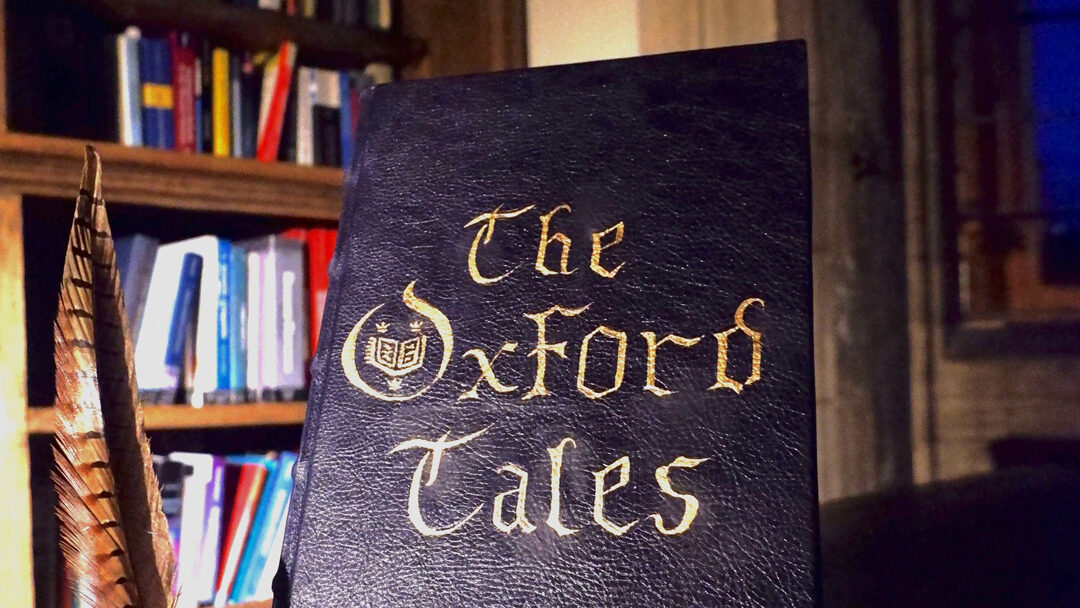
It’s no secret that Oxford has long been an idealised location for film sets; official-looking SUVs with blacked-out windows and attendants in high vis parading up and down Catte Street and around the Rad Cam are a not-unfamiliar sight. What’s missing from a lot of representations of Oxford in film, however, is a more nuanced take on the student perspective. It makes sense, then, that a key aim of the Oxford University Filmmaking Foundations’ anthology project, ‘The Oxford Tales’, was to platform the plethora of student talent at the university.
The screening of the five films in the anthology responding to the theme ‘Oxford Tales’ was the culmination of a process which had been underway since September 2024, and took place at the Schwarzman Centre on Friday, 22nd May. I was fortunate to be invited by Charlie James, creator of the project and president of OUFF from 2024-25. James informed me that ‘The Oxford Tales’ has been the ‘largest student film project in Oxford’s history’, involving around 136 students in the actual filmmaking process, in addition to the 100 who submitted scripts for the competition. The project is also notable because of the names it has behind it – acting as mentors for the project were Mike Newell, director of Four Weddings and a Funeral and Harry Potter and the Goblet of Fire, and Cleone Clarke, who produced The Father and Loving Vincent. Following the scriptwriting competition, which saw five scripts selected by the directors, Kenneth Lonergan (Manchester By the Sea, Gangs of New York) led a script development session.
With a celebrity heritage consisting of actors like Hugh Grant and Imogen Stubbs, the OUFF isn’t exactly a stranger to attracting such attention, but what is clear is the joint enthusiasm Newell and Clarke had for this project. Originally invited by OUFF to give a talk, Newell commented that he found that the “appetite” for filmmaking in the Oxford student sphere was such that he was inspired to offer a filmmaking masterclass, and from there, the idea of ‘The Oxford Tales’ anthology began to develop. Prior to the screening, Newell expressed enthusiasm about the idea of this project kickstarting a “movement” which could potentially spread to other universities: “It would be a real waste” if this was the only time such a project took place, he commented, and was matched in his enthusiasm by Clarke, who remarked that it was an “honour” to be involved in the project.
The atmosphere before the screening was tense, to say the least. Collected in front of the entrance to the cinema in the main atrium of the Schwarzman, some students buzzed excitedly about the process and Newell and Clarke’s attendance, eager to talk to the film giants, whilst others baulked at the prospect of seeing their film on the big screen for the first time. As Newell commented, seeing your own film is “horrible”, but at the same time, it can be “tremendously invigorating” to see the result.
The films themselves covered a range of topics and genres, such as the horror-comedy Food For Thought, which told the story of an English student, Myra (Irisa Kwok) who, after nurturing suspicions that her tutorial partner Victor (Gilon Fox) isn’t quite what he seems, discovers that his desire to “consume” knowledge has led him to, literally, eat books. This obsession quickly turns dark, leading him to murder (and presumably, cannibalise) their tutor. Following the same comedic inclinations was the mockumentary-style film Hinkssie, in which the Oxford University Loch Ness Monster Sighting Society (OULNMSS), headed by the overzealous Jacob Beaumont (Zee Lloyd-Elliot), will do anything they can to get funding for their trip to Loch Ness – after numerous hiccups, their fortunes finally reverse after they fish a severed hand out of Hinksey Lake, using the diamond ring on one of the fingers to fund their trip. Cherwell even gets a mention, apparently describing the society as “monster freaks”.
Comedy indeed seemed the favoured genre across the anthology, with the slapstick Free Drinks (in, exchange for as we are told by a note on the door to a college bar, “items stolen from other colleges”) taking the crown for most absurdity – starting off tame, the spoils become progressively more daring, including “Brasenose fourth year classicist’s hair”, and an actual dog (played expertly by Keble’s Rievaulx). The quest for free booze, mingled with the specific flavour of rivalry particular to the Oxford collegiate system (or, perhaps, that of 20-somethings desperate for a free pint) inevitably ends in a chaotic bar brawl-stroke-bloodbath. Following a simple but effective concept, the directors also emphasised the collaborative nature of the process, commenting that she encouraged the crew to contribute their own ideas during filming.
It wasn’t always a smooth process, though. Boyi Li, one of the directors of Hinkssie, recalled the challenges of navigating numerous issues such as dead batteries and volatile weather; budget was another issue, with the producers having to be creative about which sets they used – one of the library scenes in Food For Thought, for example, was clearly filmed in two different locations, whilst the directors of Thursday (Julia M. Schaub and Sophie Duffin-Jones) had to combat scheduling conflicts and the Herculean task of creating a believable hospital set on a miniscule budget. But, as one of the directors of Free Drinks, Marnie Rodriguez-Skellon, remarked, “with constraints come creativity”, and this was particularly true for Freshers, which utilised various spots around St John’s College, a montage of blurry club photographs from a film camera and the streets of Oxford for its set. The final scene, filmed in what appeared to be a back street somewhere between Merton and Corpus Christi, was particularly moving; as a group of carolers sing softly in the background, huddled under the light of a street lamp, the protagonist William (Ezana Betru) contemplates a poster for the Acapella Society, thus taking up an interest which the chaos of fresher’s week had threatened to quash.
Whilst all five scripts were undoubtedly strong, some of the dialogue risked slipping into Oxford stereotypes in sounding overdone or hackneyed. When in Food For Thought, Myra accuses Victor of being a “pillaging coloniser”, for instance, I couldn’t help but wince; similarly, describing Fresher’s week as “my week of anarchy, my week of wonder” in Freshers didn’t quite hit the satirical mark it had hoped to. Yet there were plenty of golden moments – the tutorial discussions were fast-paced and intense, whilst gleefully capturing the caricature of the overblown literature student (Victor’s argument for the “pseudo-liminal performance of femininity” in Chaucer was almost painfully apt). Similarly, Adrian C. Smith as the tutor, Dr Pemberton, perfectly rendered a character closer to a camp Boris Johnson, whose indignant protest, “you’d expect this at Cambridge!” as he is strangled drew easy laughter from the audience.
The standout for me, though, was Thursday, which brought the genre of the medical drama to the otherwise comedy-dominated lineup. The film followed medical student Anna (Caeli Colgan) on her night shift, dealing with a busy triage and run-of-the-mill cases such as an older patient suffering from indigestion. Tragedy strikes, however, when a young woman is brought in to A&E after being hit by a car, cycling home from her own placement at a local hospital. Anna is forced to confront the horrific truth that, had she been in the wrong place at the wrong time, this could have been her; after the patient is lost, Anna returns to triage, with the sounds of the hospital rising with her emotional distress, carefully straddling the line between intra and extra diegetic.
Though Thursday throws the pressures faced by NHS workers into sharp relief, the film does not stray too far from the theme of ‘The Oxford Tales’, as it also explores the difficulty of establishing strong relationships in both a university and working environment. We watch as Anna struggles to engage a fellow placement student in conversation after her shift; similarly, returning to her usual study spot with coursemate Mike (Alex Brogan) at her college library, we wonder if she will finally be able to open up to him about her experience, but such a hope is dashed as the mounting hospital noises in her head abruptly stop as she begins typing. What the film also achieves, then, is contributing to a discourse about the isolating experience of medical students and the importance of close friendships to navigate the challenging early stages of their careers. Thursday looks beyond the classic Oxford themes seen in film, imagining a life after it which is jarringly separate from its honey-coloured college walls and student rivalries.
After leaving the screening, I couldn’t help but agree with Newell – it would indeed be a shame if the project were to happen only once. OUFF’s ‘The Oxford Tales’ has brought the diverse and captivating talents of this university’s students to life, and I sincerely hope, in the future, that they will be brought to an even bigger screen.


