


At least nine Oxford colleges invest indirectly in Mitie Group Plc, an outsourcing company whose subsidiary runs Campsfield House Immigration Removal Centre (IRC) in Kidlington, Oxfordshire, a joint investigation between Cherwell and Oxford Student Action for Refugees (STAR) can reveal.
According to Freedom of Information (FOI) requests, Balliol, Exeter, Hertford, Pembroke, Queen’s, St Edmund Hall, St John’s, and Wadham invest in funds which hold shares in Mitie. Although Christ Church did not provide specific information in response to the FOI request, Cherwell and STAR found the college also invests indirectly in Mitie, based on an email circulated to Christ Church students in 2025 and shared by the Oxford Boycott, Divest, Sanctions (BDS) Coalition.
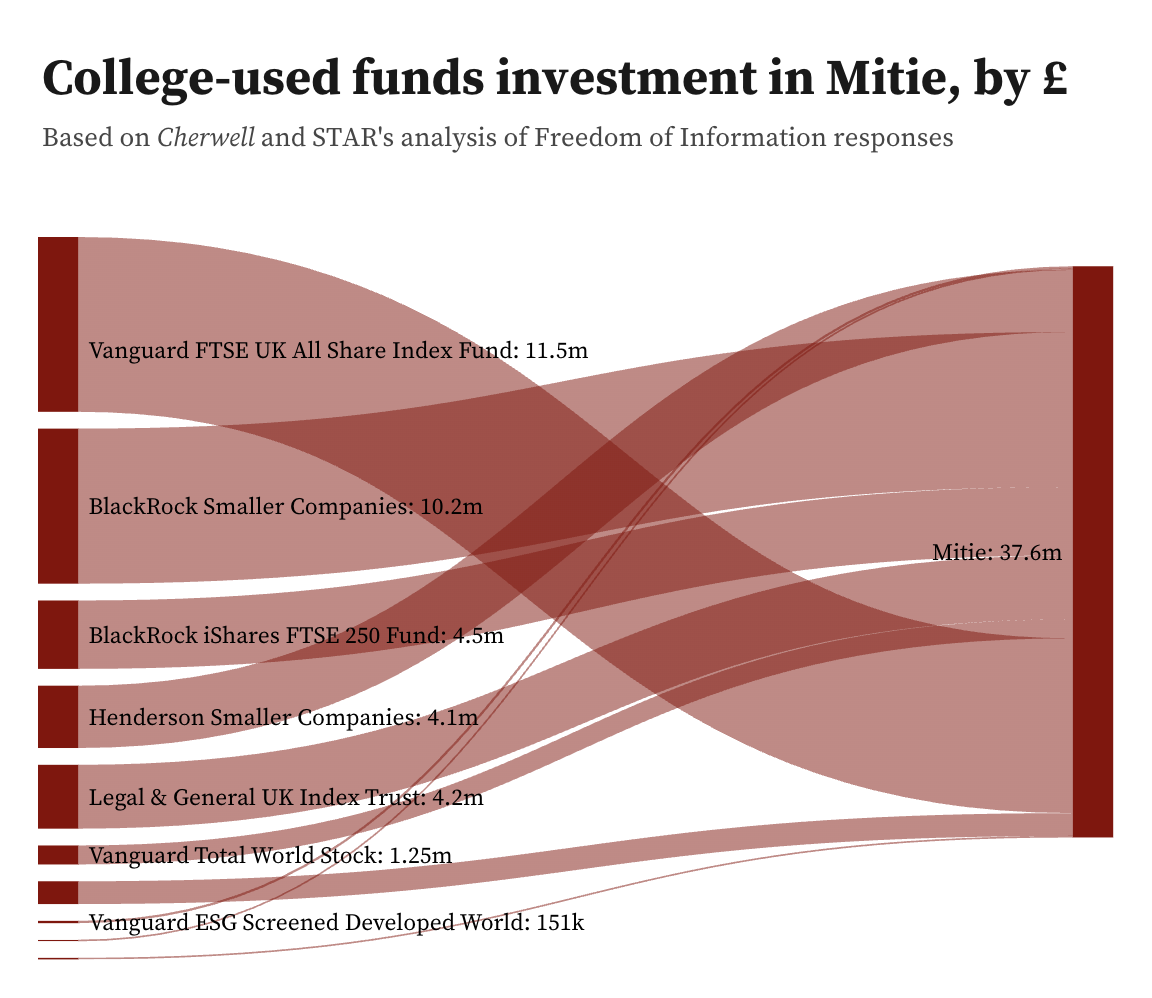
These investments are spread across ten investment funds, identified as holding shares in Mitie through analysis of their 2024-2025 annual reports. The total value of these funds’ investments in Mitie is £37.6 million, equivalent to over 1.5% of the company’s overall market capitalisation.
Vanguard FTSE UK All Share Index Trust, which Pembroke uses, invests the largest amount in Mitie at £11.5 million. The BlackRock Smaller Companies fund, used by Christ Church, invests £10.2 million.
Notably, these figures refer to the overall amount that these funds invest in Mitie, not just the amount from Oxford colleges. Exact estimates of how much individual colleges invested indirectly in Mitie were difficult to obtain, as colleges did not disclose the total amount they held in these funds.
Other funds used by colleges which hold shares in Mitie are Vanguard’s ESG Screened Developed World Fund, ESG Developed World All Cap Equity Index Fund, Total World Stock ETF, Global Small Cap Index Fund, and Charities UK Equities index; BlackRock’s iShares FTSE 250 Fund; Henderson Smaller Companies; and Legal & General UK Index Trust.
Mitie and Campsfield IRC
Mitie Care & Custody Limited (Mitie), a subsidiary of Mitie Group Plc, had previously run the Campsfield IRC from 2011 to its first closure in 2018. In 2025, the Home Office awarded Mitie a £140m contract to operate the centre again, with plans to more than double the facility’s capacity submitted to the Planning Inspectorate. Mitie has also operated the merged Colnbrook and Harmondsworth IRCs since 2014 and the Dungeval IRC in Scotland since 2021.
Mitie has faced repeated scrutiny over the conditions in Campsfield. In 2011, a detainee committed suicide, and there were repeated mass hunger strikes in protest over living conditions. Another detainee attempted suicide in October 2013, leading to a major fire, after which it transpired that Mitie had not installed sprinklers in the facility at the time.
Inspectors to the Harmondsworth IRC, another site run by Mitie, reported in July 2024 that the facility contained “the worst conditions they [had] ever seen in immigration detention”, although an independent progress review in July 2025 noted that “substantial improvements” had been made since.
The Coalition to Close Campsfield (CCC), a group made up of local organisations based in Oxfordshire, including STAR, has campaigned against the reopening of Campsfield and plans for its further expansion. Liz Peretz, an organiser of CCC, told Cherwell that she was “not at all surprised that colleges” are indirectly invested in Mitie.
“It’s a sound investment for them”, she added. “It’s government money, it’s taxpayers’ money, it’s not going to go away.” However, she told Cherwell that such investments in Mitie were “investing in people’s misery”.
Lack of transparency
Of the 32 undergraduate colleges that responded to the FOI requests, Cherwell and STAR could not confirm for 20 colleges whether the investment funds they used included Mitie shares in their portfolio.
For eleven colleges, at least one of the funds used did not publish information online about holdings, including funds Cambridge Associates, Rathbones Group, Cazenove Capital, Hollyport, and Adams Street Partners. The colleges in this category were Brasenose, Corpus Christi, Harris Manchester, Keble, Mansfield, New, Oriel, St Hugh’s, St Peter’s, Somerville, and Worcester.
Three colleges – St Anne’s, Trinity, and University – did not provide information on the specific funds through which they invested, although Trinity and University’s could be obtained through the colleges’ annual reports.
Five colleges – Lincoln, Lady Margaret Hall, Jesus, Oriel, and St Catherine’s – invoked legal protections which made them exempt from disclosing commercially sensitive information in cases where disclosure would constitute a breach of confidence or prejudice their commercial interests. However, Lady Margaret Hall told Cherwell and STAR that four exchange-traded funds (ETFs) made up 22.9% of its investment portfolio. Since Mitie is part of the FTSE 250 Index, the college added that it could have indirect exposure, which it estimated to be no more than “0.09% of its overall investment portfolio, which equates to c.£58k in monetary terms”. As Lady Margaret Hall did not share which funds they used, Cherwell and STAR could not confirm if the college had exposure to Mitie at present or just potential exposure.
Merton and St Hilda’s confirmed that they do not have any indirect investments in Mitie at present, although Merton noted that it held £4,698.20 in Mitie shares through an investment fund in 2022. Jesus and Magdalen confirmed that they do not invest in any relevant fund, although Magdalen previously invested through Vanguard Total World Stocks ETF.
Of the nine colleges Cherwell and STAR could confirm indirect investment in Mitie, the level of exposure varied. Exeter, for example, told Cherwell that Mitie’s exposure in the Vanguard ESG Developed World All Cap Equity Index Fund is 0.0036%, meaning the College’s “exposure to Mitie through the tracker is minimal at c.£6”.
Pembroke, which invests in the Vanguard FTSE UK All Share Index Trust, told Cherwell: “Any investment we have in Mitie is only through indirect legacy passive investment vehicles, and based on the information we have we understand any exposure we do have in Mitie and its subsidiaries would be a negligible part of our overall investments.” St John’s, meanwhile, which invests in the Vanguard Total World Stock ETF as part of its investment portfolio, told Cherwell that “all investments are made and monitored annually” by the college’s responsible investment policy”.
Ethical investment
Income from investment makes up a significant portion of Oxford colleges’ revenue. In 2024-2025, Oxford colleges received £448 million from their investments, constituting 60% of their overall incoming resources for that academic year.
Alongside investment managers, a large portion of the University’s and colleges’ holdings is managed by Oxford University Endowment Management (OUem), a subsidiary of the University which specialises in managing charitable endowments. According to its 2025 report, OUem has more than £7 billion in assets under management, with at least 20 colleges investing through OUem, according to FOI requests by Cherwell and STAR.
As of 2026, Oxford maintains ethical investment restrictions against companies manufacturing certain types of arms, tobacco companies, fossil fuel exploration and extraction companies, and any funds which invest in any of these types of companies. Following a report by the Ethical Investment Representations Review Subcommittee in July 2025, commissioned by Oxford University Council in May 2024, the University committed to expanding its restrictions to cover more weapon types. However, no equivalent investment restrictions in companies involved in the border industry, such as Mitie, exist.
In recent years, the University’s investments have been under scrutiny. Work from the Oxford BDS Coalition and Middle East Eye showed that, as of October 2025, the University indirectly invested in at least 49 companies flagged by human rights organisations for their ties to illegal Israeli settlements, with the total value of these holdings coming to £19 million. The coalition could not obtain any data on the value of holdings under OUem due to the company’s lack of response to FOIs. A tribunal in April 2025 upheld OUem’s refusal to disclose the value of its holdings in three companies on the BDS divestment shortlist.
While the University’s Investment Committee endorsed the EIRRS’s recommendation to work with OUem and the University to enhance investment disclosure, it is unclear what action has been taken by the University. A University spokesperson told Cherwell that the University’s Investment Committee and OUem will be publishing further information on the University’s investments, which “will be available shortly”.
Further, the University added that, as OUem invests in funds and not individual companies, “there are contractual limits” on what OUem can disclose as company positions.
Closing Campsfield
CCC has held demonstrations outside Campsfield IRC on the last Saturday of each month since December 2025, when the centre reopened. The most recent demonstration in May focused on Oxford colleges’ investments in Mitie, as well as the low pay given to detainees in the IRC for cleaning and routine labour.
Still, members of the CCC campaign remain hopeful about the impact that the University and its colleges could have. Peretz told Cherwell: “The impact could be quite strong, especially if the colleges were prepared to say why they were divesting.
“[Mitie] likes to have good PR. They like to be seen as wonderful. And this is not a good look for them.”
Balliol, Christ Church, Hertford, Queen’s, St Edmund Hall, and Wadham were contacted for comment.


