

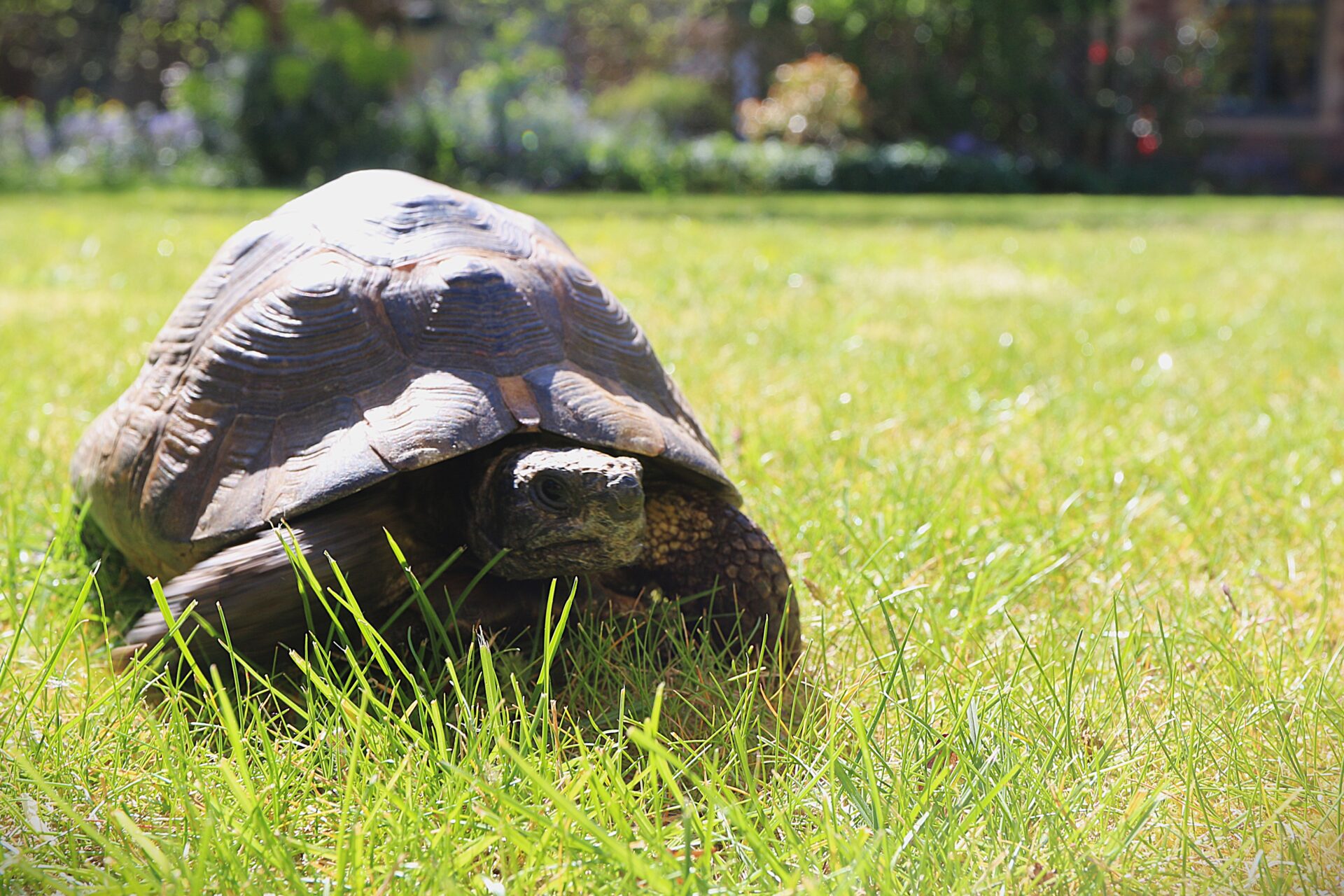
Oxford is full of weird and wonderful traditions, and the Corpus Christi tortoise race certainly takes the cake for the latter. What likely began as an informal competition between Corpus students some 100-150 years ago, has now blossomed into a day-long affair of tortoise-related festivities and slow-speed racing, attracting hundreds of spectators from across the University and the wider public. Tickets quickly sold out for what can only be described as the highlight of the Trinity social calendar, with numbers capped at 725. Having won the 2025 tortoise race, and despite a few hiccups in previous years, Corpus’ own tortoise Foxe was favoured to win this year.
I was lucky enough to be able to sit down and chat with Vivi, Corpus’ JCR tortoise-keeper (custos testudinum), in the week leading up to the race. I began by asking what exactly the role entailed, and the position turned out to be more varied than I expected. Vivi told me: “You [get] a big book of standing orders, and most of it is about organising the tortoise fair. But you also have to say that you will sign your life away for Foxe’s wellbeing. […If] the building was on fire, and I could either save Foxe or […] myself, I do have to say that I will go and save Foxe”.
Vivi described admin, and event-planning, as a large part of the role, with some aspects being fairly time-consuming: “I got into the position on the Saturday of week eight in Michaelmas and then started working immediately. It’s a lot of ordering merch, and I’ve got volunteers in from the charity that we supported [RSPCA Oxfordshire]. You have to work out training for people, how many tickets you’re selling, and where you’re selling them. There were lots of emails in college about what’s going on, and lots of health and safety meetings”.
On the day, occasional spells of June sunshine accompanied the thoughtfully curated schedule of events. Entering through Corpus’ front quad, the RSPCA stall, and tables of tortoise merch greeted incoming visitors, with displays ranging from tote bags and t-shirts to tortoise plushies and face-paint. The wafting scent of the barbecue encouraged foot traffic to move through the college, before visitors arrived in the gardens, where live music, tortoise figurine painting, and dancing were all taking place. The joint efforts of Vivi, volunteers from Corpus and RSPCA Oxfordshire, and the wider college community certainly paid off – almost everywhere you looked, there seemed to be a beaming face sporting a tortoise t-shirt or holding a tortoise plush.
Aside from the actual tortoise race, the event of the day that attracted the most spectators was the human tortoise race. As a fresher, I remember learning there was a vacancy in my college’s JCR for the position of Tortoise-Keeper. I was (understandably) very excited at the prospect of looking after a tortoise, only to be met with the mildly terrifying reality that my college did not, in fact, have a pet tortoise, and the Tortoise-Keeper was actually required to don a costume and attend all tortoise-related events as if they were one. Needless to say, I did not apply and, to the best of my knowledge, the position remains empty.
But there was a very different atmosphere on the day: at 2.45pm, the Tortoise-Keeper announced the human tortoise race, and encouraged any volunteers from the crowd to step up. The two individuals dressed as respective halves of a tortoise were the first to enter, followed by an enthusiastic group of people happily exercising their free will. The contestants were required to eat a head of lettuce as messily as possible, and then crawl to the finish line. A humorous array of crawls across the grass ensued, with Corpus bringing victory home.
Although 2026 marks the 52nd tortoise race, its documented history is not exactly linear, with it having only become a consistent annual event in the last few years. When speaking to Vivi about its history, they referenced a document known as the Illustrious History of Tortoises, which has been passed on from predecessors. “I think there was a year in the 70s when Blue Peter entered a tortoise, and I think that same year they painted designs onto the top of the tortoises so you could see where they were from. It’s been relatively recently that it’s turned into a sort of fair event. It used to be just an inter-college thing and now it’s more open to the public to raise more money for charity”.
As the afternoon progressed, crowds started to gather around the hexagonal race track for the event everyone had been waiting for: the tortoise race. The growing anticipation drew spectators in surprisingly early, with people sitting down at the track for over an hour before the race began in order to secure an unobstructed view. Tortoise enthusiasts of all ages rallied together at the fence-posts, keen for the race to begin. There were five competitors for the 2026 race: Foxe (Corpus), Bernard (Corpus), Kale (Nuffield), Truffle (Regent’s Park), and Wendy (Balliol). Excitement only intensified at the sight of the Tortoise-Keeper laying down a ring of lettuce for the tortoises to race towards. From where I was sitting, a firm fanbase had their hearts set on Wendy as the winner, despite her being the smallest and the youngest (at only three years old). Wendy had been socialising with her tortoise-keeper throughout the day, winning the hearts of everyone she crawled by, with her pancake-shaped shell.
After a best-of-three race was declared, the tortoises each started their crawls towards victory. Truffle and Kale were unperturbed by the pressure of winning, and the cheering of the crowds, each taking the distance to the lettuce in their own stride. Wendy, being the smallest by far, still gave it her all and made a beeline for the lettuce as fast as her little legs would allow. Foxe seemed less concerned this year with winning glory, and more focused on trying to bite Wendy. Speaking to Vivi about Foxe’s personality, I learnt that he seems to have a penchant for biting and a long history of grumpiness. Nevertheless, victory was still brought home to Corpus by Bernard, who reached the lettuce to a chorus of victorious celebration.
The painstaking thought and effort put into the organisation of the tortoise fair, and the dutiful care taken of Foxe by the Tortoise-Keeper and his caregivers in the lodge, embody how Oxford’s communities are more than meets the eye. Animals, though a minority at the University, tend to shine light where it is needed the most. Discussing their importance, Vivi summarised it best: “Animals really help it feel like somewhere you live, rather than just somewhere you work.”


