

Nathan Cofnas, who was suspended from Ghent University following a “preliminary investigation” launched after Professor Jason Arday’s death, has now been permitted to resume his research.
This follows close to a thousand academics signing an open letter in defence of Cofnas, arguing that he must not be “punished” and has a right to ‘academic freedom’. Among signatories were 18 Oxford University academics.
Such concerns of ‘academic freedom’ for a self-described “race-realist”, however, are meaningless considering that for the past three years, we have not heard the slightest about ‘academic freedom’ when it comes to academics who have been fired, bullied, and suppressed for supporting the Palestinian struggle.
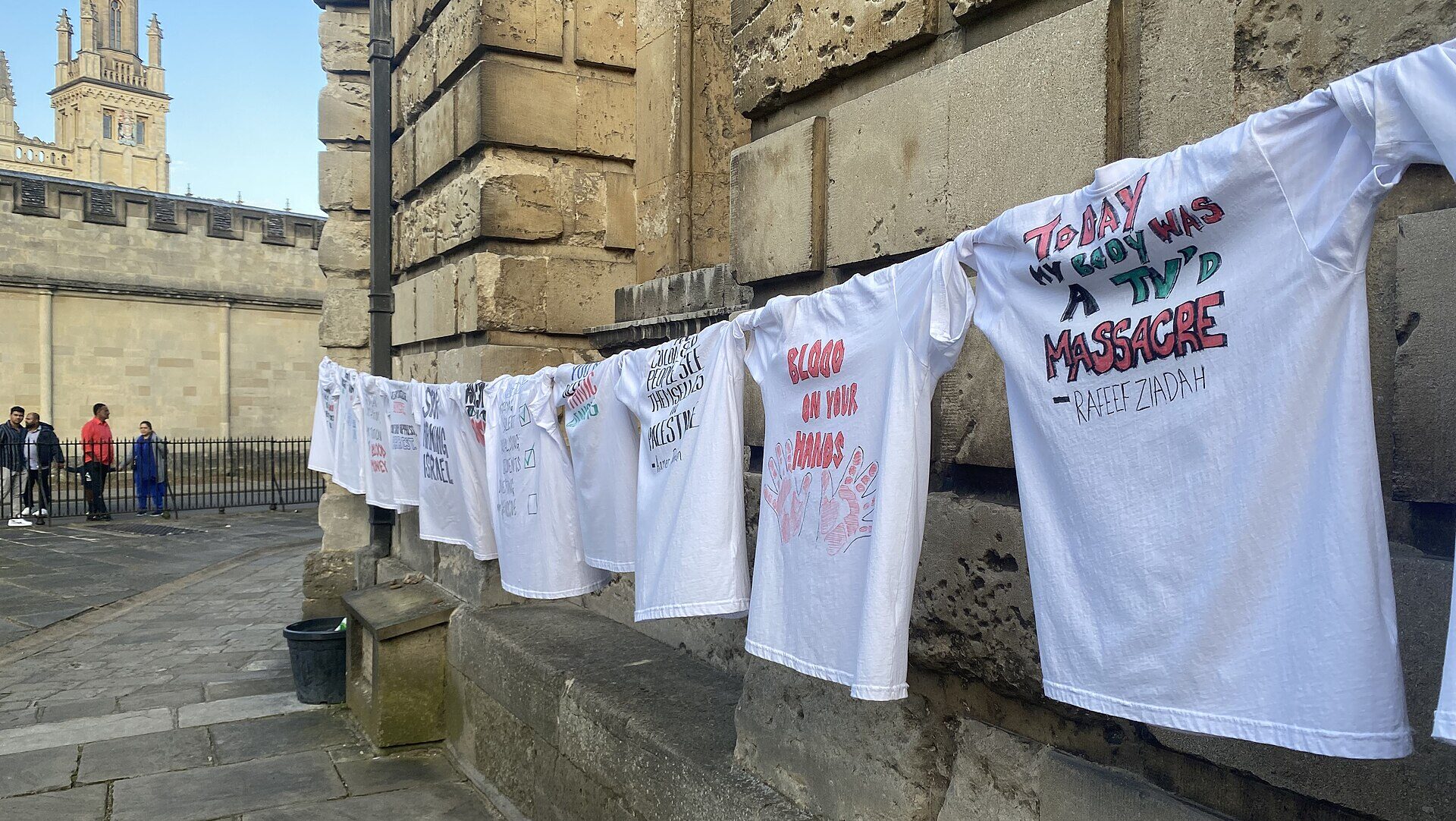
It was not long ago that Palestine encampments across universities in the UK, including those set up by Oxford students, were dismantled and 17 student protesters from Oxford Action for Palestine (OA4P) were arrested for a sit-in that took place at the University Offices in Wellington Square.
In June 2025, 13 of those arrested students underwent disciplinary proceedings. And while the University has not condemned the decades of Israeli occupation of Palestinian land, it was quick to call a sit-in protest a “temporary occupation”. And while the University has not condemned the daily violence imposed on Palestinians by the IDF, Israeli state, and settlers, it was also quick to call this sit-in a “violent action”. Protesters were accused of “overpowering the receptionist” despite CCTV footage contradicting that claim.
The suppression of those who support the Palestinian cause in academic spaces has become ever more pervasive. Indiana University suspended a professor for assisting a Palestinian rights student group; Muhlenberg College fired a Jewish Professor for pro-Palestine Instagram posts; and students like Usama Ghanem of King’s College were indefinitely suspended from their studies. The list can go on.
For those who say that academics should only advocate for these causes through their research: How are they to do this if universities receive complaints for simply using historical terms like ‘ancient Palestine’?
Neither can academics assign case studies for Art Therapy that mention the violence against Palestinians, as just two months ago, a professor from the School of the Art Institute of Chicago was suspended for it. Speaking about the suppression of academic freedom, she said: “We call it the P-word.”
In fact, Palestinian mental health is perhaps the most censored area of research. A recent case that comes to mind is Springer Nature, the world’s largest academic book publisher, retracting an entire peer-reviewed chapter on Palestinian collective trauma and mental health, following an anonymous complaint.
In 2024, amid Oxford Action for Palestine’s (OA4P) protests, the Jewish Faculty signed an open letter critiquing the University’s lack of engagement with members of the Jewish community who supported the Palestine encampments and protests. Prominent Oxford academics signed the letter, which noted that Jewish academics “reached out to you [the University] recently to propose a conversation” but were “ignored”.
It is the example of these Oxford academics that embodies the true essence of standing up for academic freedom, the right to call out academic institutions, and the right to protest in academic spaces.
It is therefore a shame to see that two years on, other Oxford academics who did not stand by their colleges in this matter in 2024 are now signing a different letter in defence of Nathan Cofnas.
Cofnas was dismissed from Cambridge University following controversy over his racist statements, and his writings, according to Counsellor Pierre Thiriar of the Antwerp Court of Appeals, are punishable under Belgian criminal law. Last year, Cambridge dismissed 58 students’ formal complaints about Cofnas, and when Belgium’s Ghent University first employed Cofnas earlier this year, they received 300 complaints from their student body and staff.
They, of course, outnumber the 18 Oxford academics who have recently signed a letter in defence of Nathan Cofnas. These are Michael Biggs, Michael Sharpe, Jane Lightfoot, Paul Elbourne, Jacek Karwowski, Jonathan A Jones, Edward Howell, Shivaji Sondhi, Ruth Dixon, Nigel Biggar, David Deutsch, Amir Goharshady, David Owens, Ace North, Thomas Noe, C Hennessy, Graeme Creffield, and Richard Dawkins.
The letter says: “We are also concerned that the University appears to be treating threats to academic freedom… as grounds for disciplining the very individual targeted by those threats.”
I’d like to ask each of these academics whether ‘academic freedom’ is only reserved for those who believe in eugenics? Or who believe Black people to be biologically and intellectually inferior to white people? Is ‘academic freedom’ only reserved for discussing race on podcasts with other former Cambridge academics like David Starkey, who said that “so many damn blacks survived” during slavery?
For the past three years, academics have repeatedly witnessed their fellow academics dismissed from their jobs, and their peer-reviewed writings on mental health retracted from psychiatry journals. I have been left stunned as to why the majority of academics did not unite to defend the academic freedom of academics who oppose the killing of Palestinians.
The majority of Oxford academics did not seem to care in the slightest about ‘academic freedom’ then. In comparison, only a dozen Oxford academics had signed the Jewish Faculty’s letter in support of student protesters.
Now, it cannot be clearer: ‘Academic freedom’ is only ever collectively invoked for those like Cofnas. Or for those like Oxford academic Nigel Biggar, so he can defend certain aspects of colonialism, and more recently defend the use of racial slurs against Black people.
‘Academic freedom’ is never cared for, considered, or invoked when truly required; not even when merely acknowledging Palestinian trauma, let alone critiquing Israel, has put academics’ careers at risk.
Academics and students are navigating a minefield, having to weigh every word and action to simply condemn one of the most pressing humanitarian catastrophes that continues to this day.
If any one of these Oxford academics cared about ‘academic freedom’, surely they would not be selective nor reserve this only for Cofnas? Surely they would have instead started where and when it mattered the most?