

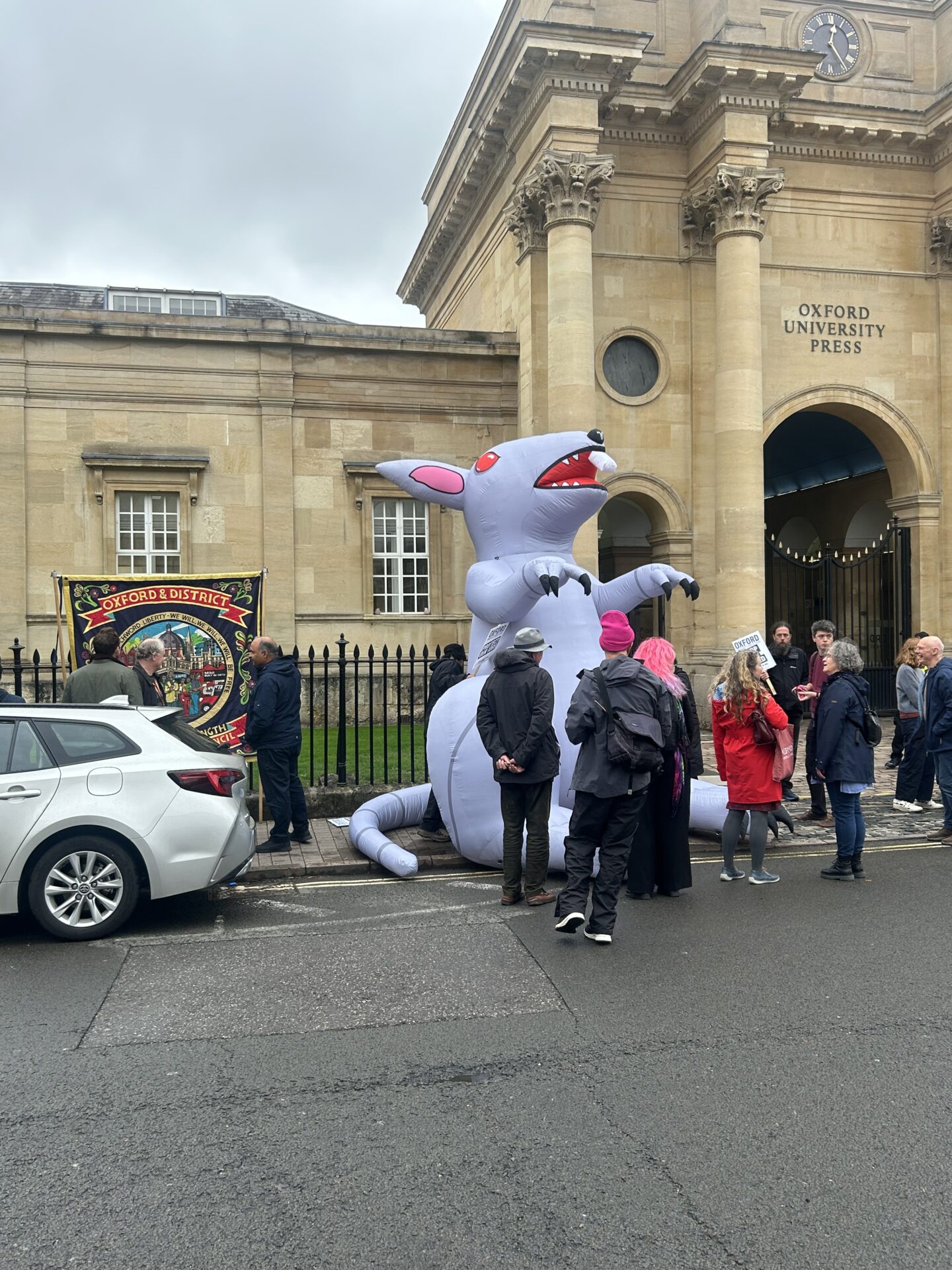
A demonstration in favour of striking finance workers was held outside the Oxford University Press (OUP) last week, as the dispute over offshoring at the world’s oldest publishing house continues.
Last week’s strike, which began on 28th September and ended on 9th October, marked the second round of strike action by the affected workers, who first went on strike between 1st and 11th September. The dispute began over OUP’s plans to offshore 48 finance department jobs to India-based EXL Services.
On Wednesday, Unite, the union behind the strike, held a demonstration outside OUP on Walton Street. The demonstration was attended by around 25 people, including union representatives, striking workers, and OUP workers who had come out in solidarity with those on strike.
Under the shadow of a giant inflatable rat brought by the demonstrators, striking workers told Cherwell that OUP was trying to “intimidate” workers into not striking. One striking worker, who is not allowed to talk to the media, said that OUP had tried to say the strike was illegal. Cherwell understands that 21 of 28 union members, the only people legally allowed to strike, voted in support of it.
Naomi Gravett, Unite’s regional officer, told Cherwell: “Some of these staff have been with Oxford University Press for 20, 30 years. They’ve given their heart and soul to this place… and they just feel like they’ve had their legs taken out from under them…
I could understand if it was a company that’s on their knees and they need to cut costs, but this is one of the biggest publishing houses in the world. They don’t need to save money, so it’s just profit over people.”
According to public filings, the press made a profit of £47.1 million in 2025/26. OUP is an official department of Oxford University overseen by a delegation of the University’s academic staff. Asked whether OUP was in active consultation with the union to end the strike, Gravett and other union representatives told Cherwell that the union has received no contact from OUP since August. She added that “it was made very clear to us at the outset of the collective consultation that the decision had already been made. It was going to be outsourced; we were just discussing the measures.”
Discussing the aims of the strike, Gravett said that “what we’d really like is Oxford University Press to turn around and say, ‘look, we screwed up here. You know we’ve made a mistake because this is people’s lives’”.
In response, OUP told Cherwell: “All of the colleagues impacted by the changes have accepted the terms offered, which include enhanced redundancy terms. We have provided outplacement and wellbeing support, and funding for professional development. We continue to seek opportunities for redeployment, and some colleagues have secured alternative roles within the Press.
“We have met with Unite to explore ways to resolve the dispute. Approximately half of the colleagues who voted in favour of industrial action took part in the strike. We have always acted, and will continue to act, in good faith.”


 last week, as a dispute over offshoring at the world’s oldest publishing house continues.)