Saturday 2nd May 2026
Blog Page 203

‘Home is where the heart is.’

0

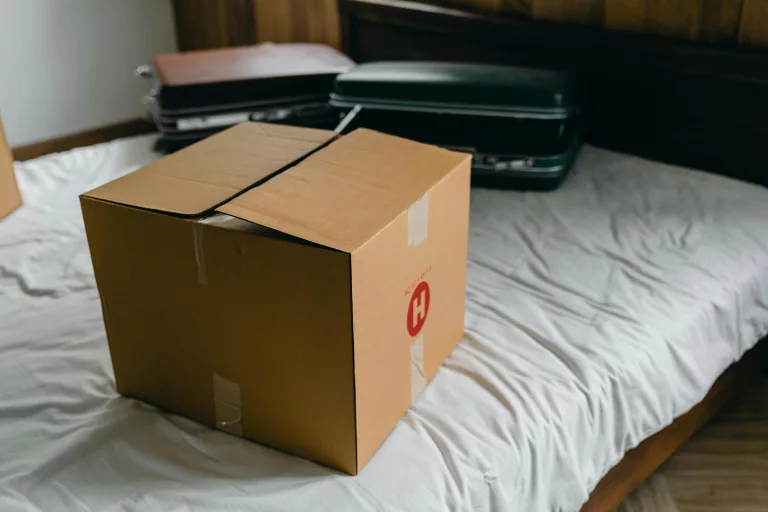
The Michaelmas vac is a strange part of the Oxford calendar. For freshers, it is the first time they will be making the return home – having to stuff overpacked suitcases and newly purchased stash into their car after just eight weeks here. Some return to tiny villages, others to big cities and others remain in Oxford. Others spend a couple of weeks on the slopes of Val D’Isere. Very few of us, however, are as lucky as I am to be returning to the land of Milton Keynes…

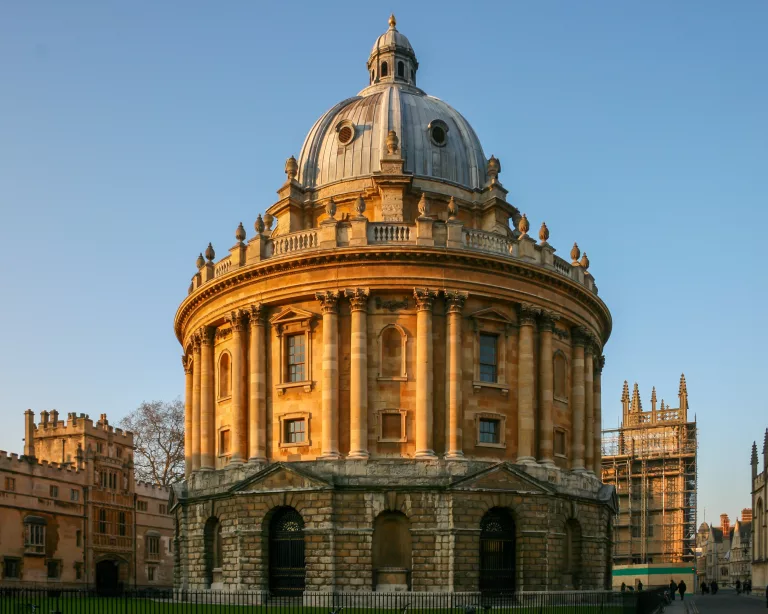
Going back can be a challenge. The student returns to a familiar land, but everything feels different. I just started getting used to being in Oxford again and suddenly it’s time to move back. No longer are my weeks filled with hours at the Rad Cam, spontaneous Swan and Castle trips or Bridge Thursdays. Rather, I return home to find my younger sister has raided my clothes and makeup, and is somehow taller than me (although at 5’ 2, I have no right to act surprised…). While I was busy in the Oxford bubble, the familiar parts of my hometown have also grown in their own ways (like the number of roundabouts for example).

In my opinion, a good vacation should always feature copious amounts of sleep. Even if your tutors may have fed you the age-old line of ‘a vacation is just when you vacate Oxford and continue to work elsewhere’, it is important to take a proper break and to help yourself recover after the trauma of an Oxford term. The lack of impending deadlines is an exhilarating feeling and the threat of collections is not quite enough to destroy that feeling either. I like my recovery days to be punctuated by long naps, mum’s cooking and Netflix’s ‘Are you still watching?’. Although I found this term that Oxford managed to creep its way onto my screen regardless; thank you Saltburn and Wonka. 

At some point, the time for the vacation staple arises – the big termly catch up with home friends. This consists of life updates and embarrassing ‘remember when’s’ and before long all the time apart seems to just melt away. It feels like nothing has changed yet at the same time it feels like everything has. I catch myself accidentally letting words like ‘Michaelmas’, ‘Hilary’, or ‘rustication’ slip and have to make sure not to use the word ‘Oxford’ too much in conversation for fear of sounding absolutely insufferable. One of my friends has developed a Scottish twang in her accent (studying in Edinburgh), another has spent two years in the real world working after deciding not to go to University. There is a bittersweet feeling as I remember how we have all grown as people but also how much our lives have grown apart over the last two years. People are starting to think about jobs and where they might want to settle down in the future. Others are taking the ‘go with the flow approach’. It all feels as though it is moving a bit too fast. 

I often grapple with a persistent feeling of guilt about not staying in touch with home friends in the way I feel I should have. And yet, every year I also feel a sense of guilt for letting those earlier Oxford friendships wane. Throughout my time at Oxford, I have grown so much as a person that coming home almost feels like a bit of a culture shock – even though I live only an hour’s drive away.

It can feel like a bit of a conflict – the home where I grew up now feels like a waiting room before I get back to my ‘real life’ at Oxford. It’s been months, and soon it will be years since I walked down paths I used to take daily. But regardless of where ‘home’ is, or where it becomes throughout my life, there is no feeling quite like returning to the place you were made.


New Year’s Resolutions: Why are we so bad at keeping them?

0

New year, new start. It is a terrible cliché. But the fact is, as another year ticks by, it’s a good opportunity to close down the open tabs in our brains and refresh the browser. However, having created some new, unused space, we fall into the trap of filling it with so-called New Year’s resolutions, stacking up new tabs and maxing out. According to a You Gov poll, 29% of 18-24-year-olds intend to start 2024 by making a New Year’s resolution. Yet, how many will actually stick? 

The custom of a New Year’s resolution dates back 4000 years to the Babylonians. They would celebrate the new year by promising the gods to pay their debts and return any borrowed objects. Whilst today we don’t make promises to the Gods, we do make them to ourselves. Has this innovation made it easier to stick to them? Well the same poll reported that only 9% claimed to have stuck to their resolutions throughout the year. Even after 4,000 years of practice, why are we so bad at keeping them?  

New Year’s Resolutions are about getting into the habit of doing new things. Too often, we set such overwhelming ambitions that we’re just lining ourselves up for failure. The first hurdle we trip down on is Mondays. Like the new year, starting something new at the beginning of the week is certainly enticing. The synergy of 2024 starting on a Monday should make committing and sticking to our promises easier. But the problem with Mondays is that there are 53 of them this year. There will always be another Monday to star again but before you know it, it will be 2025. 

In all seriousness, it’s because we’re muddled up between means, and our ends often confuse the difference between aspiration and practice. If the polling data is anything to go by, we make a practice out of setting goals and aspiring to achieve them. This is the wrong way around. If we are to stick to our ‘resolutions’, there has to be a change. The most effective habit to create this change is focus.

What is focus? The idea of focusing is often misleading. It’s not a switch that can be flicked on, where we say, “Right, I’m going to focus today”. Instead, it is a habit that, once formed, must be constantly maintained. That is done by saying no to other stuff. It means sacrifice. It means saying no to things you want to do with every bone in your body. Saying no to things you can’t stop thinking about from waking up until falling asleep again. It takes practice. Research shows it takes 66 consecutive days to form a habit in the brain. That is hard. Start small. Start with one thing to say no to and build it up from there. 

Optimism alone will not create the habit of achieving the goal you’ve set for yourself. This is the reason why so many resolutions fail. Without the ability to focus, it just creates an endless doom loop of failed ambitions. 

Why not form the habit that will allow you to create further habits? Change is big and hard. It’s also lots of baby steps on a bigger journey. Most importantly, refining your ability to focus will give you the confidence to decide what is essential and what isn’t. Therefore it sets the parameters for further change in the future. 

Meaningful and lasting change is a lot of little things done well. It will scare you how many goals can be achieved when you truly learn to focus. Otherwise, every year, we just become a nation of almosts and maybes. 

0th Week: ‘Dough(nut) trust strangers!

0

Thursday evening. Eighth week. My head has finally stopped spinning after a tumultuous Park End (I think). A crinkled pastry bag is tucked under my elbow. I elegantly sit down on the landing of my college’s only building which predates the Russian Revolution (yeah Hilda’s!), lovingly refurbished with institutional blue-grey carpet which must be hiding a multitude of bacterial sins.

This landing is currently the locus that’s fuelling my body. With fuel comes growth. Although I’m not sure I’ve grown many inches since October, this landing, coupled with yummy food and great company, has probably been the site of my most productive (emotional) learning this year. So, this column hopes to bring you earnest musings from an (at times) foolish twenty-year-old. And maybe some culinary inspo from my college’s resident ‘Ottolenghi-in-waiting’ (a self-awarded title, sadly). 

Firmly positioned in the corner of the landing, I begin to inhale a creamy and decadent crosstown doughnut (it was the end of term; needs must). I glance up at this evening’s guest. My college daughter. Her azure eyes still twinkling with that fresher glow, she sighs before exclaiming: ‘Never, ever, leave your bike unlocked outside the faculty on the weekend!’

Whilst this doesn’t seem like a particularly revelatory thought – to not leave your belongings unattended – this throwaway comment lingered with me as much as the flavour palette of Crosstown’s Chocolate Truffle Doughnut still dances on my tongue six weeks later. 

The notion of a silly fresher leaving their unlocked bike out in the world, putting all their faith into their newfound city, has a vague naivety to it that intrigues me. The fact I’ve spent less than a year actually in my university city, and yet have amassed friends that I feel I’ve known for years appears both bewildering and paradoxical. 

Existentialism aside, I would have never built these friendships, without putting just a little bit of trust in the hands of complete strangers – leaving my metaphorical bike unlocked as it were. 

With it being the month of new beginnings, maybe those who feel a little too settled in the Oxford ecosystem and those who feel that Oxford still isn’t quite ‘home’, should have a little faith and welcome in some new characters. Leaving your ‘bike’ locked only limits your narrative. It can be all too easy to fall into a comfortable routine of library-lecture-bar-bed. Trust me (a stranger!!) and disrupt your daily ritual. January is too dreary after all. 

The Patience of Ordinary Things

0

Pre-university packing is undoubtedly a chore. But it is more than the boredom of the task that makes deviations from it so enjoyable. 

I try to avoid procrastination. I find it is generally an exercise in dread and guilt; more ‘deer caught in the headlights of too many deadlines’, than ‘casual enjoyment of leisure time’. What little self preservation instincts I have in this matter, however, fall completely out of the window when it comes to the distractions I find during packing for my return to Oxford. 

The ease with which I am entirely absorbed by the (re)discovery of my own possessions is an offence with a myriad of causes. Latent hoarder-ish tendencies, the multiple misguided phases of my teenage years, and an embarrassingly eroded attention span all play their part – but the clutter of an old bedroom evokes a tenderness that extends far beyond the mere distractions they provide. 

The detritus of our pasts reflect the hopes, ambitions and disappointments that accompanied them. What may appear to the untrained (or undeluded) eye as a wardrobe full of ugly hats and ill-fitting jumpers, contains the narrative of all the joys and pains and lessons learned of navigating a shifting identity, while also slowly realising that a ‘signature hat’ is a CBBC  costuming prop, not a thing that any actual functional person should aspire to own. The rediscovery of a notebook half-filled with ‘potential future catch phrases’ is not only proof that in 2016 I truly considered saying ‘schwing’ at the end of every joke I made; it is an encounter with yet another discarded attempt at reinvention, a reminder of the old yearning for change. 

How truly can we say that our past selves are gone, when there they are, right now – pressed between the pages of an old diary (in my case, rarely kept), woven into the fabric of a poorly-knitted scarf, wound tight around gifted rosary beads from a long-forgotten Catholic education? How easy is it to put down what you’re doing and hold a fragment of your own history in your hands? What version of you painted these walls and chose these posters and arranged these books? Do you miss them? 

When I finally get around to packing my actual necessities, I will (tragically) have to leave behind my old fidget spinners and top trump cards, so spending so much time rifling through them may seem like a waste – but it provides a valuable space for reflection on the past, as we move into yet another new beginning. It’s almost a story in itself, really; once, a girl lived in this room. She couldn’t leave a beach without taking a pocketful of ‘cool’ rocks, and imagined a whole different life for herself every time she bought a new item of clothing. She isn’t here any more, not really. But her dog-eared books and used-up perfumes and unfinished plans are. And so am I.

South Park to be restored following Bonfire Night damage

0

The Oxford City Council has pledged to restore the city’s South Park “as soon as the growing season permits.” The beloved park sustained significant damage to its grounds during its Bonfire Night fireworks display on 5 November last year. The Charity Fireworks Display, now in its 55th year, is organised by the Oxford Roundtable, which deemed November’s display a “great success.” In an announcement after the celebration, the Oxford Roundtable said that “more than 20,000 people attended and [they] were hoping to raise £50,000 for local charities.” 

However, due to heavy rainfall in the week leading up to the event, the grounds had become overly saturated and particularly vulnerable to the heavy machinery used for the display. Locals noted that this was a usual occurrence after Bonfire Night and that they “have pleaded repeatedly with organisers” to ensure the ground is protected with sheeting – a policy reportedly rejected by the Oxford Round Table “on the grounds of cost.” One local even noted that the day after the celebration, lorries took surplus pallets to be burned on the remnants of the previous night’s bonfire, creating a “bonfire of the vanities.” 

When approached for comment, Neil Holdstock, chairman of the Oxford Round Table, said he was “absolutely heartbroken” after being “bombarded [by a] small number of residents,” contrasted with mostly positive feedback. He noted that the group, entirely composed of volunteers, did not get paid to organise the event but “are doing everything they can… as they do every year” to repair the park grounds. 

Despite a claim by Oxford Round Table Representative Christian Petersen that the areas affected “could have recovered by Christmas,” the wrecked grounds have continued to affect the park’s walkability throughout the winter period. Signs have been posted near the damaged areas to inform passersby of uneven, muddy ground.

In response to about 40 lodged complaints, the Oxford City Council launched an inspection of the grounds and announced that no long-term damage had been caused. However, it will be necessary to reseed and level areas of the park, which will be possible during the germination season in the spring; local stakeholders such as Friends of South Park and Oxford Preservation Trust will be kept informed of the restorations. The council has also revealed that the Oxford Round Table will fund the repair work, and they are in discussion with the group on how to best protect the park going forward while preserving the iconic Bonfire Night celebrations.

Councillor Susan Brown, Leader of the Oxford City Council, stated: “South Park is one of the jewels in Oxford’s crown… After all the rain we’ve had, the heavy plant used to take stalls and the funfair on and off the site churned up the ground in a way we haven’t experienced before. There are lessons to be learned to prevent this happening in future. We will of course ensure the park is fully restored, as soon as the growing season permits.

“At this stage I don’t want to rule in or out any options. I will also ensure we engage with the wider Oxford community before any final decision is taken.”

Oxford Vice-Chancellors’ compensation passed £1 million last year

0

Due to sabbatical payment for former Vice-Chancellor Professor Louise Richardson, Oxford University Vice-Chancellors’ compensation passed £1 million in the last financial year; this figure includes the market rental value of their accommodation.

Richardson was compensated £289,000 for her time in office from August to December 2022, when she left Oxford with an additional £423,407 – equivalent to a year’s salary – as “payment in lieu of sabbatical” (as agreed upon when she took office in 2015, according to the University’s newly released Financial Statements).

Vice-Chancellor pays are set by the Committee to Review the Salaries of Senior University Officers (CRSSUO), which in 2019 decided on a 8.4% increase in the role’s salary, previously set in 2009. Before the increase, Oxford’s Vice-Chancellor remuneration ranked 11th nationally; now it ranks second after the £714,000 received by ICL’s Alice Gast.

However, Richardson chose not to take the increase until after the pandemic, when she received £542,000 for her work in the 2021-2022 financial year. ​​The figure includes her basic salary, a one-off payment for exceptional leadership during the pandemic, and the market rental value of the University-owned accommodation in which she lived and conducted duties – a chargeable benefit for tax purposes, but not money she actually received.

Professor Irene Tracey, who took office at the beginning of January 2023, was compensated £336,000 for her work until the end of July. Tracey chose not to take the 2019 salary increase in light of the current economic situation, so her pay adjustment matched the national awards for all higher-education staff. She also waived her entitlement to a sabbatical for when she leaves office.

According to the University’s financial report, Richardson’s total pay is 6.9 times that of average academic staff and 12.2 times that of all university staff, while the ratio for Tracey’s total pay is 6.5 times and 11.4 times greater, respectively.

Oxford University and College Union (UCU) Committee told Cherwell: “Whilst Oxford University’s Vice Chancellors continue to receive six-figure salaries, the pay and conditions of many staff who work to make this University a world-leading educational institution continue to deteriorate.”

2023 saw industrial action organised by Oxford’s UCU over salaries, working conditions, and pensions. What The Economist calls the university’s “other diversity crisis” further highlights Oxford academics’ low pay and short-term contracts.

UCU’s recent report on casualised staff at Oxford’s colleges and the Department for Continuing Education found that 64% of hourly worker respondents receive a real wage that falls below the Oxford Living Wage (£11.35/hr). Hundreds of University and College staff members are also effectively locked into a cycle of short-term contracts. In January 2023, two lecturers who were on fixed-term personal services contracts for 15 years sued Oxford over the “Uberisation” of their contracts.

Head of University Communications Stephen Rouse told Cherwell: “The organisation is highly complex and competes with other internationally preeminent universities to attract and retain the highest calibre academic talent and leadership. Recruitment of senior academics in this challenging market is a key responsibility of the Vice-Chancellor.”

CRSSUO Chair Charles Harman said in a statement: “The Vice-Chancellor’s pay is required to reflect the complex responsibilities of leading the world’s highest-ranked university in the face of ever-increasing global competition.”

On Saltburn, integrity and class

0

I feared the day that the Film Studies people would touch Saltburn, largely because the stubborn thorn of ‘but sometimes the curtains are just blue!’ remains firmly, and unfortunately for an English student, fixed within my attitude towards film. 

However, the overarching reason why I wanted Saltburn to remain far from academic busybodying is that Saltburn, for myself, is a profound testament to the ability of directors to pull shock-value out of a hat. Which is not to say that the necrophilia, the sucking of semen from a drain, nor the murderous ascent to landed status is frivolous. It wasn’t frivolous when Emily Brontë slapped two of the above three into Wuthering Heights, anyway. Instead, it is all to say that ‘class’ and ‘power’ – two themes which haunt the Cherwell machine, primarily because they haunt the Oxford machine with an undeniable omnipresence – haunt Saltburn too. 

The tale of Oliver Quick has parallels to Wuthering Heights, in fact: effectively adopted by a land-owning family with a country house, then killing and shagging one’s way to the top. Do as the Romans do, as they say. But whilst the twist comes in that Heathcliff was portrayed as quite legitimately poor, Oliver isn’t. He comes from a middle-class family. This film is set in the Blair era, too, so the middle-class aesthetic differs from our current understanding of it. Yet what it predicts about the 2020s, way ahead of its time, is the feeling of necessity to create an identity by using, if not outright appropriating, working-class culture and suffering. 

Talking of ‘working-class suffering’ assumes that Emerald Fennel achieves what seems to be desired: that an alcoholic cracking his head on the pavement should be seen as a working-class death, and substance abuse, mental illness and distinct dialects are characteristically working-class. Fundamentally, dying that way and substance abuse are horrific. Using them as a false working-class experience denotes either Oliver using lazy stereotypes about poor drunkards dating back to the 19th Century, and being classist himself, or that these experiences are the easiest way to signal to an audience that a character (even off-screen) is working-class. I hope it’s not the latter.

Before I continue, before I get wrapped in very reasonable doubts about my ability to talk on such matters, I concede that I come from a lower-middle class or upper-working class (depending on the economic conditions) family, both parents born to labourers, which influenced my upbringing, too. Admittedly, I attended a grammar school predominantly populated by upper-middle class boys with aspirations to be either bankers or private doctors. I do not think that Oliver Quick is the equivalent of any of these upper-middle class boys within Saltburn; the class distinctions of the early 2000s and of the late 2010s and early 2020s are markedly different. However, it is worth pondering on how (and why) Oliver and my classmates both desire to use working-class culture for their benefit.

My first theory is that conservative approaches to economics have sacrificed personal identity to aspirational wealth. Who cares what your background is when you have money to spend? Well, you do, for one. It’s not fun being soulless. Therefore, if you have a grandfather who happened to be a miner, you might as well use this to parade some working-class credentials and inherit a claim that some form of intergenerational hard graft and suffering has fallen to you to wear as a badge. Yet, given the reforms which Blair did institute, I want to hold off judgement on this theory for the case of Oliver.

To turn instead to Oxford, and escaping the suburbs, a sentiment I feel much closer to. There is a reason why the TV programme discussing Boy George’s childhood is called Get Me out of Suburbia: the complete functionality and absence of colour in the place. There’s a whole Twitter (or ‘X’) account devoted to hating new-build houses, whose primary function is to be built and meet necessary regulations – and, one can only assume, be identical to the eyesores to the left and right of them. Oliver is a young man from suburbia, aching from an inability to escape from a place primarily defined by function into somewhere with a simply perplexing amount of forks, gowns and port bottles. It’s not beauty driving him; a glance at the final minutes, when Oliver explains his plotting, and when he desecrates Saltburn with his dancing, naked body, indicates as much. So, a possible response for Oliver to ascend upwards is to be as alien to this environment (a place still containing a disproportionate amount of private-school students – and grammar school students, sorry) and its inhabitants as possible and get dragged into it by force, and a little empathy on Felix’s part, rather than trying to muddle though. 

This is the fault with Oliver. There is possibly some nobility in muddling through, in being refreshingly honest about finding the rhythm and ritual simultaneously fun, liberating, whilst also a tad pointless. There is a sweetness to be found in being fine with drinking port (even if my IBS disagrees) from a plastic cup, as the vessel doesn’t matter, and anyway, I drop glasses like they’re hot. But Saltburn would have been very boring if Oliver had just been honest. 

Cherwell Food dines at Lula’s Ethiopian and Eritrean Cuisine

0

I knew it would be good when we were sat opposite Lula’s poetry library. 

On a warm afternoon in early June, my friend and I resolved our fast-approaching-Prelims woes with dinner at Lula’s Ethiopian & Eritrean Cuisine restaurant on Park End Street. Quiet, softly broken from the relentless thrum of exam seasoned central Oxford, this was a welcome idyll. 

Other than the practice of feeding your dining partner as a gesture of friendship, I had no knowledge of Ethiopian cuisine. We opened the door through the heavenly glow of refracted summer sun, greeted with a rumble of nondescript jazz and the familiar face of a local barista (who was probably less pleased to have been followed by parasitic students). We would later discuss how much of a blessing Lula’s is for Oxford’s vegans and non-students. Indeed, I’d much rather keep it a secret. Still, this welcome stood us newbies in good stead. 

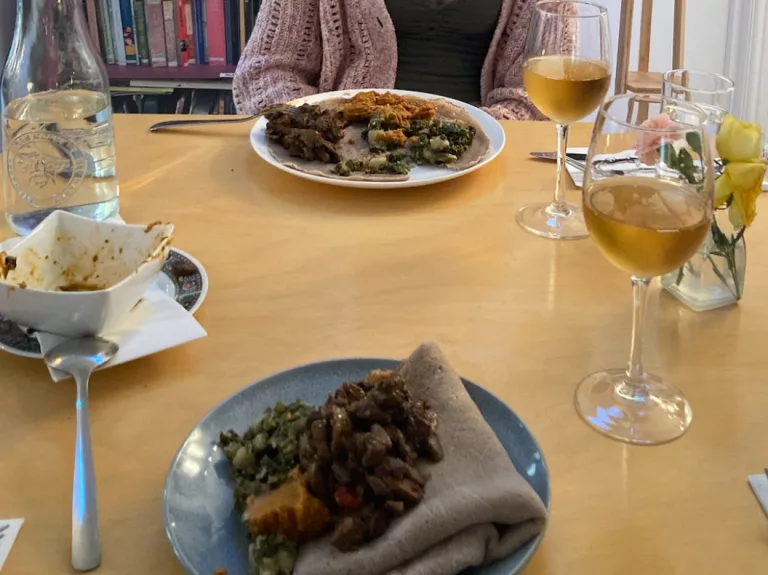
The waiter happily guided our ignorance through the menu. By his recommendation and willingness to cooperate with our student budget, we ended up with:

Habesha Hamli – Kale and potatoes cooked in olive oil with onions, garlic, and chilli.

Red lentils – Slow cooked in a rich sauce of caramelised onions, garlic, mixed spices and

Berbere (a particular spice mixture).

And an injera each.

The injera is a staple of Ethiopian cuisine. It is a pancake-like flatbread made with traditionally just teff flour and water. Lula’s explains that “Brown tef is an ancient East African cereal grass that originated in Ethiopia circa 4000 BC to 1000 BC.” Though the injera is not complex, it is delicious. Its wonderful simplicity laughs at restaurants that need liquid nitrogen to distract from the food.

It was a filling meal but definitely left me wanting to taste more. The garlic – and this is a true garlic lover’s haven – made for rich fulfilment. The potatoes were perhaps aligned with the sag aloo dish with chest-kicking hotness. I could venture to compare the food to various dishes – lentils to dal, potatoes to sag aloo, injera to pancakes (celebrate pancake day with a trip to Lula’s) – but, if truth be told, Lula’s has its own, unparalleled jazzy cheekiness. It’s spicy where you least expect it. 

And, in the spirit of such cheek, we were coaxed into trying the traditional honey wine. Lula’s offers sweet or dry; we went for sweet. Lula’s menu writes: “The production of wine in Ethiopia can be traced to the early centuries of the first millennium A.D. In Ethiopia and Eritrea, Tej is often homemade and served at Tej houses and for special occasions. Served in a flask-like carafe or bottle, called a berele.” I think this wine would be my highlight. It tastes remarkably like honey and its delicate gloopiness is, well, ethereal against the slosh of Fruity Red. 

We ate at Lula’s in the week after Eritrean Independence Day. On the 24th of May, 1991, Eritrea reinstated independence after a 30-year war against the military regime of Ethiopia. I had thought about this while we ate and asked the head chef that day if it was something she had considered. But, as is embodied by the restaurant’s ethos, she insisted that the food was instead a celebration of the cultural – not political – partnership of the two countries. 

After all, the Habesha Hamli we ate is a combination of Eritrean and Ethiopian. Hamli is the sauteed onions, garlic, and chilli; it comes from Eritrea originally. And Habesha, from the Habesha People, is an ethnic identifier which spans both Ethiopia and Eritrea.

It is also a venue for frequent jazz, poetry readings, and, in December 2023, a wonderful amalgamation of the two in the form of an evening of Lemn Sissay (check him out). The restaurant embodies cultural inclusion. It is forgiving of Western ignorance with explanations and histories of the cuisine in its menu. It is entirely vegan unless you opt for one of the separate meat dishes. And, after a glass of honey wine, you can still do some revision.

Weaponised incompetence, laziness, or narcissism? Fathers at Christmas

0

Another Christmas came and went, and with it, I got to witness the adult men around me get away with doing little to nothing. For many years it has been a running joke in my family, as well as online, that dads will always be as surprised as their children to find out what presents they gifted them. In the past, I’ve found this joke amusing. However, as I get older and I really get to witness the amount of effort my mum puts into Christmas, the charm of this ‘joke’ has faded, and instead, I’ve been left with a sour taste in my mouth.  

Perhaps what tipped me over the edge this year was a specific incident on Boxing Day. My mum had spent days cooking dozens of different dishes, adhering to everyone’s likes, dislikes, and dietary requirements, all whilst ensuring they were all classically festive dishes. My dad, on the other hand, made one dish. A mezze-type dish. If this were another thing made by my mum, it would be a perfect side dish that we would all enjoy, but not focus on. But as it was the one thing he made, it somewhat became the centrepiece, or at the very least, the hot topic of conversation. 

Initially, the conversation was in jest. Irony and sarcasm were certainly at the heart of what was being said. However, when the talk and jokes continued throughout the day, into lunch and past it, it started to feel less funny. Ultimately the attention was still on the ‘mezze platter’ and my dad. Despite the fact my mum was the true hero of the day, weekend, and Christmas period, she was overlooked. It was expected of her. Of course she’d do it all, deliciously and effortlessly. Because that’s what she always does. But one sprinkle of effort from my dad and forget Jesus! My father was the new king of Christmas.  

Now, this isn’t to go in on my own dad too harshly. Despite what you have just read, and may have consequently assumed, I am extremely fond of him, and I think of him as a thoughtful and generous man. The issue is not with him specifically, but it’s the culture our society has perpetuated which has allowed even the best of men to do the bare minimum. And more sadly, all the hard work put in by brilliant mothers to become overshadowed.  

Even more tragically, I have seen many worse cases online. Women who fill their own stockings and buy their own presents on top of doing all the cooking and organizing for the day. It’s not that I believe these men are horrible people. I don’t think they’d want their wives and children to be gift-less or upset on Christmas day. It’s just that they know the women in their lives are always going to pick up the slack. Because quite frankly, what would happen if they didn’t? Would Christmas be cancelled? Would turkeys be burnt? Would the illusion of Father Christmas be ruined for young children everywhere?  

I don’t think that many husbands, fathers, and grandfathers across the globe are that innately incompetent. However, I do think we’ve allowed them to become so. And that doesn’t mean the onus is on the women in their lives to teach them how to roast a potato or know what their children would like for Christmas. They should be capable of sorting that out themselves. But I’m also not sure we can continue letting them get away with it. And because this issue is so widespread, it stretches much further than Christmas.  

Until we reach a place where we share domestic labour, we can’t truly hope for proper equality. Mothers will always come home from a full day of work and know what is in the fridge, ready to cook for supper. The façade that women love ‘having it all’ is not true, because really, it’s not like men have ever even tried. It has historically always been the women’s role to juggle everything all at once, and we are expected to be grateful that in recent years we have been given the opportunity to balance domestic work with a job outside of the home. It isn’t that women are better at multi-tasking or enjoy taking on the mental load. Because, of course, cooking for hours is tedious, wrapping presents can become boring, and writing Christmas cards is repetitive. But they’ve put in the time and effort needed to become good at these things so to reach the expectations society has set them. And most of us could achieve this too if the buck stopped with us. But, instead, a dangerous cycle has been created where many men in our lives have come to believe they are allowed to be lazy, or in the rare cases they are not, that they should be especially praised, as this is all they know.  

Truthfully, I’m not sure I can sit through another Christmas where I watch my grandad park himself in front of the television, drinking wine from noon, whilst my granny labours away in the kitchen from morning until mid-afternoon because ‘that’s how it’s always been’.

2023 Fashion: Wrapped

0

As 2023 comes to a close, it’s time to reflect on and deconstruct the year’s most popular fashion trends. From the runway to the streets, the past 12 months have witnessed an eclectic assortment of nostalgia and chaos, with seemingly little rhyme or reason for such fads. However, it’s no secret that the influence of TikTok on young people is accelerating not only the emergence, but also the extinction of such fashion trends. Whilst some looks this year, therefore, may be here to stay, it seems as if the majority have died out almost as quickly as they were ignited.

One of the standout trends of 2023, the resurgence of which may point to the debut of Miu Miu’s F/W 22 show, is ‘ballet-core’, a whimsical fusion of ballet-inspired fashion elements. On the runway, this can take the form of pastel, sheer chiffon and puff-sleeve looks by designers such as Simone Rocha and Zimmermann. However, the filtration of this trend into everyday wear, encouraged and paraded by fashion icons like Ruby Lyn, sees garments such as ballet flats, leg warmers and even tutus and ballet cardigans exhibited in everyday wear. Whilst for some this may be reminiscent of traditional girlhood and femininity, ballet-inspired fashion has been depicted through many forms of media, from Black Swan to the opening credits of Sex and the City. Having in fact been an influence on the fashion world since 1941, when fashion editor Diana Vreeland first launched the idea of ballet shoes as everyday wear on account of their lack of wartime restrictions, it is possible that this trend is not as fleeting as it initially appears. Although tutus may not become commonplace, it is arguable that more subtle allusions to the ballet-inspired aesthetic, such as lace, wrap-tops, tights and Margiela Tabis may be here to stay. 

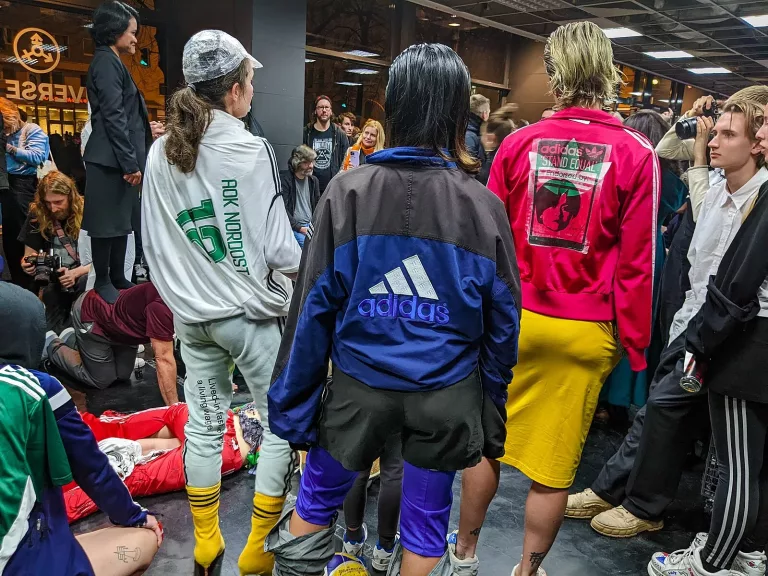
On quite the opposite end of the spectrum, and potentially initially sparked by the 2022 World Cup, comes the interesting and rather unexpected conflation of sport and femininity to create the ‘blokette’ appearance, the term of which was coined by Alexi Alario. A look which combines garments such as frills and bows with sportswear, particularly Adidas and football scarves, this has been pioneered by trendsetters like Bella Hadid. With this trend, comes the classic revival of Adidas Samba shoes. Unless you’ve been living under a rock, you’ve likely witnessed the comeback of variations of the Adidas Samba, Spezial or Gazelle shoe. These versatile and timeless shoes have been a go-to choice for so many this year, especially in their bold colour combinations of yellow, blue and red, indicative of the experimentation and expression of 2023. 

Speaking of colour, whilst many argue that a colour in itself cannot be a trend, there’s no denying the prevalence of red through 2023. From pops of red in accessories such as bags, tights and socks, to full monochrome such as that which saw Doja Cat adorned with 30,000 crimson Swarovski crystals for Schiaparelli during Paris fashion week, this colour has dominated the fashion landscape, adding vibrancy and passion to contrast the pastels of ballet-core. 

Perhaps similarly embracing this flair, the ‘pantless’ trend has taken the fashion world by storm and has seen Kendall Jenner and Hailey Bieber in the streets ditching their lower half and opting for options such as tights, hot pants, or boxers. Personally, however, I have to say that I have not witnessed this in everyday wear, and nor do I think I will. Whilst fashion icons have embraced this playful and rebellious look, challenging conventional expectations and encouraging a carefree attitude towards fashion, its impractical nature makes it unlikely to break into the mainstream. 

As we bid farewell to 2023, the current fashion landscape reflects a perplexing amalgamation of versatile trends. Looking forward, this eclectic hodgepodge of styles raises the question of whether these looks will transcend into 2024, or remain rooted in the departing year.