

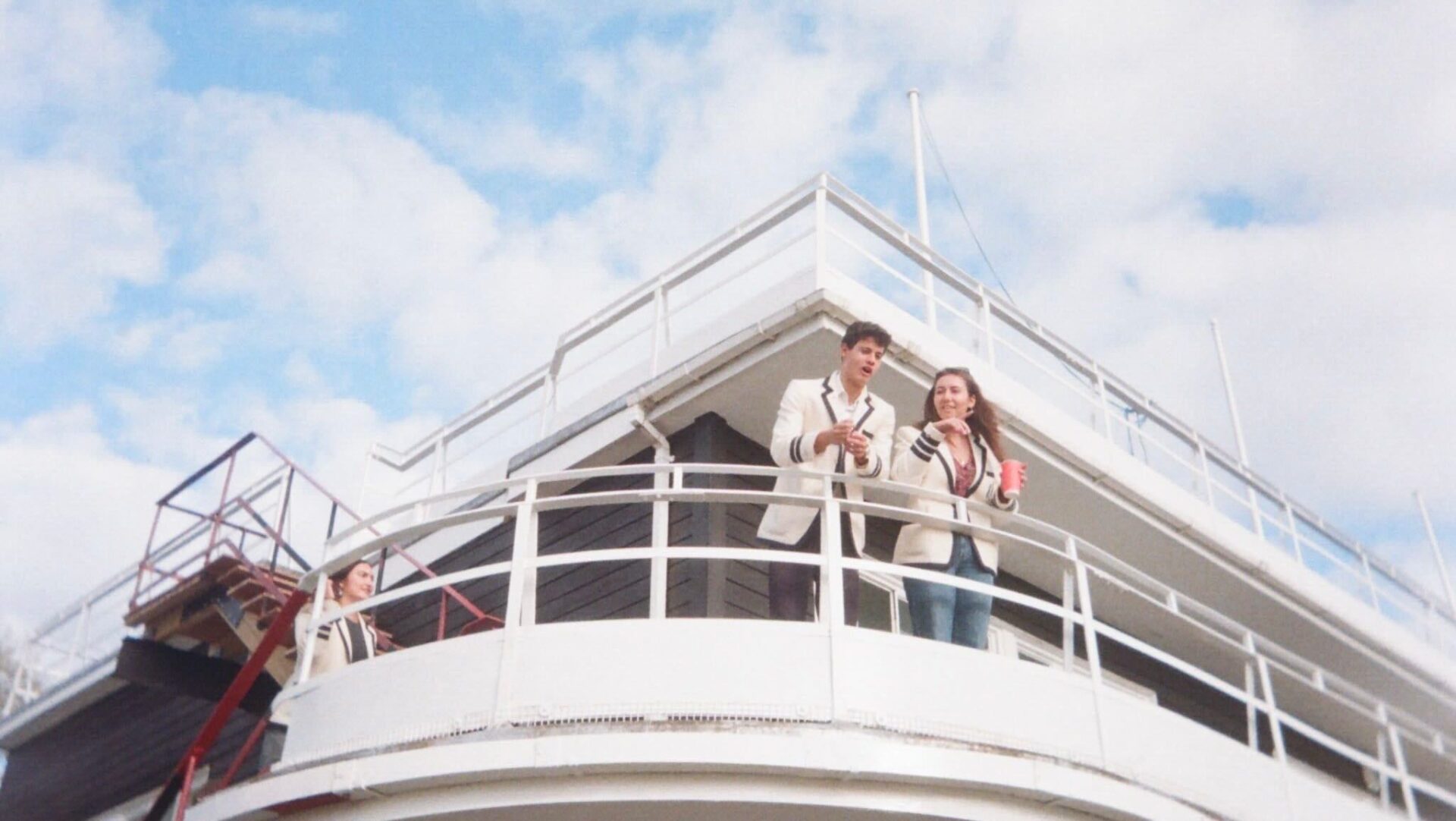
Sitting in Oriel Boat Club’s Captain’s room, across from Captains Freiderikos and Merle, I am immersed in a blue and white legacy. The walls, as Freiderikos tells me, are ornamented with the pictures of every Men’s Captain since 1880 – “I’m in contact with 15 of them”, he adds, recounting one night he returned to college after a tough training session, all set for bed, only to find 30 septuagenarians pointing to their pictures between sips of wine and reminiscence.
What stands out most after speaking to Oriel Boat Club’s Captains is the sheer devotion of its alumni network: as Oriel approaches the 700th anniversary of the College’s foundation, generations of Oriel College alumni have banded together to row across the English Channel. Part of Oriel’s fundraising campaign ‘700 Years of People and Place’, the cross-channel row, taking place across April and May, aims to raise £1 million to establish the Boat Club Endowment Appeal.
“The endowment fund is a massive thing for the club”, Merle tells me, in awe of the enthusiasm for the channel row, in which six to seven decades of Oriel rowers are represented. “It makes me really proud to be part of this club”, she adds, explaining that the £1 million endowment would be combined with the College’s endowment fund to generate money for equipment, coaching, and to provide a sustainable source of yearly income that would keep Oriel rowing free for everyone.
Freiderikos gestures to some new gear beside me, quipping that the club has done “a bit of equipment maintenance since last year”, a reference to the unfortunate mishap faced by Oriel’s M1 at last year’s Summer VIIIs when Oriel’s Tom Mackintosh, Oxford University Boat Club rower and Olympic Champion, resorted to a climb up from the ‘seven’ seat up, all the way past the cox, to examine the broken fin on their boat.
Oriel’s legacy manifests in the Club’s Crewbook, honouring the names of every athlete who has ever lifted an oar for the Boat Club. An alumni association, ‘The Tortoise Club’, also contributes massively to this culture, keeping many Orielenses in contact with the club as it trains up young new cohorts.
Fuzzy sentimentality for one’s university years is almost a given. Yet, there’s something about the bonds made through sport, through the river’s highest tides and lowest ebbs, that holds the community together just that much tighter. “I think the really special thing about bumps is that it is a cultural thing”, Merle considers, “you really pass it on from generation to generation and year to year. The fact that we are able to start in the position we are in now is really because of all the years of rowing by previous generations. That all comes together during eights”.
With the Club’s great investment, of course, comes great pressure. I wonder how exactly Freiderikos and Merle handle the weight of expectation, both placed upon themselves, and from preceding generations.
“There is definitely the expectation to do well”, Merle agrees. “If anything, though, it’s motivating.” Freiderikos chimes in: “If people care, that fosters a good culture. At school, you just row for yourself, your family, the coaches. Here it’s much, much bigger than that.” Indeed, all one needs to do is turn up to the banks of the River Isis on the Saturday of Trinity’s Fifth Week to understand that, for Oxford, Summer VIIIs might as well be an Olympic event.
On the Men’s Side, hopes are high. “I’m feeling really positive”, says Freiderikos, noting the two Blues standard rowers moving into Oriel’s M1 Boat, accompanied by another rower of international standard. A win at Torpheads this year, the substitute event for Torpids, has left the boat feeling well placed to strive for headship. This, Freiderikos tells me, is what they have been training for.
The opportunity to bump up to headship in the 700th year is particularly special, Freiderikos adds, “almost like a fairytale waiting to be written. I don’t think it’s something we’ve been working for just this year; we’ve been working for this over the last two years, even as freshers rowing in our first Torpids. We really wanted to catch Wolfson [last year], and we weren’t able to, so now it’s hopefully retribution time”.
With Torpids 2026 cancelled, an anti-climax replaced a staple event in the Hilary Term calendar. Torpids keeps novices engaged with the club, motivates crews throughout the damp, dreary mornings of winter months, and helps clubs to hone their selection strategy ahead of Summer VIIIs. “Usually we have the opportunity to switch people around between Torpids and Summer VIIIs, explains Merle, but we don’t have the opportunity to do that this year.”
Starting off the year slightly disappointed, with fewer rowers than usual who had trained before, Freiderikos was able to rapidly turn this around: “I was nervous at the start of the year, but coming into Torpheads everything clicked”. This he attributes to the Club’s success in the training up of novices: “It’s really important to raise the novices to a high standard – you can’t have any weak members in the boat – they all have to be strong.”
Rowing, in that sense, is arguably “the ultimate team sport”. Merle reinforces the technicality of training up novices: “This is also a skill: being able to train people up relatively quickly. I think that’s really impressive.” Investing in rowers at every level is the strategy that underpins the breadth of Oriel’s Boat Club. As Freiderikos points out, “Instead of just having a pool of ten people who’ve rowed at school before, you could have a pool of 400 prospective rowers.”
Currently, of the four eights on the Women’s side, over three eights learned to row at Oriel, while two full eights learned to row this year. Freiderikos lends some of the credit to the club’s Vice captains, who have been particularly good at novice retention. Oriel boasts five crews on the Men’s side and four on the Women’s, bringing up their numbers to nine crews in total. Women’s Captain Merle is amongst the Oriel ‘home-grown’ herself, having tried out rowing as an undergrad, only to take up the sport seriously in Michaelmas of 2024.
Tapping into the competitive spirits of the captains, I attempt to find out who they see as their top rivals in this year’s competition: “Obviously Wolfson”, Freiderikos responds without hesitation. “They’re the head of the river, so someone has to remove them if they want to get ahead”. After Wolfson, he notes the verbose confidence of Pembroke’s M1 (all in good spirit) and the strength of University College’s M1 in this year’s races.
On the Women’s side, Merle finds the competition a little less clear cut: “It’s hard to tell who the strongest competitors are – you never really know. Even between Torpids and VIIIs, there’s a whole Easter Vacation. It’s also Trinity term, the most rowing-dense term, so clubs will have the most water time because the weather gets better and the light lasts longer. Even between Torpids and Eights, a lot can change. It’s really hard to predict what’s going to happen,” she stresses; no club can be entirely ruled out. “I’m just really excited to show what we have worked for.”
When I ask if Wolfson will retain headship, both captains agree that they have “full faith” in their M1. “It’s going to be hard to bump them, but I think we’ll do it”, replies Freiderikos. I ask Freiderikos who their biggest rivals are: “Anyone who is near the top of the pile” is his answer.
Taking on the role of Captain in the college’s 700th year is a unique opportunity, but Captainship also comes with its fair share of trials. “It has been really special to be captain in the 700th year”, says Merle, especially while the endowment fund is being established and the channel row has been organised, and having such big squads on both sides of the Club. The pair have, nevertheless, had their fair share of tough decisions. Freiderikos identifies a key skill that has helped him navigate this: “Always be quite transparent with people.”
“We’ve had two or three seat races”, he explains, “one was between two people for the ‘last slot’ in the M1 boat, and they were aware that they were up against each other”. Whilst tensions can build in situations like this, transparency ensures that the rowers respect the Captains’ decisions, whilst a competitive spirit is maintained.
I finish up by asking what the celebrations will look like if Oriel claims head of the river. “It’s going to be big”, remarks Merle, “the 140 seats in Oriel’s hall are entirely booked out for Summer VIIIs dinner.” Her family are even flying in to support from the banks of the River Isis. This is no event to sit out on – “Our cox is even missing the Champion’s League final to cox us,” Freiderkios exclaims. In the evening, Oriel will host the ‘Bumps dinner’, where the first Men and Women’s Boats will sit on the high table, whilst all other Boat Club members will have to sing for their supper – an Oriel tradition. In the case of a win, this will be followed up by the famous boat burning, the organisation of which, they assure me, is safely in the Porter’s hands rather than their own.
The Summer VIIIs of Oriel’s 700th year is the biggest competition Freiderikos and Merle believe they may participate in throughout their rowing careers. “If we win”, says Merle, “it will not only be a celebration of this year’s achievements, but also of the boat club as a whole”.